U.S. Producer Prices Advance in May Led by Energy
Summary
- May PPI +1.1% m/m (+6.5% y/y, highest since Nov. ’22), driven by a record 10.7% rise in energy and 0.6% in food prices.
- PPI ex foods & energy +0.4% (+4.9% y/y); services +0.3% (+4.9% y/y); construction +0.2% (+3.5% y/y).
- Core goods prices +0.8% (+5.1% y/y), largest m/m increase since Apr. ’22.
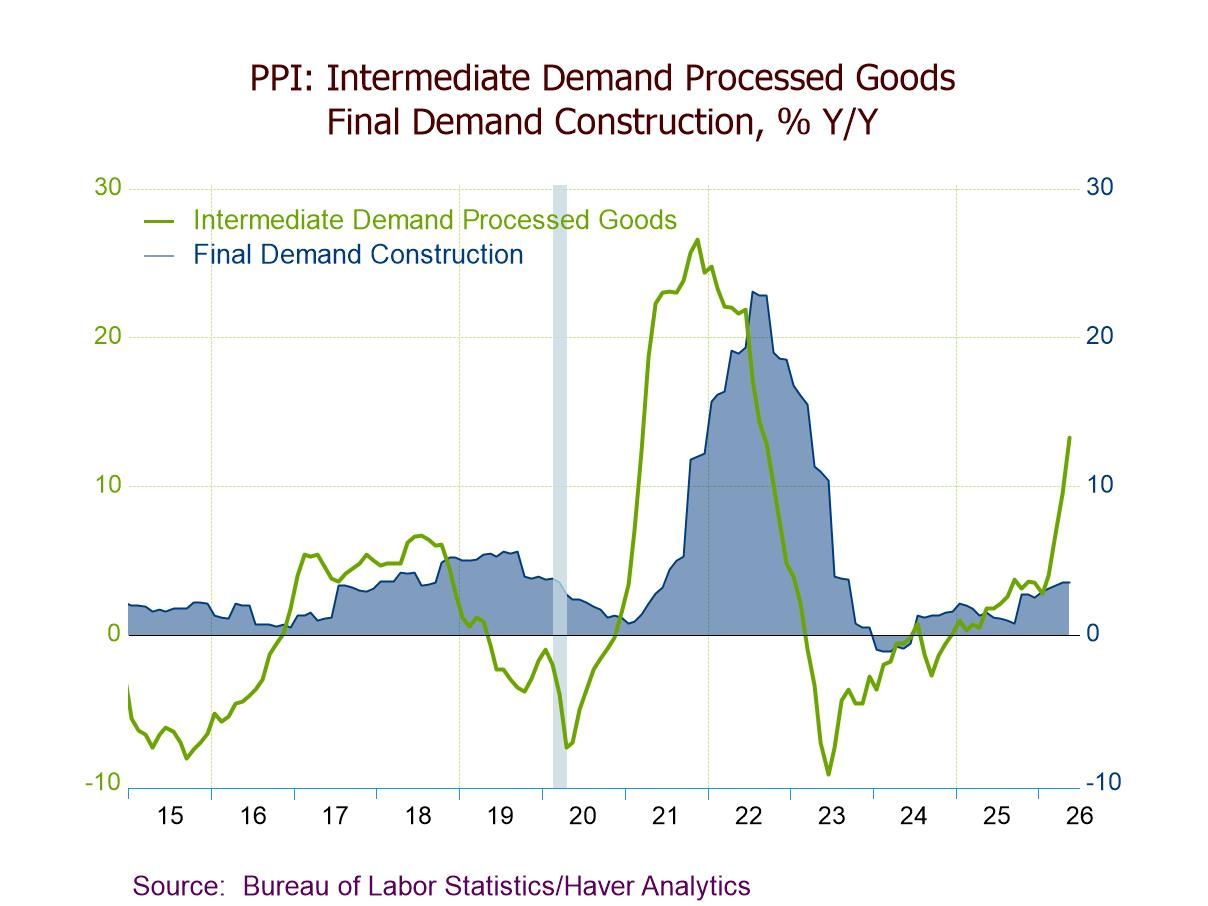
- Intermediate demand processed goods prices +3.5% (+13.3% y/y), strongest m/m gain since Mar. ’21.
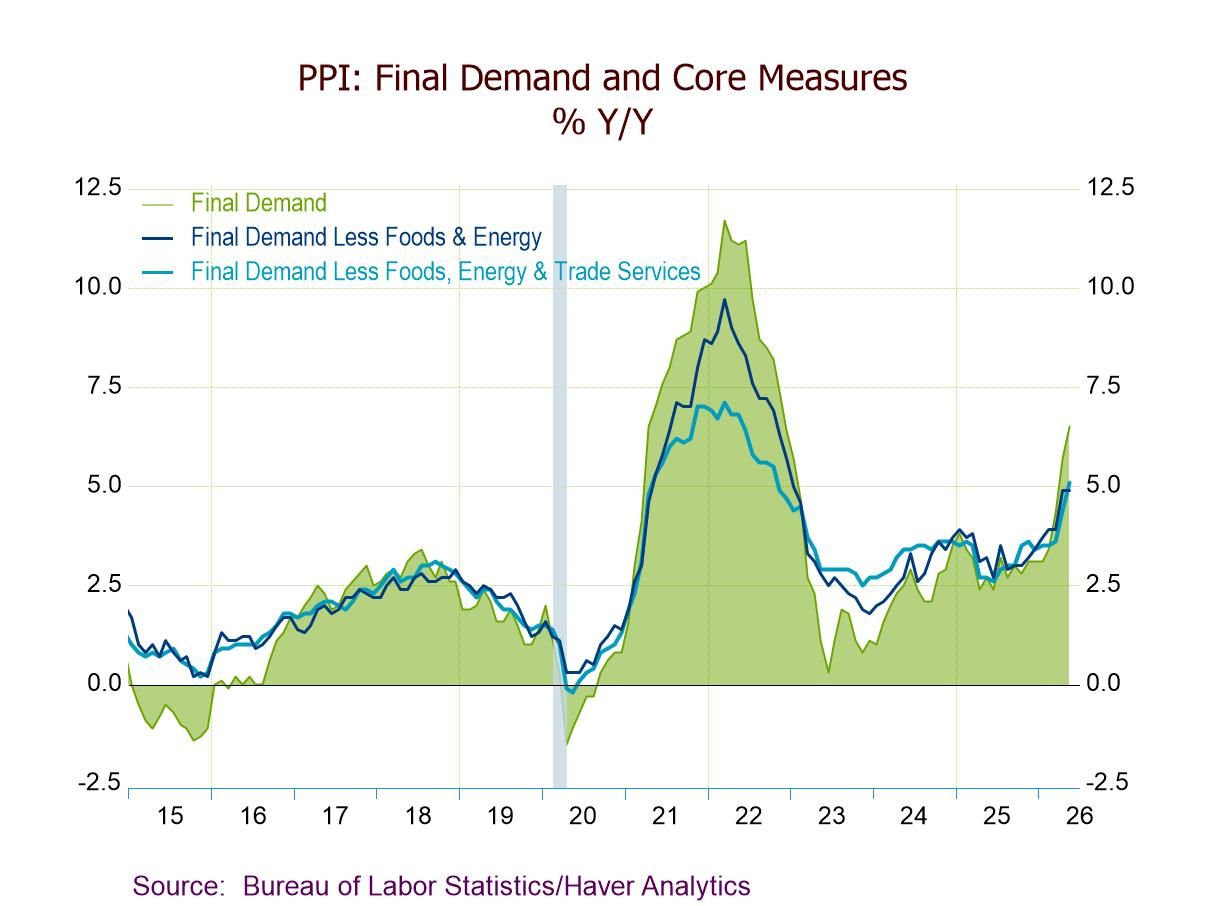
The Producer Price Index for final demand rose a stronger-than-expected 1.1% m/m in May, the ninth consecutive m/m rise, after gains of 1.1% in April (+1.4% initially) and 0.7% in March (unrevised), according to the Bureau of Labor Statistics. A 0.7% m/m May increase had been expected in the Action Economics Forecast Survey. The year-over-year rate accelerated to 6.5% in May, the highest since November 2022, from 5.7% in April (2.7% in May 2025). Compared with May CPI data (+0.5% m/m, +4.2% y/y, released on June 10), the PPI figures reinforce the view that U.S. inflationary pressures remain elevated on both the producer and consumer sides.
Producer prices excluding food & energy grew 0.4% (4.9% y/y) in May after rises of 0.7% in April (+1.0% initially) and 0.3% in March (+0.2% previously). A 0.5% m/m increase had been expected. Another core price measure—producer prices less food, energy & trade services—advanced 0.8% (5.1% y/y), the strongest of 13 straight m/m gains, after increases of 0.5% in April (+0.6% initially) and 0.2% in March (unrevised).
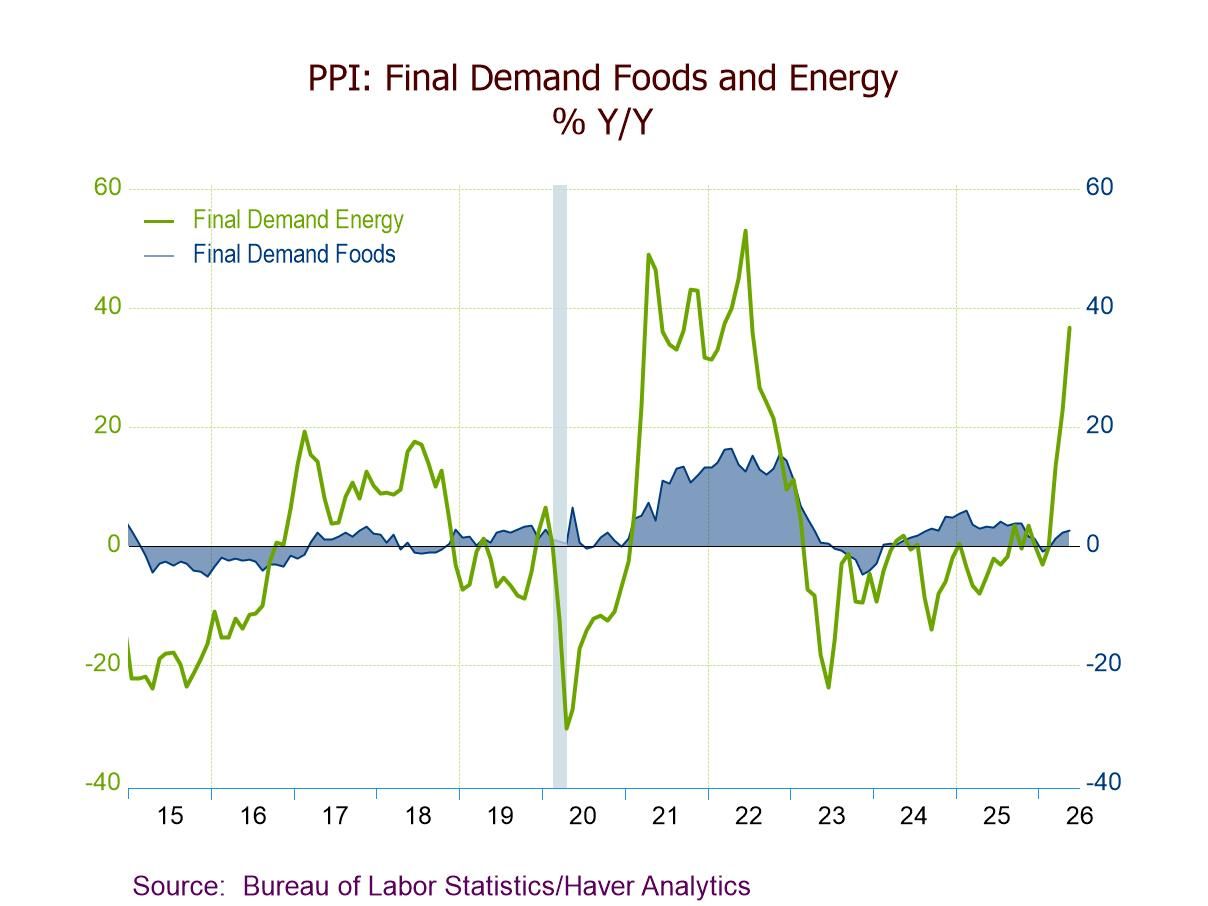
The May PPI 1.1% m/m rise was led by a 10.7% jump (36.6% y/y) in energy prices—the fourth consecutive m/m increase and the largest on record—following a 7.5% April gain. The surge in energy prices reflected m/m increases of 23.4% (69.5% y/y) in gasoline, 16.3% (87.0% y/y) in home heating oil & distillates, 15.7% (105.9% y/y) in diesel fuel, 15.6% (37.5% y/y) in natural gas liquids, and 0.4% (2.1% y/y) in residential natural gas. In contrast, prices for residential electric power, the only declining category, fell 0.2% (+4.0% y/y) in May following two successive m/m gains.
Food prices rose 0.6% (2.6% y/y) in May, the third m/m rise in four months, after a 0.2% increase in April (unrevised) and a 0.6% decline in March (unrevised). Food prices for exports (1.8%; 4.8% y/y) and finished consumer foods (0.4%; 2.2% y/y) increased m/m in May, while prices for government purchased foods (-0.1%; +3.4% y/y) dipped m/m following five straight monthly rises.
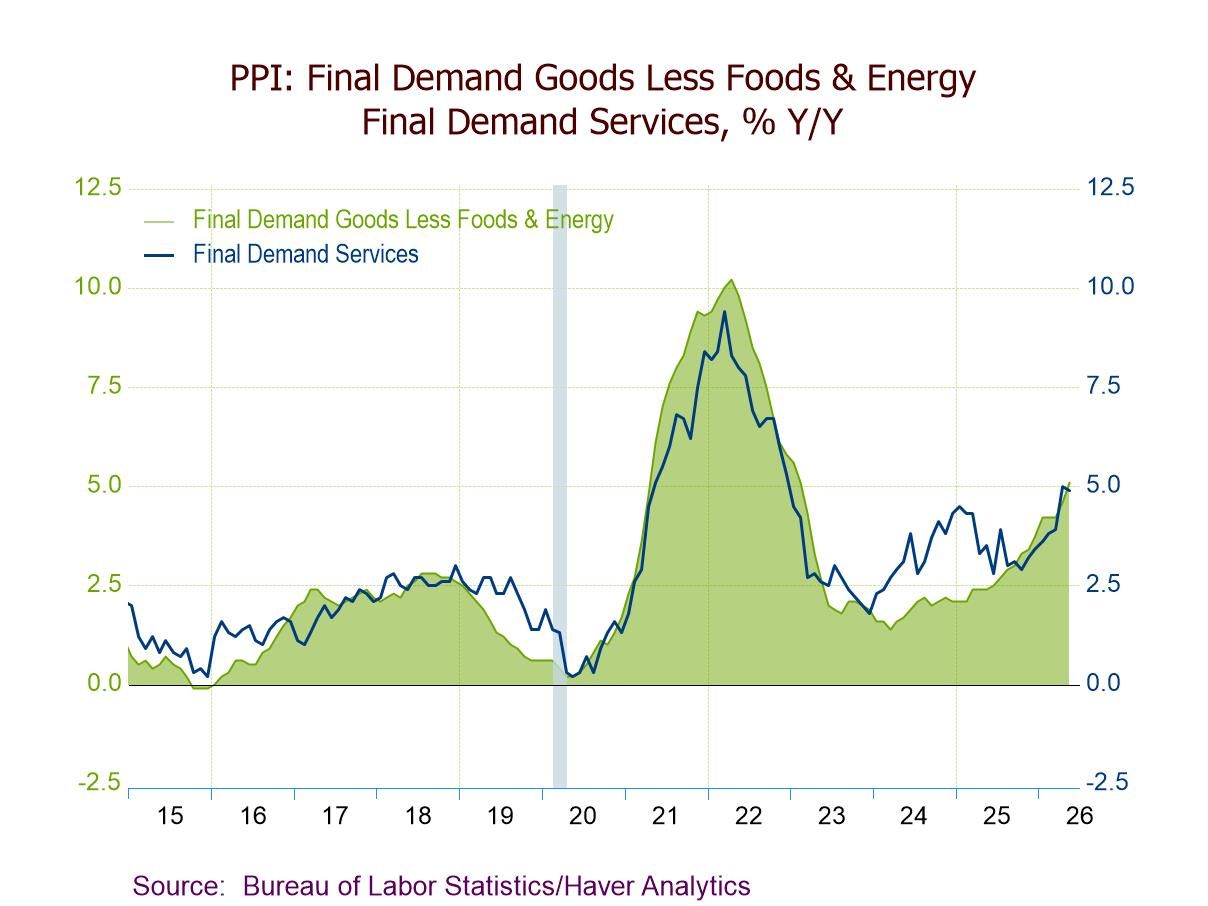
The PPI for final demand goods climbed 2.8% (10.4% y/y) in May, the fourth consecutive m/m increase and the biggest on record, following a 1.9% rise in April (+2.0% initially). The PPI for final demand goods less food & energy rose 0.8% (5.1% y/y) in May after a 0.7% rise in April—marking the largest m/m gain since April 2022 and continuing its string of m/m increases since August 2023. Prices for final demand finished goods less food & energy rose 0.3% (3.7% y/y) after a 0.4% April rise. Finished consumer goods prices less food & energy grew 0.3% (3.5% y/y) in May after a 0.4% advance in April, with durable consumer goods prices up 0.3% (3.3% y/y) and core nondurable consumer goods prices up 0.3% (3.7% y/y). Prices for private capital equipment increased 0.3% (3.9% y/y) for the third successive month in May. Prices for government purchased goods excluding foods & energy rose 1.0% (5.6% y/y), extending m/m gains since November 2024.
Prices for final demand services grew 0.3% (4.9% y/y) in May, the ninth straight m/m rise, following increases of 0.7% in April (+1.2% initially) and 0.2% in March (unrevised). Trade services prices fell 1.1% (+4.1% y/y), the first m/m fall since February, after a 1.3% April increase. Services prices of transportation & warehousing rose 2.6% (14.2% y/y) in May, the seventh consecutive m/m rise, while services prices less trade, transportation & warehousing increased 0.7% (4.2% y/y), the fourth m/m gain in five months.
Prices for final demand construction rebounded 0.2% (3.5% y/y) in May, up for the fourth time in five months, following a 0.1% easing in April (unrevised). Construction prices for private capital investment edged up 0.1% (3.4% y/y) in May, the fourth m/m increase in five months; construction prices for government rose 0.2% (3.7% y/y) after a flat April reading.
Meanwhile, prices for intermediate demand processed goods climbed 3.5% (13.3% y/y) in May, the strongest of seven straight m/m increases and the largest since March 2021, on top of a 2.7% rise in April (unrevised), led by a 10.4% jump (43.6% y/y) in intermediate demand processed fuel & lubricant costs.
The PPI data are published by the Bureau of Labor Statistics and can be found in Haver’s USECON database. Further detail is contained in PPI and PPIR. The expectations figures are available in the AS1REPNA database.

Winnie Tapasanun
AuthorMore in Author Profile »Winnie Tapasanun has been working for Haver Analytics since 2013. She has 20+ years of working in the financial services industry. As Vice President and Economic Analyst at Globicus International, Inc., a New York-based company specializing in macroeconomics and financial markets, Winnie oversaw the company’s business operations, managed financial and economic data, and wrote daily reports on macroeconomics and financial markets. Prior to working at Globicus, she was Investment Promotion Officer at the New York Office of the Thailand Board of Investment (BOI) where she wrote monthly reports on the U.S. economic outlook, wrote reports on the outlook of key U.S. industries, and assisted investors on doing business and investment in Thailand. Prior to joining the BOI, she was Adjunct Professor teaching International Political Economy/International Relations at the City College of New York. Prior to her teaching experience at the CCNY, Winnie successfully completed internships at the United Nations. Winnie holds an MA Degree from Long Island University, New York. She also did graduate studies at Columbia University in the City of New York and doctoral requirements at the Graduate Center of the City University of New York. Her areas of specialization are international political economy, macroeconomics, financial markets, political economy, international relations, and business development/business strategy. Her regional specialization includes, but not limited to, Southeast Asia and East Asia. Winnie is bilingual in English and Thai with competency in French. She loves to travel (~30 countries) to better understand each country’s unique economy, fascinating culture and people as well as the global economy as a whole.
More Economy in Brief


 Global