Global| Jul 27 2026
An Update on Withering Money Growth Metrics
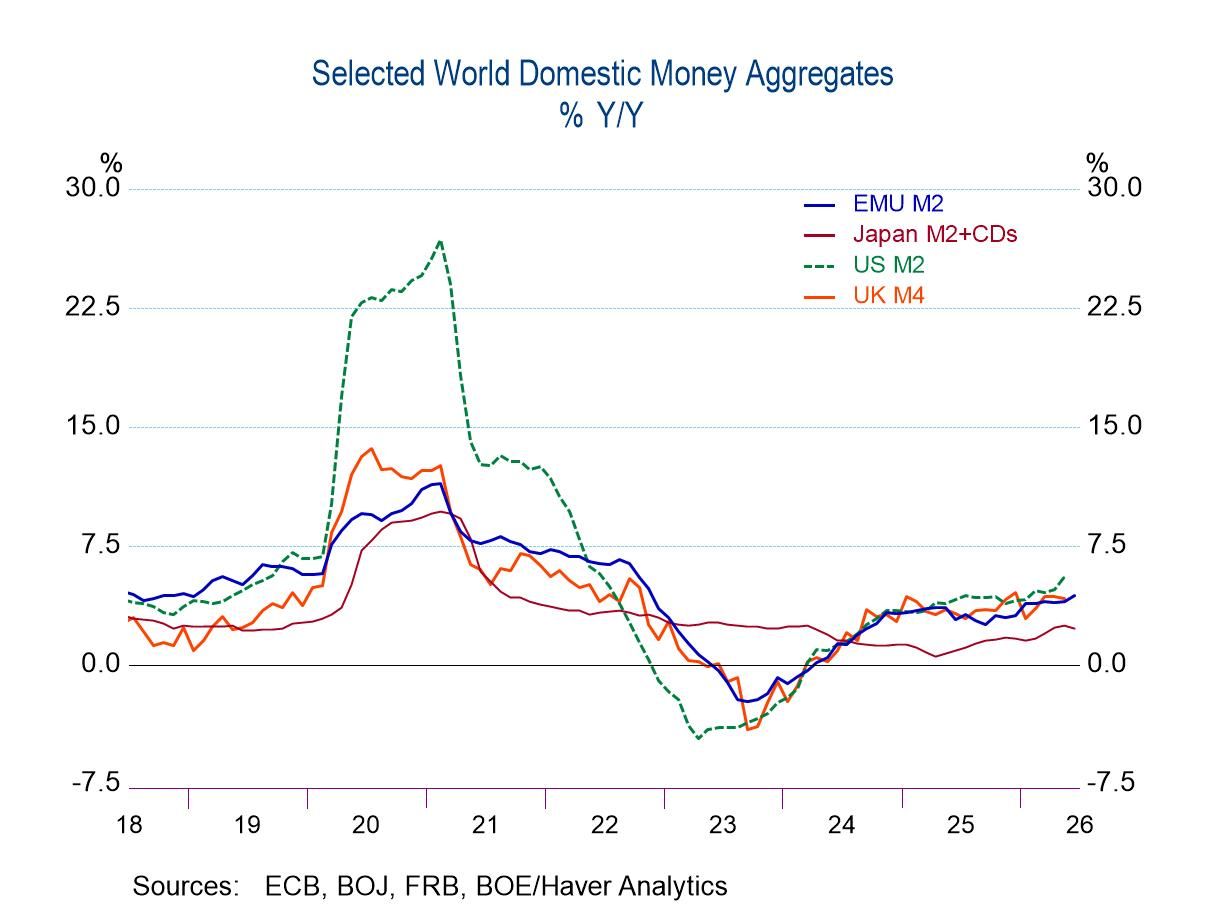
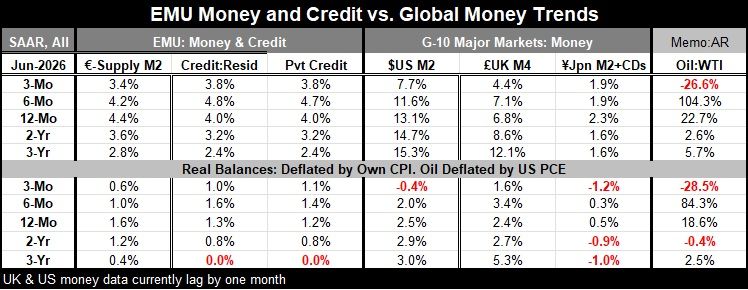
Money works with a lag but sometimes it’s reported with a lag too: U.S. and U.K. money supply data lag the results for the monetary union and for Japan by one month. Monetary trends currently based on the most up-to-date data, which are either May or June depending on the country we're looking at, show that three-month money supply growth, and credit growth in the case of the monetary union, have slowed compared to six months, except in the case of Japan. In Japan, for the six-month and three-month growth rates are identical at 1.9% overall; growth rates are lower over three months and six months compared to 12 months.
Real money balances: The growth rate of real money balances shows the step-down in growth in the monetary union from 1.6% over 12 months to a 1% annual rate over six months to a 0.6% annual rate over three months. Over the same sequence of dates, private credit in the monetary union has gone from 1.2% over 12 months to a pace of 1.4% over six months, and then down to 1.1% over three months. In the U.S., money growth over this period has decelerated from 2.5% over 12 months to 2% at an annual rate over six months to -0.4% over three months annualized. The U.K. shows a slightly different pattern for real money balances that grow 2.4% over 12 months, accelerate to 3.4% annually over six months, but then back down to a 1.6% annual rate over three months, showing a net deceleration from 12 months to three months but with an intervening bulge. In Japan, the money growth slowdown is monotonic, from 0.5% over 12 months to a 0.3% pace over six months to a -1.2% pace over three months.
Pattern reversal: Nominal money growth, which had shown some acceleration early in the year, is now beginning to show deceleration, and this is before central banks have generally begun to raise rates, although there have been ongoing rate increases of a slight amount in Japan and also the start of a tightening cycle in the European Monetary Union. In the U.S., there's a new head of the central bank and policies there are expected to shift, but the jury is out on what to expect, as is often the case with a new chairman. There are a variety of views on what he plans to do; he will most likely make his reputation by what he in fact does rather than by what he says about what he intends to do. On balance, growths in the U.S., the monetary union, and Japan are all showing deceleration with a slight exception from the U.K. But generally speaking, money supply no longer is showing a moderate disturbing acceleration pattern; in real terms, money growth has lost a great deal of steam, particularly in the U.S. and Japan, where three-month growth rates of real money balances are declining and show negative rates of growth.
Summing up These are new trends, and they are not much talked about in markets because markets don't speak the language of money supply growth much anymore. However, it's a good idea to continue to look at money supply and what it does. Just because central banks aren't targeting money doesn't mean that it isn't relevant anymore; it just means that central banks have put their attention someplace else. At present, central bankers seem to be arguing about where their attention should be. It could be a good time for us to keep close tabs on what money supply is doing.

Robert Brusca
AuthorMore in Author Profile »Robert A. Brusca is Chief Economist of Fact and Opinion Economics, a consulting firm he founded in Manhattan. He has been an economist on Wall Street for over 25 years. He has visited central banking and large institutional clients in over 30 countries in his career as an economist. Mr. Brusca was a Divisional Research Chief at the Federal Reserve Bank of NY (Chief of the International Financial markets Division), a Fed Watcher at Irving Trust and Chief Economist at Nikko Securities International. He is widely quoted and appears in various media. Mr. Brusca holds an MA and Ph.D. in economics from Michigan State University and a BA in Economics from the University of Michigan. His research pursues his strong interests in non aligned policy economics as well as international economics. FAO Economics’ research targets investors to assist them in making better investment decisions in stocks, bonds and in a variety of international assets. The company does not manage money and has no conflicts in giving economic advice.
More Economy in Brief