U.S. Payroll Employment is Unexpectedly Firm in September; Earnings Rise Steadily, but Jobless Rate Edges Up
by:Tom Moeller
|in:Economy in Brief
Summary
- Hiring improves broadly.
- Construction, private services & government jobs rise, but factory employment declines.
- Earnings improvement is steady y/y, but slows m/m.
- Unemployment rate moves higher as job growth lags labor force gain.
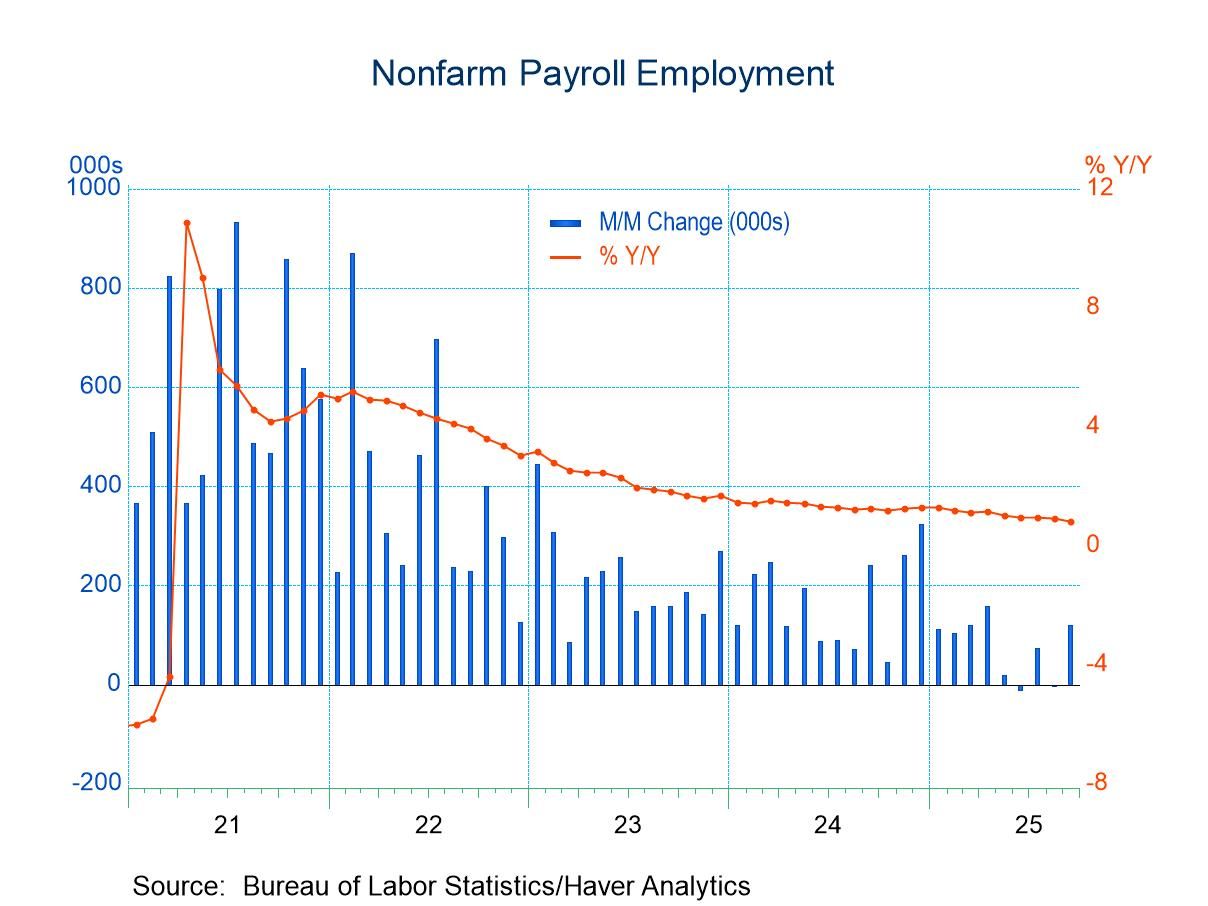
Nonfarm payrolls increased 119,000 in September after falling 4,000 in August, revised from a 22,000 increase and rising 72,000 during July, revised from 79,000. Expectations had been for a 45,000 rise in the Action Economics Forecast Survey. The three-month average change in payrolls of 62,000 compared to 18,000 in August, but stood far below its high of 232,000 in January.
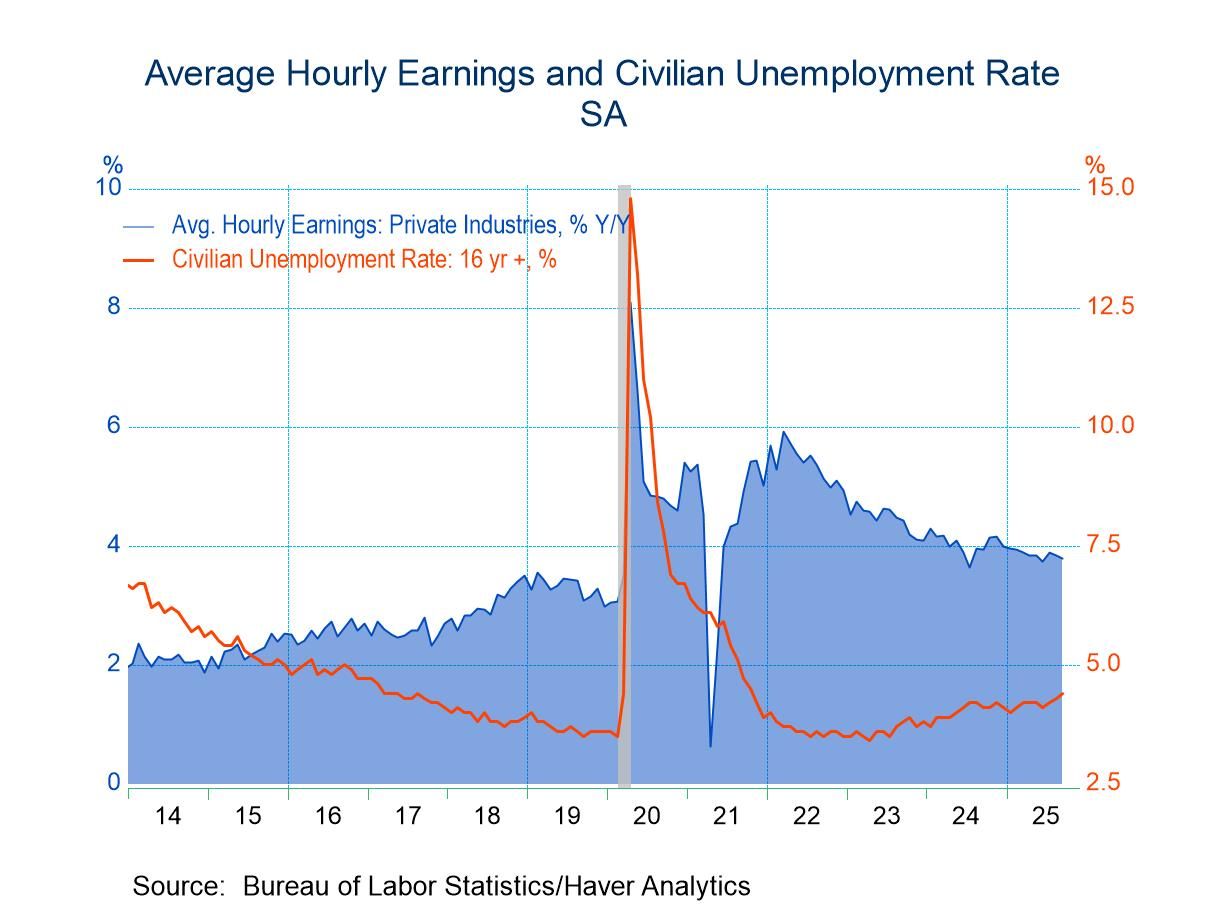
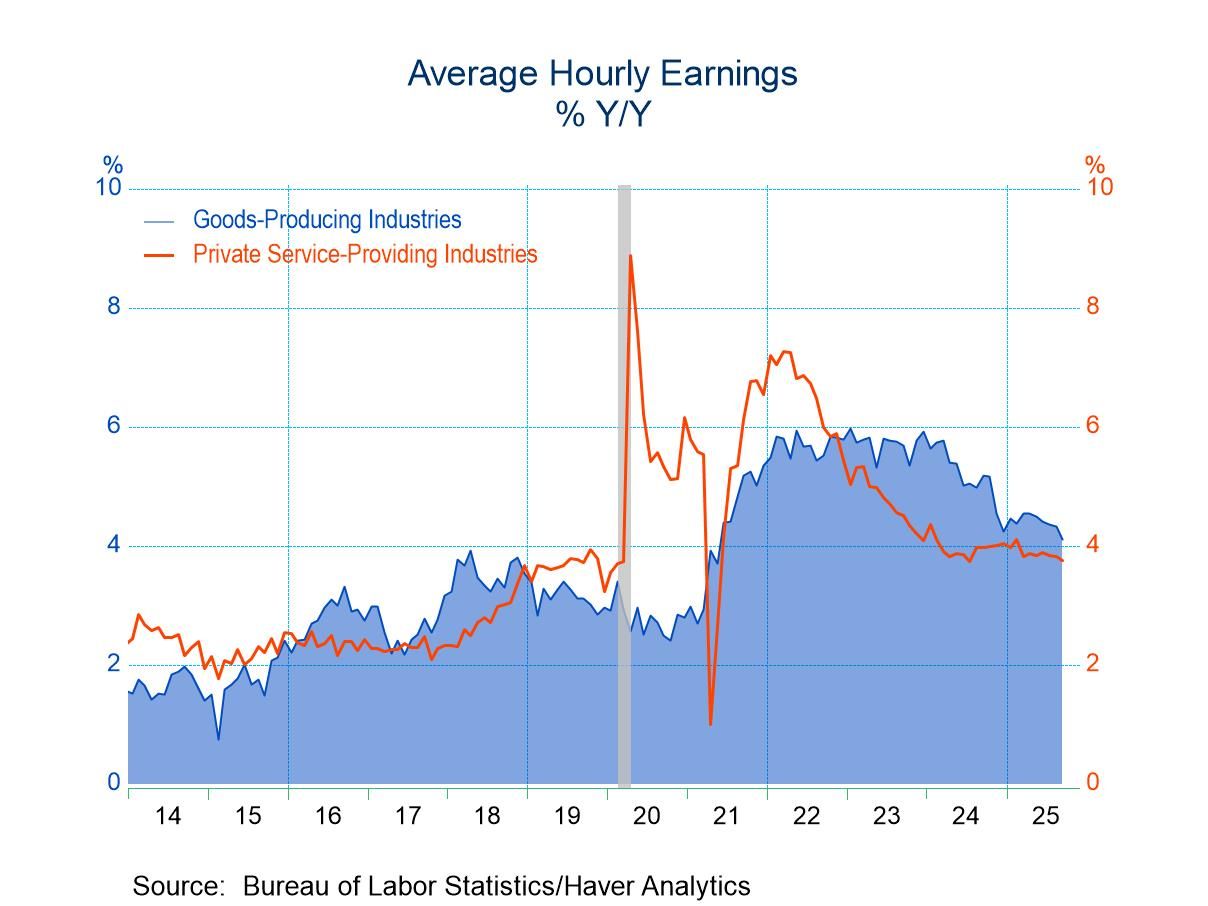
Average hourly earnings rose 0.2% in September after increasing 0.4% in August, revised from 0.3% and an unrevised 0.3% in July. Earnings growth of 3.8% y/y equals that in August. It has been trending lower from its 5.9% high in March 2022.
The unemployment rate, measured in the household survey, edged up to 4.4% from 4.3% in August and 4.2% in July. It reached a low of 3.4% in April 2023. The unemployment rate, including employees working part-time for economic reasons plus all marginally-attached workers, eased to 8.0% after rising to 8.1% in August. It was 6.6% in April 2023.
In the establishment survey, private-sector employment in September increased 97,000 after rising 18,000 in August. Construction sector employment strengthened 19,000 after falling for three consecutive months. Elsewhere employment fell. Factory sector jobs declined 6,000, off for the fifth straight month. Durable goods employment weakened 4,000 in September following a 21,000 decline. Nondurables employment fell 2,000 after a 6,000 August increase. The number of mining & logging industry jobs declined 3,000, the fifth consecutive monthly shortfall.
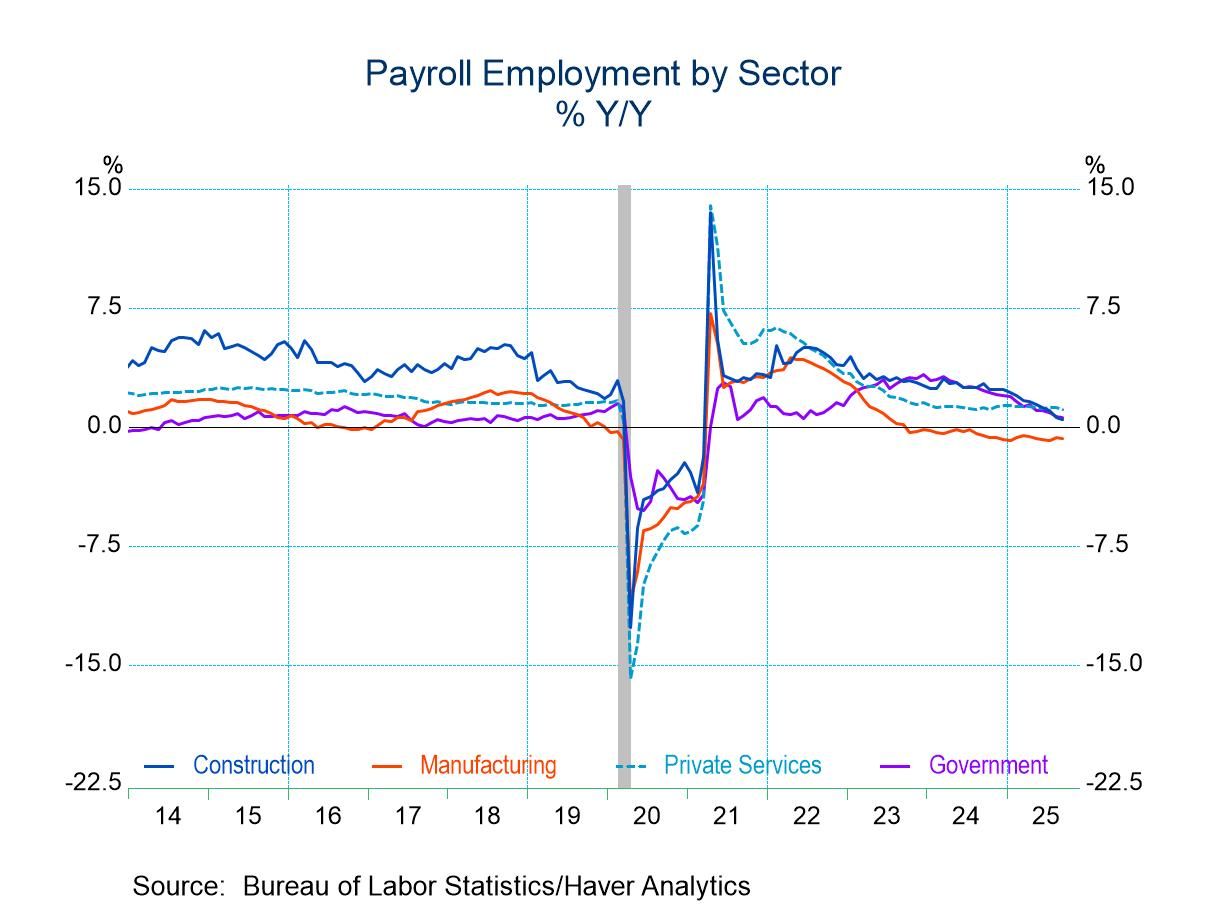
Private service-sector employment increased 87,000 during September after improving 50,000 in August. Employment increases occurred in just three service-sector categories. Private education & health sector employment rose 59,000 in September, following a 43,000 August increase. The number of leisure & hospitality jobs rose 47,000 after a 32,000 gain while financial activities employment improved 5,000 after falling 15,000 in August. Elsewhere, employment was weak. The number of professional & business services jobs fell 20,000, down for the fifth straight month as temporary help employment declined 15,900, also off for the fifth month in a row. Trade, transportation & utilities employment eased 2,000, off for the seventh consecutive month. Information services employment held steady after falling for three consecutive months.
Offsetting some of this weakness, government sector payrolls rose 22,000 in September and reversed the 22,000 August drop. State government payrolls increased 16,000 after falling in each of the prior four months. Local government hiring rose 9,000 following a 14,000 August increase. Continuing to decline, federal government employment weakened 3,000 in September and has fallen in all but one month this year.
Private-sector average hourly earnings improved 0.2% (3.8% y/y) in September after rising 0.4% in August, revised from 0.3%. Earnings in the goods-producing sector increased 0.3% in September after two straight 0.4% gains, although the 4.0% y/y increase is below the 5.4% high early last year. In construction, earnings rose 0.3% (3.8% y/y) following a 0.6% rise, while factory sector earnings improved 0.4% (4.2% y/y) after a 0.2% gain. In the private service sector, earnings rose 0.2% (3.8% y/y) in September after a 0.4% gain. Information earnings improved 0.3% (5.2% y/y) after rising 0.7% in August. Professional & business services pay increased 0.3% (4.8% y/y) after four straight months of 0.5% increase while leisure & hospitality earnings rose 0.3% (3.7% y/y) after rising 0.4%. Private education & health services earnings eased 0.2% (+2.5% y/y) following a 0.1% gain.
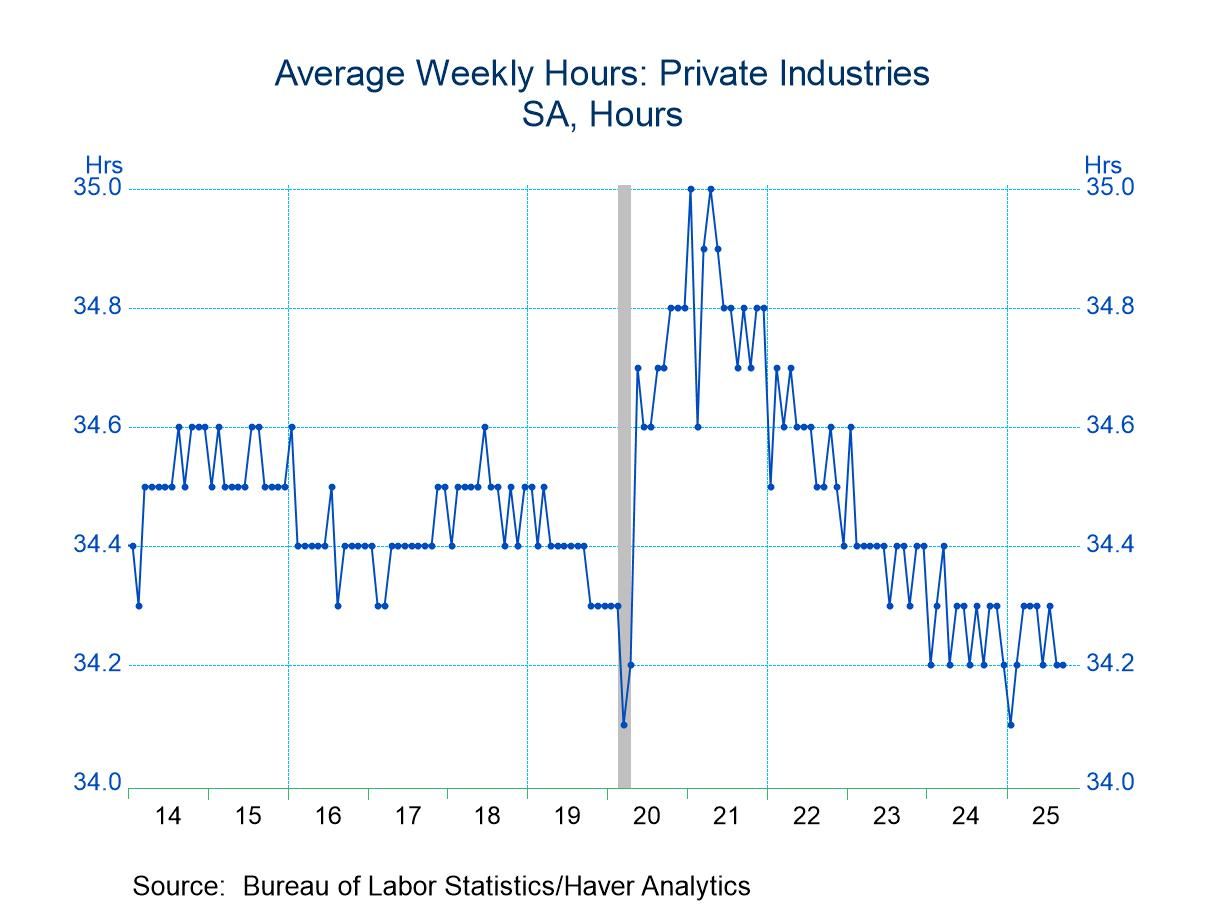
The length of the average workweek held at 34.2 hours in September after falling from 34.3 hours in July. The workweek in the goods-producing sector fell to 39.7 hours from 39.8 hours in August. The construction sector average workweek was 39.0 hours for the third straight month while the factory sector workweek eased to 39.9 hours, the weakest since October of last year. The average workweek in the private service sector was 33.2 hours for the third straight month. Information sector hours surged to 37.5, the most in five years. Financial activities hours held at 37.6. Private education & health services hours steadied at 32.7 in August.
In the household survey, the unemployment rate increased to 4.4% in September after rising to 4.3% in August from 4.2% in July. A 251,000 rise in employment lagged the 288,000 August gain. Labor force growth picked up to 470,000 in September from 436,000 in August. It was the highest jobless rate since October 2021, up from a 3.4% low in April 2023.
The labor force participation rate rose to 62.4% in September from 62.3%, remaining well below the high of 63.3% early in 2020. The rate for teenagers jumped to 36.3%, a five-month high. For workers aged 20-24, the rate rose to 71.1% after plunging to a four-year low of 70.2%. For workers aged 25-54, the participation rate held at 83.7% after increasing from 83.4% in July. For individuals 55 and over, the rate held steady at 38.1% but remained near a 20-year low of 38.0% in June.
The employment/population ratio for all workers edged up to 59.7% in September. It remained below the peak reading of 61.1% in February, 2020 just prior to the pandemic. For men, the rate slipped to 64.8% from 65.0% in August and for women, the rate increased to 54.8% after slipping to 54.5% in July.
The employment and earnings data are collected from surveys taken each month during the week containing the 12th day of the month. The labor market data are contained in Haver's USECON database. Detailed figures are in the EMPL and LABOR databases. The expectations figures are in the AS1REPNA database.

Tom Moeller
AuthorMore in Author Profile »Prior to joining Haver Analytics in 2000, Mr. Moeller worked as the Economist at Chancellor Capital Management from 1985 to 1999. There, he developed comprehensive economic forecasts and interpreted economic data for equity and fixed income portfolio managers. Also at Chancellor, Mr. Moeller worked as an equity analyst and was responsible for researching and rating companies in the economically sensitive automobile and housing industries for investment in Chancellor’s equity portfolio. Prior to joining Chancellor, Mr. Moeller was an Economist at Citibank from 1979 to 1984. He also analyzed pricing behavior in the metals industry for the Council on Wage and Price Stability in Washington, D.C. In 1999, Mr. Moeller received the award for most accurate forecast from the Forecasters' Club of New York. From 1990 to 1992 he was President of the New York Association for Business Economists. Mr. Moeller earned an M.B.A. in Finance from Fordham University, where he graduated in 1987. He holds a Bachelor of Arts in Economics from George Washington University.
More Economy in Brief
 Global