U.S. Light Vehicle Sales Edge Higher in November
by:Tom Moeller
|in:Economy in Brief
Summary
- Light truck and auto purchases increase m/m.
- Passenger car sales continue to decline sharply y/y.
- Imports' market share increases.
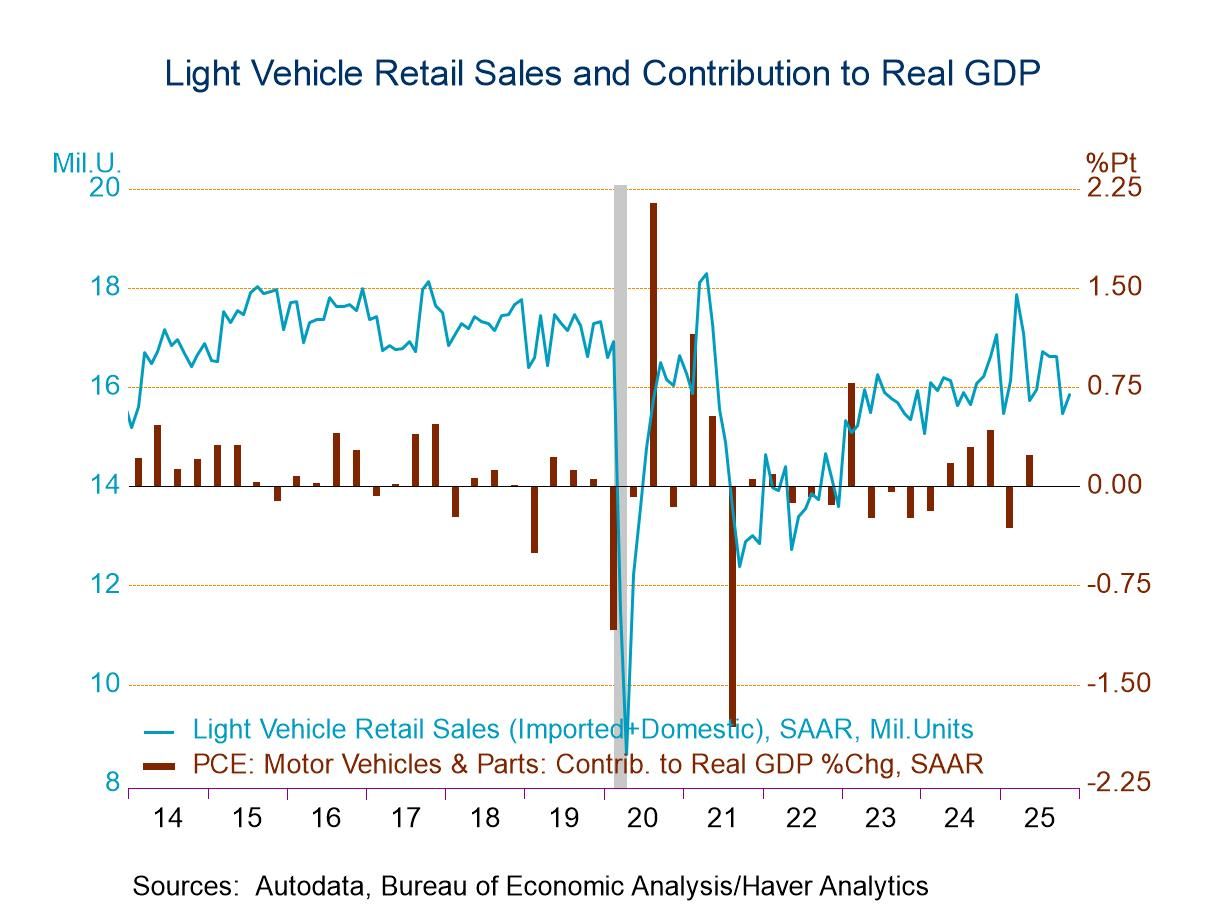
U.S. light vehicle sales increased 2.4% (-4.6% y/y) in November to 15.84 million units (SAAR) after falling 6.9% to 15.47 million units in October. Sales improved broadly last month.
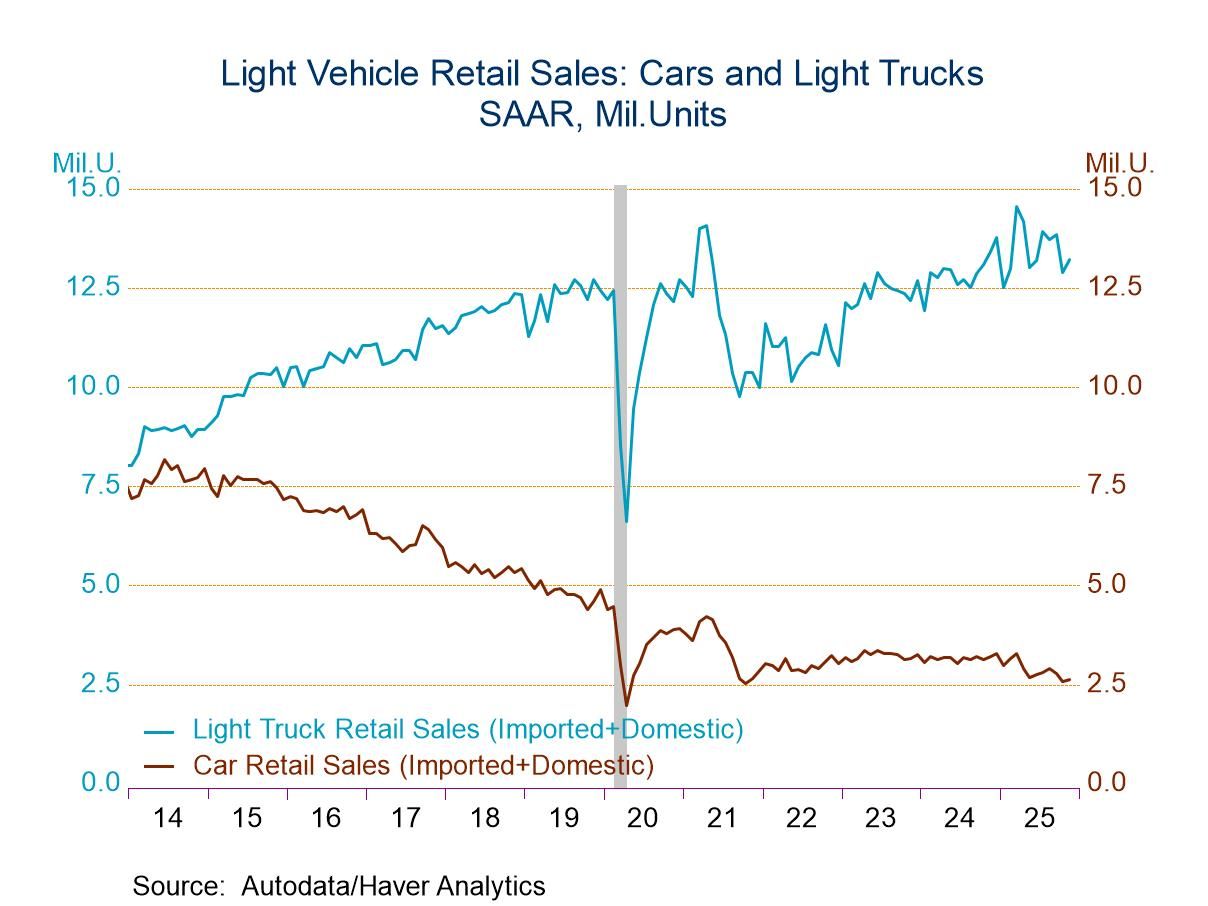
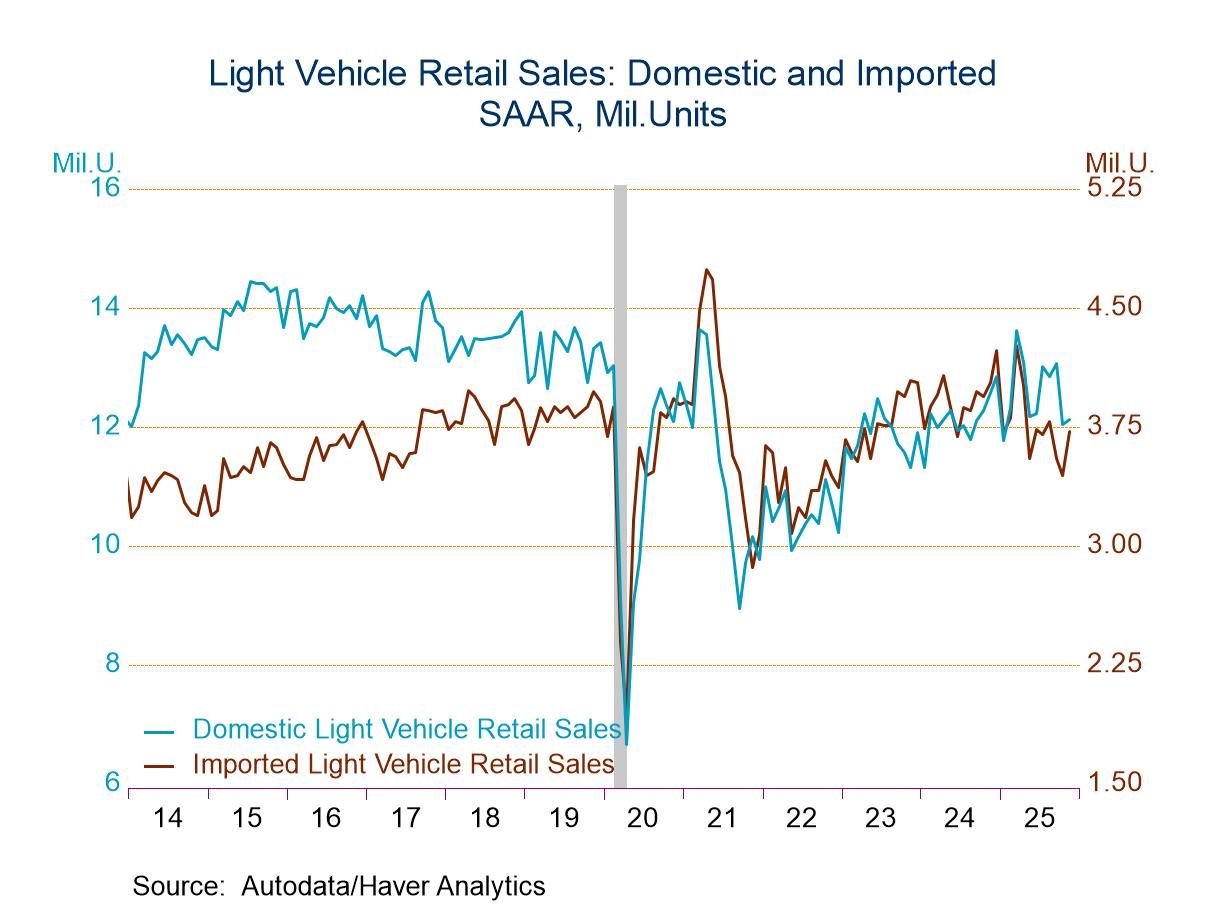
Light truck sales rose 2.5% (-1.5% y/y) in November to 13.22 million units, after declining 6.9% in October. Purchases of domestically-made light trucks improved 0.7% (-0.3% y/y) to 10.17 million units, after falling 7.9% in October. Sales of imported light trucks strengthened 8.9% (-5.0% y/y) to 3.05 million units, the highest level in three months, after a 2.8% October decline.
Trucks’ record 83.5% share of the light vehicle market last month was close to its 83.4% share in October and compared to 80.8% in November of last year. The share has averaged 82.5% so far this year versus 56.7% in November ten years earlier.
Passenger car sales rose 1.9% (-18.4% y/y) last month to 2.62 million units, after falling 7.2% in October. Sales of domestically-produced cars rose 1.0% (-18.1% y/y) last month to 1.95 million units, after weakening 7.2% in October. Imported auto sales rose 3.1% (-19.5% y/y) to 0.66 million units after falling 4.5% in October.
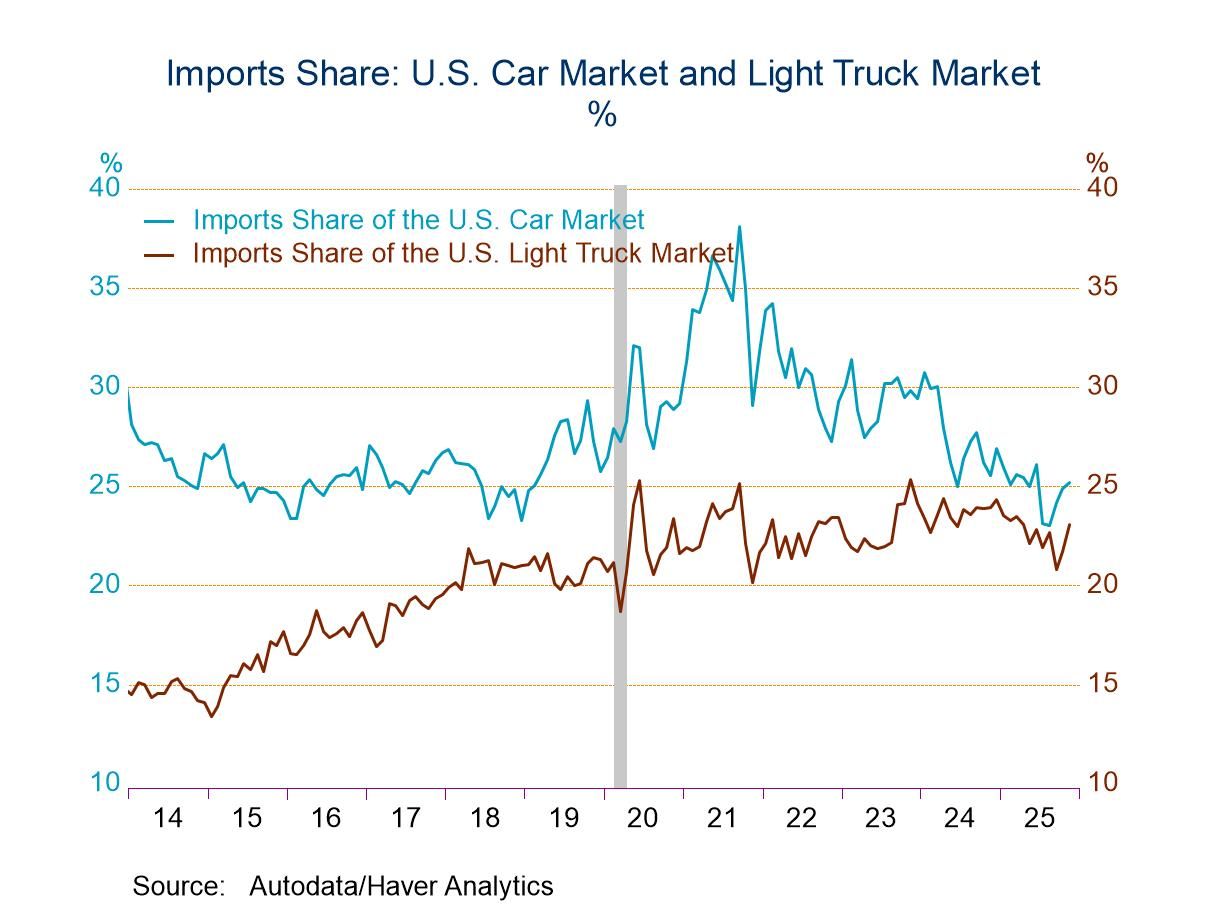
Imports' 23.5% share during November of the U.S. light vehicle market rose from 22.2% in October. These compared to a high of 26.3% in November of 2023. Imports' share of the passenger car market edged up to 25.2% last month from 25.0% in October. It reached a high of 38.1% in September 2021. Imports' share of the light truck market increased to 23.1% last month from 21.7% in October.
U.S. vehicle sales figures can be found in Haver's USECON database. Additional detail by manufacturer is in the INDUSTRY database.

Tom Moeller
AuthorMore in Author Profile »Prior to joining Haver Analytics in 2000, Mr. Moeller worked as the Economist at Chancellor Capital Management from 1985 to 1999. There, he developed comprehensive economic forecasts and interpreted economic data for equity and fixed income portfolio managers. Also at Chancellor, Mr. Moeller worked as an equity analyst and was responsible for researching and rating companies in the economically sensitive automobile and housing industries for investment in Chancellor’s equity portfolio. Prior to joining Chancellor, Mr. Moeller was an Economist at Citibank from 1979 to 1984. He also analyzed pricing behavior in the metals industry for the Council on Wage and Price Stability in Washington, D.C. In 1999, Mr. Moeller received the award for most accurate forecast from the Forecasters' Club of New York. From 1990 to 1992 he was President of the New York Association for Business Economists. Mr. Moeller earned an M.B.A. in Finance from Fordham University, where he graduated in 1987. He holds a Bachelor of Arts in Economics from George Washington University.
More Economy in Brief
 Global