U.S. JOLTS: Openings Slipped and Hiring Edged Up in August
by:Sandy Batten
|in:Economy in Brief
Summary
- Openings slid 256,000 in August, the third monthly decline in the past four months.
- However, the number of openings marginally exceeded the number of unemployed for the fifth consecutive month.
- Hiring edged up 46,000, the third monthly increase in the past four months, due entirely to increased state and local government hiring.
- Separations fell 58,000, led by a 61,000 decline in layoffs.
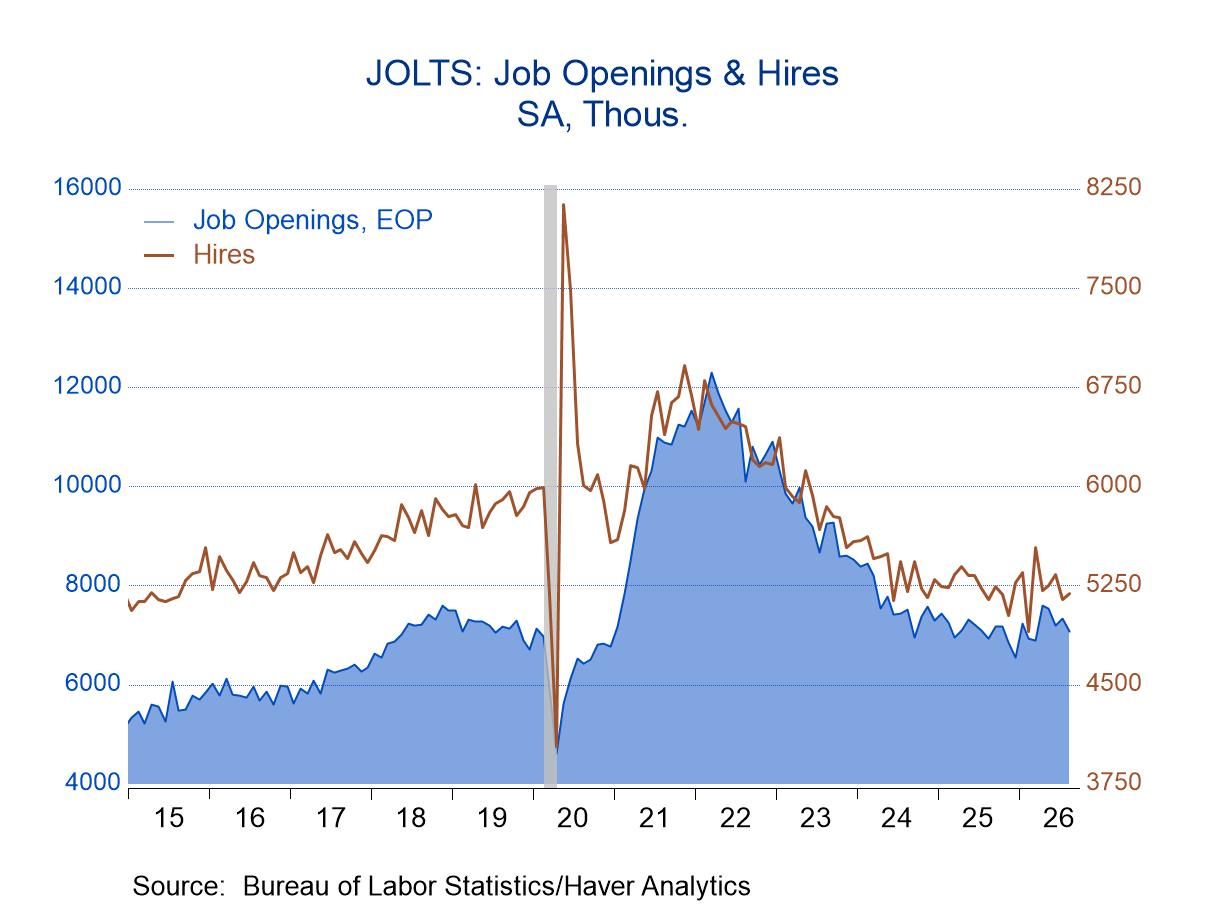
The August Job Openings and Labor Turnover Survey (JOLTS) continued to depict a labor market in which demand and supply are relatively balanced. Job openings slid 256,000 to 7.079 million in August from an upwardly revised 7.335 million in July (previously 7.271 million). This is the lowest level of openings since March and was the third monthly decline in the past four months. The financial market had expected a small decline in openings in August. The job openings rate (the ratio of openings to nonfarm employment plus openings) declined to 4.3% from 4.4% in July. In August, the number of openings fell while the number of unemployed increased. However, the number of openings continued to marginally exceed the number of unemployed for the fifth consecutive month. After openings had significantly exceeded the number of unemployed from early 2022 to the middle of 2024, the two have been roughly in balance since then.
Private sector openings fell 214,000 in August to 6.348 million after a 142,000 increase in July. The performance was varied across sectors but was generally weak. A 61,000 gain in leisure and hospitality was the largest increase, following by increases of 45,000 in information and 43,000 in trade and transport. Openings in business and professional services fell 119,000, their third monthly decline in the past four months and a possible reflection of the rise in AI. Openings in private education and health services slumped 101,000; construction openings declined 48,000, their first monthly decline in six months; manufacturing openings fell 54,000 but failed to reverse the 75,000 gain in July.
Total hires increased 46,000 in August, the third monthly rise in the past four months, to 5.192 million after a 186,000 drop in July. The hiring rate edged up to 3.3% from 3.2% in July. The August rebound in hiring was due solely to a 46,000 increase in state and local government hiring. Private sector hiring edged down 1,000 in August. Oddly, manufacturing led the hiring in August with an increase of 39,000, followed closely by a 36,000 increase in professional and business services hiring. Construction hiring fell 50,000, the first only decline in the past three months. Information hiring slipped 18,000, and leisure and hospitality hiring declined 10,000, the fourth decline in the past five months.
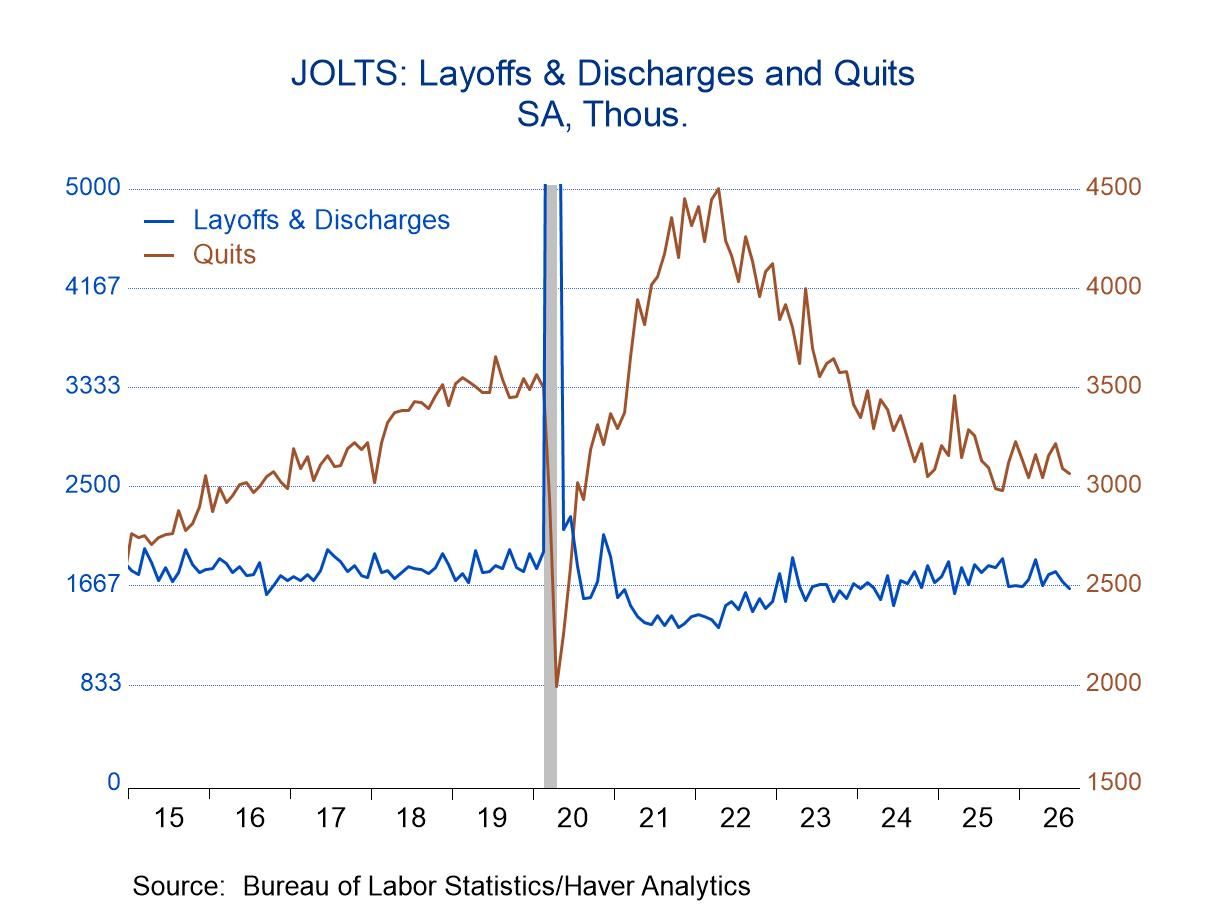
Total separations fell for the second consecutive month, declining 58,000 in August to 5.070 million on top of a 209,000 drop in July. The separation rate was unchanged at 3.2%. The August decline in total separations was led by a 61,000 decrease in layoffs to 1.641 million, the lowest level since March 2025 and below the 2024 and 2025 monthly averages. Private sector layoffs fell 50,000 in August, led by a 58,000 drop in construction and 56,000 decline in professional and business services. Quits declined 23,000 in August to 3.066 million following a 124,000 decrease in July. Quits have been range-bound so far this year but continue to indicate that workers are feeling uncertain about their employment prospects and hence are choosing to remain in their current jobs.
The Job Openings and Labor Turnover Survey (JOLTS) data are available in Haver’s USECON database.

Sandy Batten
AuthorMore in Author Profile »Sandy Batten has more than 30 years of experience analyzing industrial economies and financial markets and a wide range of experience across the financial services sector, government, and academia. Before joining Haver Analytics, Sandy was a Vice President and Senior Economist at Citibank; Senior Credit Market Analyst at CDC Investment Management, Managing Director at Bear Stearns, and Executive Director at JPMorgan. In 2008, Sandy was named the most accurate US forecaster by the National Association for Business Economics. He is a member of the New York Forecasters Club, NABE, and the American Economic Association. Prior to his time in the financial services sector, Sandy was a Research Officer at the Federal Reserve Bank of St. Louis, Senior Staff Economist on the President’s Council of Economic Advisors, Deputy Assistant Secretary for Economic Policy at the US Treasury, and Economist at the International Monetary Fund. Sandy has taught economics at St. Louis University, Denison University, and Muskingun College. He has published numerous peer-reviewed articles in a wide range of academic publications. He has a B.A. in economics from the University of Richmond and a M.A. and Ph.D. in economics from The Ohio State University.
More Economy in Brief
 Asia
Asia