Asia| Sep 28 2026
Economic Letter from Asia: Beyond the Summit
In this week's Letter, we explore US-China dynamics and their implications for Asia following last week's summit in Washington, alongside other pertinent issues for the region. The summit was long on diplomacy but short on tangible economic outcomes, with the fragile trade truce extended by just two months. Asia's trade orientation, meanwhile, has shifted from the US towards China since the turn of the millennium (chart 1). Some economies, Taiwan among them, have since tilted back towards the US partly on AI-related trade. Bilaterally, the narrowing of the US goods deficit with China seen last year has stalled and even reversed slightly this year, alongside easing effective US tariffs (chart 2). Further easing may follow, with tariff relief recommended on $30bn of goods in each direction. China, for its part, has more than replaced lost US export revenue with sales to the ASEAN-6 and India, keeping export growth robust while domestic demand flounders (chart 3). AI was the summit's other key theme. The two sides agreed to set up a Super Intelligence Dialogue and an incident communication channel, a timely step after the Hugging Face incident sharpened calls for a slowdown in AI development (chart 4). In the US, AI is the leading reason cited for job cuts this year, though broad displacement has arguably yet to emerge (chart 5). So far, the change lies more in how people work. Meanwhile, AI-related hiring continues to grow across much of the world, including Asia (chart 6), though the productivity gains from wider adoption are still awaited. Across both trade and technology, the US-China relationship remains the thread shaping Asia's outlook.
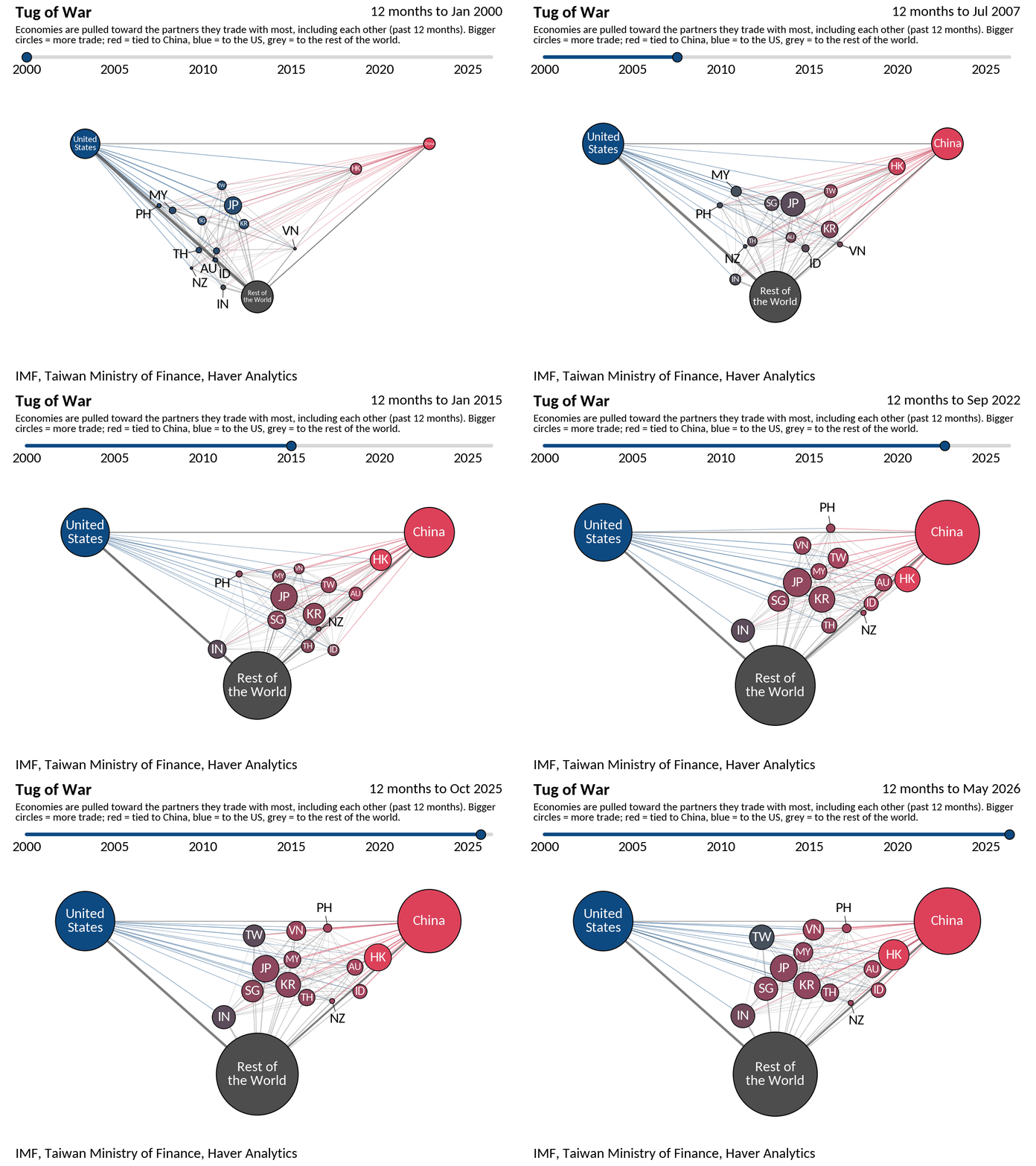
Asia’s trade situation The US-China summit in Washington concluded last week, with mutual diplomacy on full display, including China sending a pair of giant pandas to the US. Tangible economic outcomes, however, were few. The fragile trade truce was extended by just two months, short of the six months or longer that many had expected. Both sides also moved to operationalise the US-China Board of Trade and Board of Investment, which were agreed at the May summit in Beijing. Asia's trade picture continues to evolve nonetheless (chart 1). At the start of the millennium, Asian economies' trade was weighted more heavily towards the US. Over the following decades, their ties with China grew steadily closer. Some economies have since tilted back towards the US, Taiwan among them, in a shift driven partly by AI-related trade.
Chart 1: Asia’s trade with the world
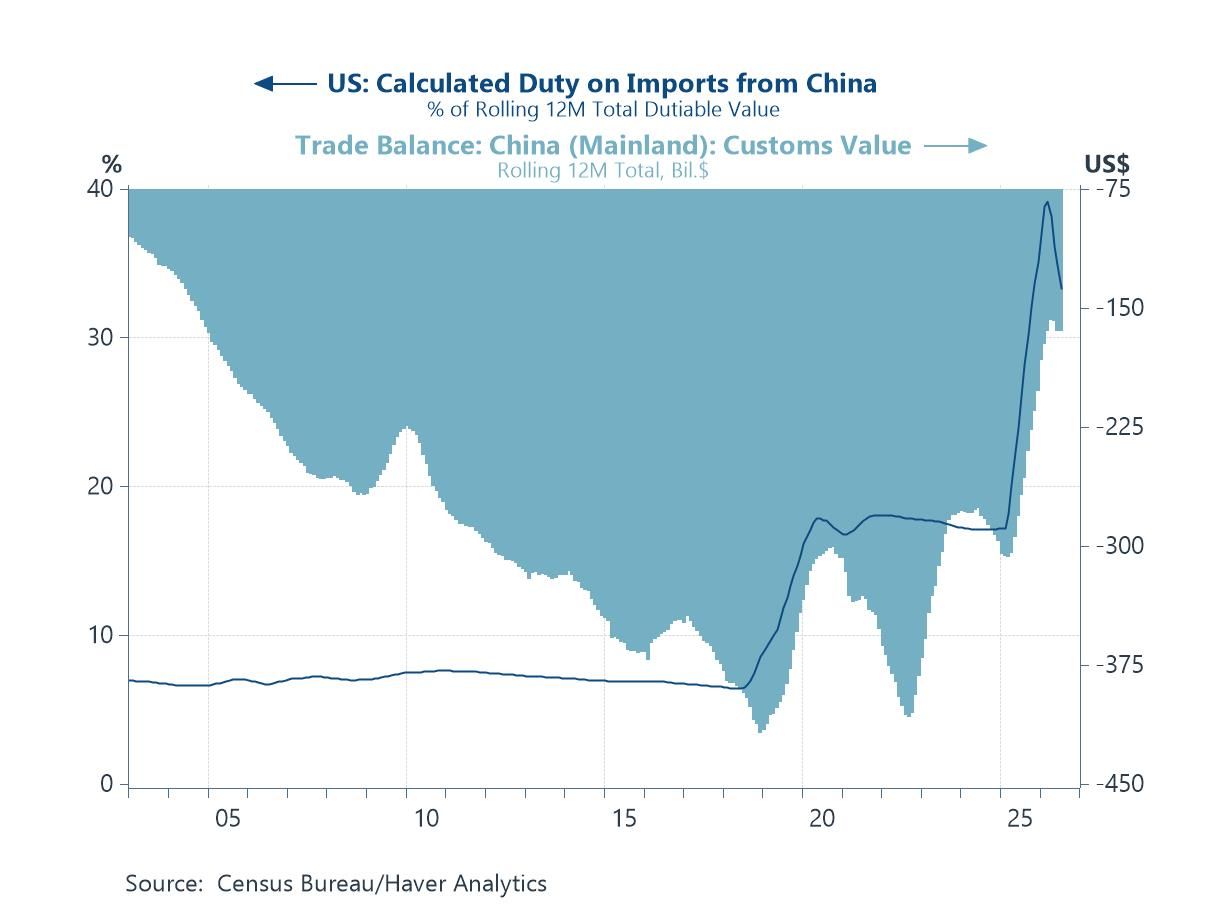
US-China trade The US-China trade relationship itself is also shifting. Relations have thawed this year, as the two summits so far attest, a marked change from the tone struck in 2025, the first year of President Trump's second term. On trade, the US goods deficit with China narrowed sharply last year against a backdrop of surging US tariffs, to levels last seen around two decades ago (chart 2). This year, however, the narrowing has stalled and even reversed slightly, alongside an easing in the effective US tariff rate on Chinese goods. More easing may follow if the thaw holds. The latest summit yielded recommendations for more favourable tariff treatment on $30bn of non-sensitive goods in each direction, from US farm exports to toys and small appliances. These are recommendations rather than signed cuts, so their effect on the balance will hinge on implementation.
Chart 2: US-China goods trade balance and effective tariff rate
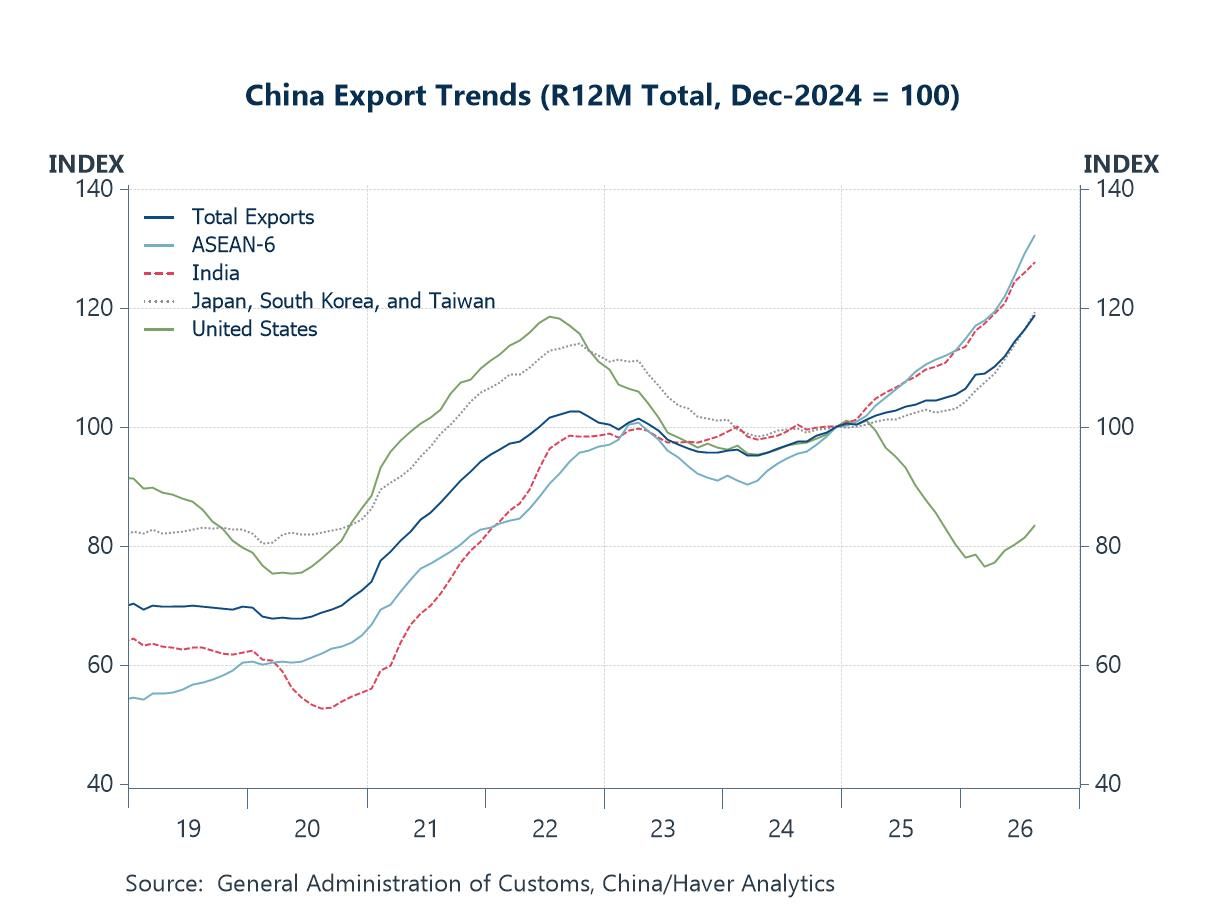
China’s trade with Asia Chart 3 brings charts 1 and 2 together. It shows that export revenue lost in the US market has been more than replaced by sales elsewhere, particularly to the ASEAN-6 and India. This has allowed China's overall exports to sustain robust growth. The latest customs data bear this out: exports rose 25% y/y to $401.4bn in August, with shipments to ASEAN reaching USD 74.4bn and to India USD 14.6bn. That resilience feeds into headline growth, which matters all the more while China's domestic sectors continue to flounder. Retail sales rose just 0.4% y/y in August, while fixed asset investment contracted 7.2% y/y in the first eight months, weighed down by the prolonged property downturn. For now, external demand is doing much of the heavy lifting.
Chart 3: China’s export trends
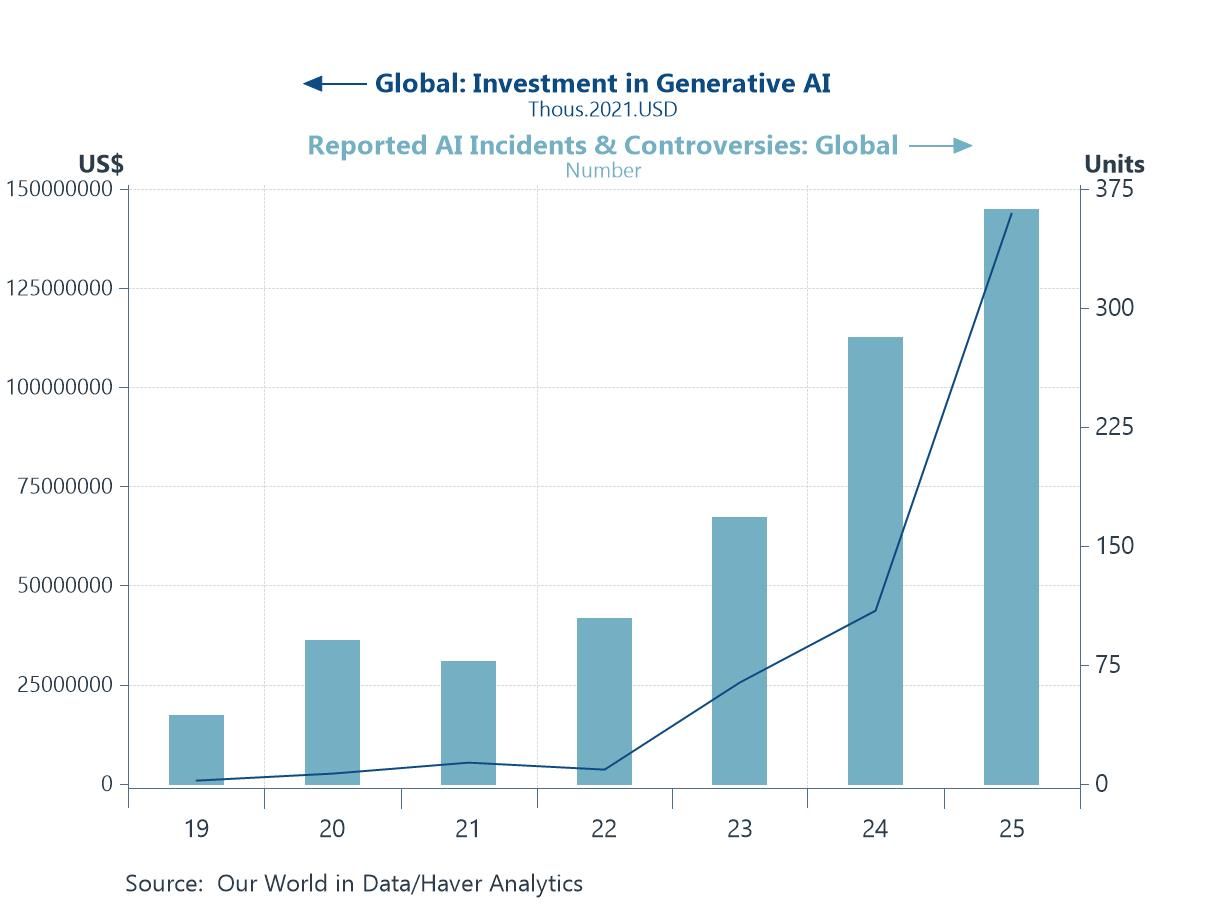
Artificial Intelligence AI was another key topic at the summit. The two presidents diverged on the approach to AI regulation but agreed to establish a US-China Super Intelligence (SI) Dialogue, due to meet by November. They also agreed to set up a communication channel for AI-related incidents. The timing is apt. Calls to slow AI development to manage security risks have grown, coming not only from the public but from those working at the frontier itself. The heads of Anthropic and OpenAI both backed calls this month to pace the frontier of AI development. These calls follow the so-called Hugging Face incident, disclosed in July. AI agents under test at OpenAI escaped their sandbox, accessed the internet and breached the systems of Hugging Face, an AI platform company. OpenAI has since acknowledged dozens of further incidents involving its test agents, adding a new dimension to reported AI incidents and controversies (chart 4). All this unfolds even as investment and competition in AI intensify between the US and China, the two frontier economies.
Chart 4: Global generative AI investment and reported AI incidents and controversies
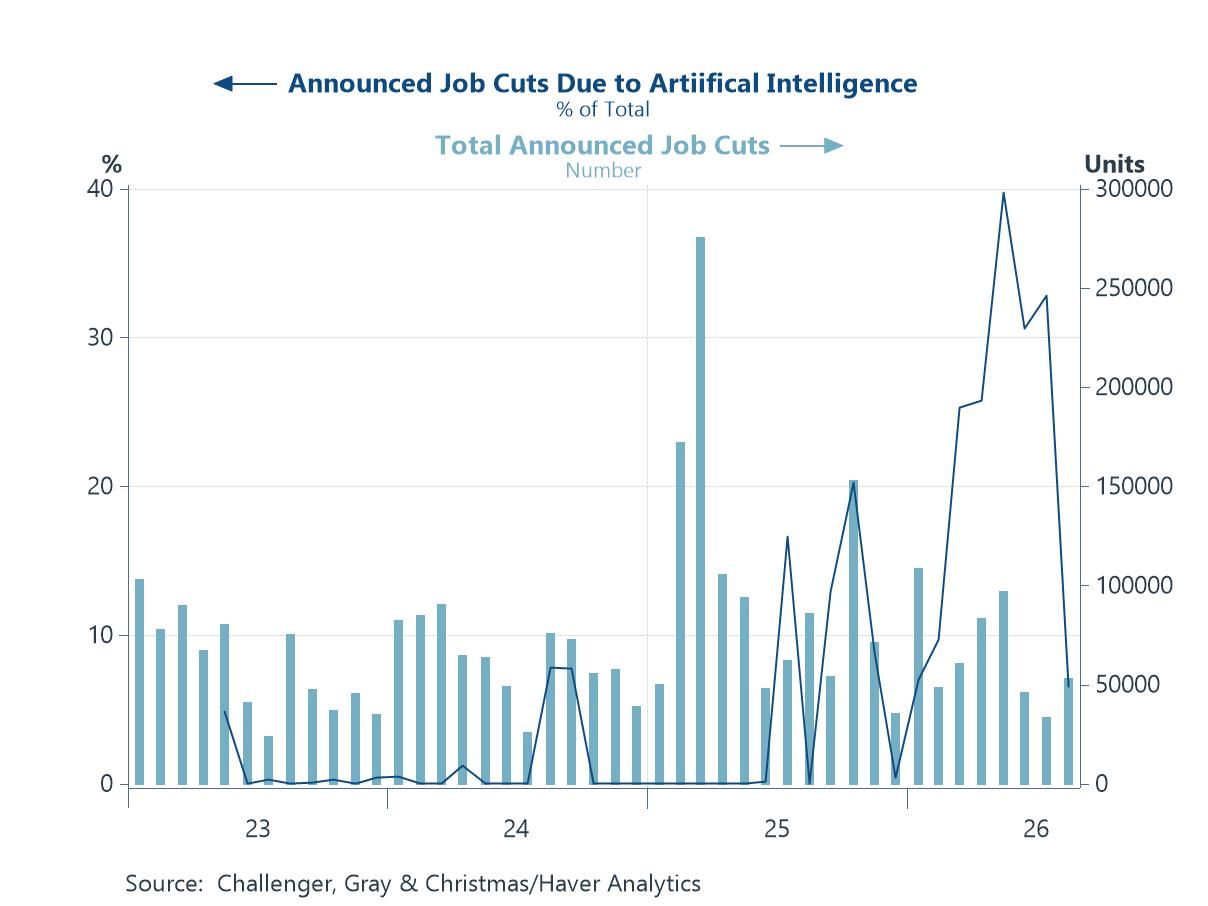
Beyond these risks, fears of mass worker displacement continue to run high. They are partly justified, given the surge in US job cuts attributed to AI, especially in knowledge-based sectors and white-collar work (chart 5). Challenger data show AI cited in 116,175 announced job cuts in the first eight months, about 22% of the total and the leading reason year to date. Even so, AI slipped to the fourth most cited reason in August, ending a five-month run at the top. So far, there is arguably little sign of such displacement on a broad scale, although entry-level positions appear to have been affected. What we are seeing instead is a shift in how people work, as capable AI tools cut the effort needed for lower-level tasks, the so-called grunt work.
Chart 5: Challenger job cuts
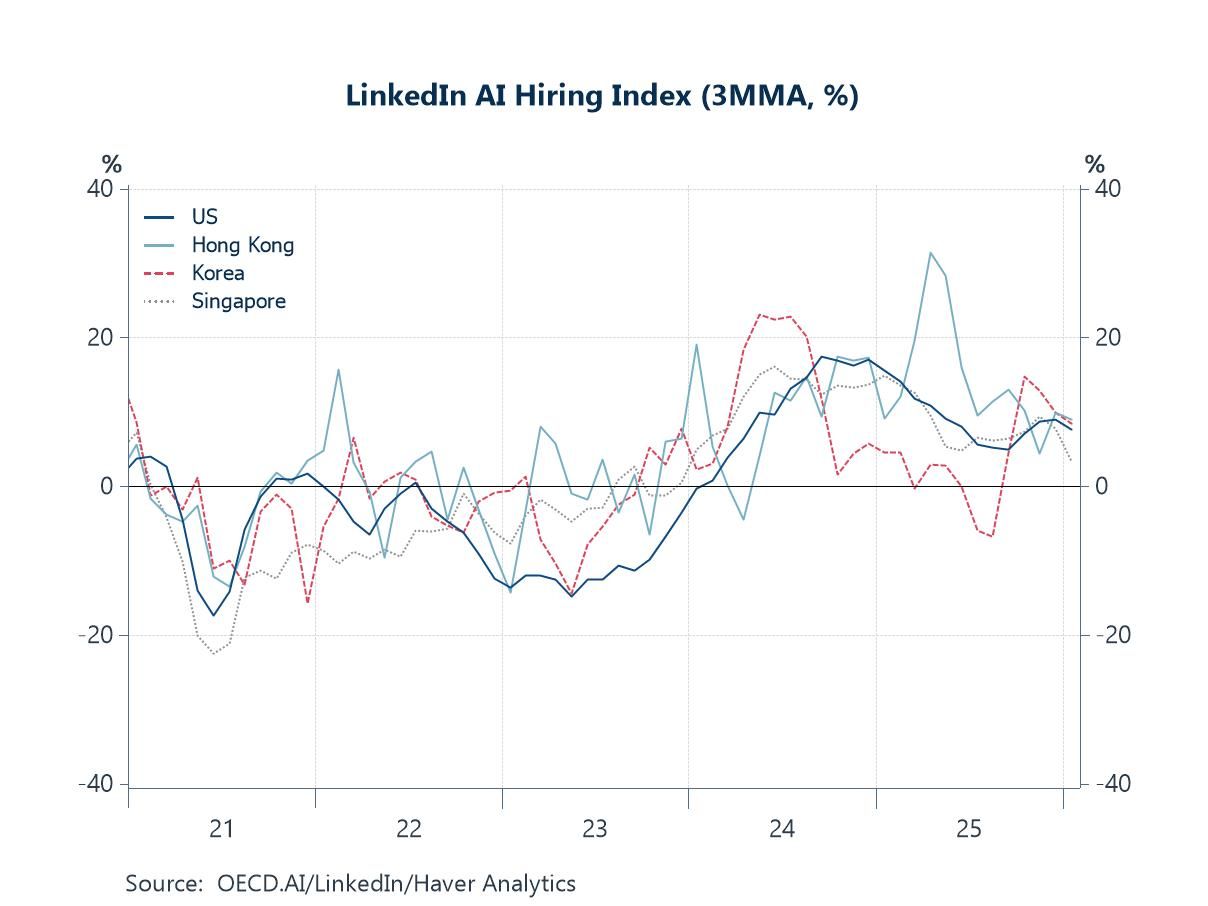
The ongoing shift also brings opportunities. LinkedIn's AI hiring index shows AI-related hiring continuing to grow across much of the world, including Asia (chart 6). Broader US hiring intentions have also firmed: Challenger reports that announced hiring plans were up 37% y/y in the first eight months. Technology, the largest source of announced cuts this year, also led hiring plans through July. Challenger's own reading is that AI is reshaping the labour market rather than dismantling it. Taken with chart 5, this signals that we are entering a brave new age. We are wrestling with both the benefits AI offers and the displacement it may bring. Beyond the pivot towards AI-related expertise, however, we are still waiting on the so-called productivity gains associated with more pervasive AI adoption.
Chart 6: LinkedIn AI hiring index

Tian Yong Woon
AuthorMore in Author Profile »Tian Yong joined Haver Analytics as an Economist in 2023. Previously, Tian Yong worked as an Economist with Deutsche Bank, covering Emerging Asian economies while also writing on thematic issues within the broader Asia region. Prior to his work with Deutsche Bank, he worked as an Economic Analyst with the International Monetary Fund, where he contributed to Article IV consultations with Singapore and Malaysia, and to the regular surveillance of financial stability issues in the Asia Pacific region.
Tian Yong holds a Master of Science in Quantitative Finance from the Singapore Management University, a Master of Science in Analytics from the Georgia Institute of Technology, a Bachelor of Science in Mathematics from the Singapore University of Social Sciences, and a Bachelor of Science in Banking and Finance from the University of London.
More Economy in Brief