Global| Sep 25 2026
Money Supply Growth Slows Except in the U.S.
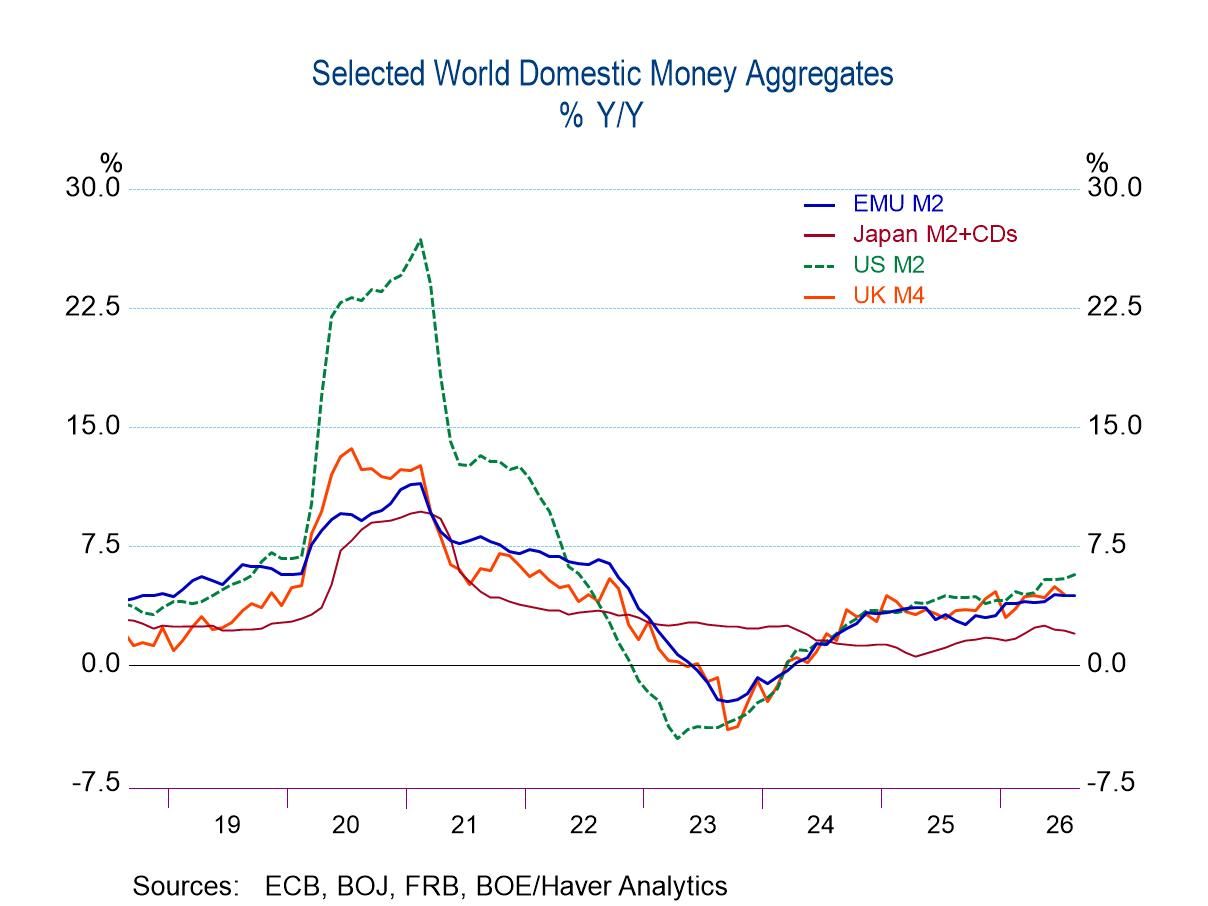
Globally, money growth is easing but the U.S. has become an exception to global trends.
In the EMU, money growth has been slowing within the last year as 12-month growth at 4.3% turns to 2.8% over six months and to 2.4% over three months. In addition, speaking more broadly, the three-month and six-month growth rates are slower than the cumulative pace over three years and two years.
The performance of credit growth in the EMU runs along very similar lines, with greater easing within the 12-month span and growth being broadly weaker over three months and six months than over the last two years and three years cumulatively.
EMU money growth in real terms—real money balances—show not just slower growth but contraction over both three months and six months. They show a broad slowing, with some irregularity compared to longer periods.
The U.K. is not a clear read on money trends, but its three-month nominal growth rate is weaker although there is a small pickup over 12 months and six months compared to previous periods. U.K. real money balances also show contraction over three months but have speeded up over six months and 12 months from very weak rates of growth in their performance in earlier periods.
Japan shows clear slowing in nominal growth from 12 months on. Its recent growth rates are slower than its already slow rates over two years and three years. Japan’s real balance growth also shows real balance contraction over three months and six months as well as more broadly.
The U.S. is an outlier, with slightly weaker three-month nominal growth but with accelerations over 12 months and six months, and with three-month growth that is stronger than over the longer horizons of two years and three years. Growth in real money balances in the U.S. has accelerated and is accelerating within the last year and over the longer horizon as well. U.S. real balance performance shows monetary stimulus running flat-out, marking the U.S. as a clear monetary outlier.
While tracking and relying on monetary signals has fallen “out of fashion,” a lot of that is because of monetary innovation. It is not clear that the finding that U.S. real balances are accelerating should be treated as a benign event. Money growth in the U.S. is strong in real and nominal terms.
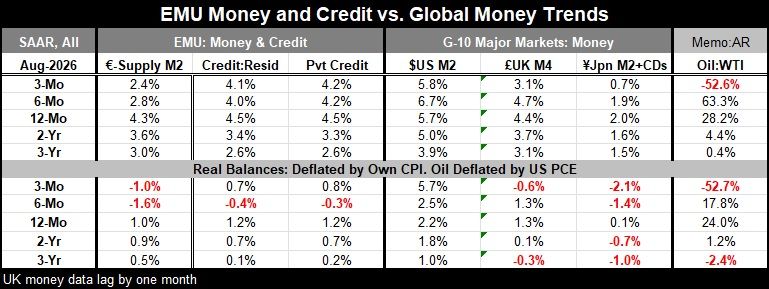
Our convoluted future Oil prices (WTI in dollars) have broken lower over three months. But in “real time” oil has pressed higher. The contribution of oil to an incipient inflation rate may not have broken lower as much as this table suggests. It’s still a good time to remain wary about inflation. We are hearing all sorts of interpretations on this from people who are warning that diesel prices are going to stoke much more inflation to people who are convinced of the opposite that the push up in various prices will quickly weaken the economy, constrict supply, and lead to eventual Fed rate cuts. What seems clear is that inflation will come first. What is contentious is how much monetary policy should react to a supply shock and try to limit knock-on effects. Frankly, everyone has their own opinion, but it is really hard to nail down the consensus.
Inflation is multi-dimensional In addition to those concerns, there are concerns about the availability of diesel, heating fuel for Europe this winter, and specialty synthetic oils needed by modern cars, as well as many other supplies, including ingredients for fertilizers for farmers. If ever you wanted an example of how little we really know about inflation, read the papers today. And that, of course, is all on top of arguments being made that fiscal policy will make monetary policy potentially ineffective if it is not brought to heel. Analysis has gotten wild and very open-ended on the economic front; beware. If you are not dogmatic about it, it should not be surprising to note that many different things feed into the inflation process. Money supply is important, as are interest rates, fiscal policy, and the economy’s ability to deliver goods & services as expected. But the precise weighting and calibration of these things remain contentious among economists and policymakers. On occasion, occasions like this one become sticking points.

Robert Brusca
AuthorMore in Author Profile »Robert A. Brusca is Chief Economist of Fact and Opinion Economics, a consulting firm he founded in Manhattan. He has been an economist on Wall Street for over 25 years. He has visited central banking and large institutional clients in over 30 countries in his career as an economist. Mr. Brusca was a Divisional Research Chief at the Federal Reserve Bank of NY (Chief of the International Financial markets Division), a Fed Watcher at Irving Trust and Chief Economist at Nikko Securities International. He is widely quoted and appears in various media. Mr. Brusca holds an MA and Ph.D. in economics from Michigan State University and a BA in Economics from the University of Michigan. His research pursues his strong interests in non aligned policy economics as well as international economics. FAO Economics’ research targets investors to assist them in making better investment decisions in stocks, bonds and in a variety of international assets. The company does not manage money and has no conflicts in giving economic advice.
More Economy in Brief