Finland’s Confidence Erodes Only Slightly
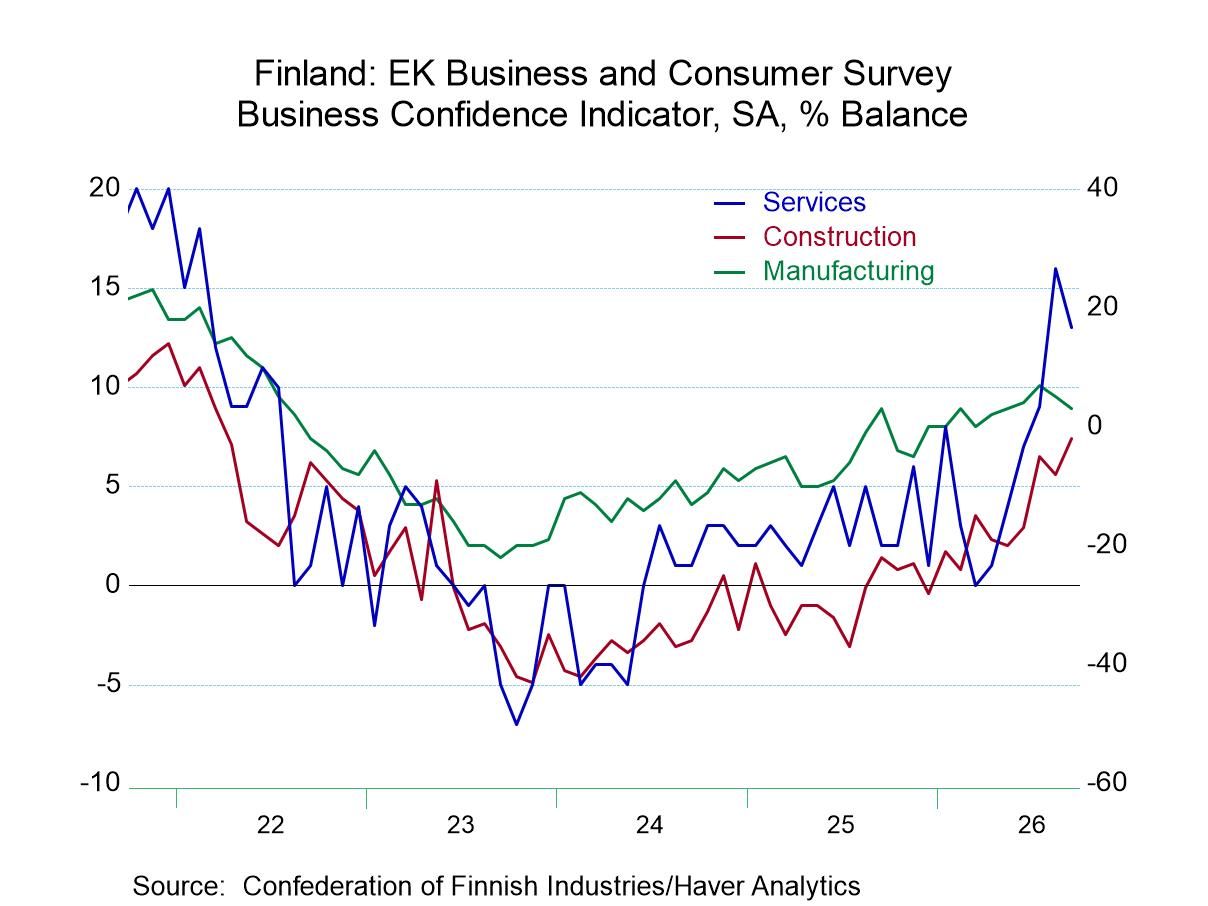
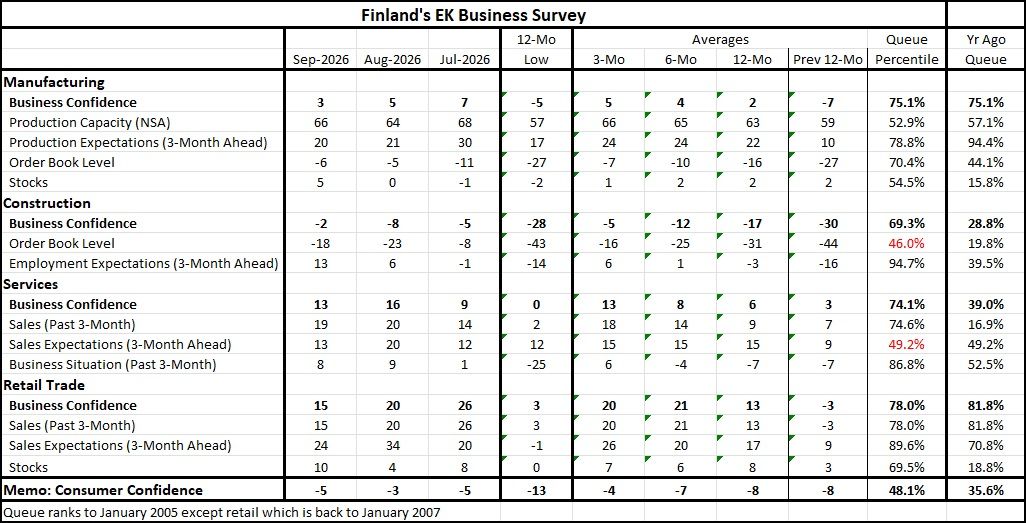
Confidence across business sectors and consumers stepped back slightly in September in Finland. However, the overwhelming trend result is that business sector confidence is on an upswing; consumer confidence has undergone some slight weakening to its trend recently, led by some deterioration in its macro-indicator.
The monthly setbacks in September were relatively small, while the changes in confidence show improvement in the averages over three months compared to six months for all the sectors except retailing where the step-back is a single point to an average of 20 over three months from an average of 21 over six months. However, the retail sector is an exception and also shows a substantial step-down in September compared to August to a level that is going to point to a further deterioration in the moving averages ahead. But that phenomenon seems to be limited to retailing.
Manufacturing confidence holds steady with low single-digit positive readings over three months, six months, and 12 months. The September level has a 75.1 percentile standing, which is quite solid. Sector readings generally display this same phenomenon; construction is an exception as its headline readings are negative; however, they're improving more substantially. The retailing readings have been improving from 12 months to three months, based on the averages, until the recent drop-off in September.
The consumer sector shows consistently mild negative readings, and they have decayed slightly. The consumer sector is the only one with a current queue standing that ranks data back to 2007 below its historic median, meaning below a ranking of 50%. The consumer sector ranking in September is at 48.1%, marginally below its median. The other sectors have rankings generally in their mid-70th percentile, with the exception being construction, which has a 69.3 percentile standing. All of those are quite solid.
Finland’s business sector and consumer rankings as well as their within-sector readings are, for the most part, firm. The line item for the order book level in construction has a below-median standing in September; however, that reading has been improving smartly from 12 months to six months to three months. Expected sales in services register a 49.2 percentile standing, below their median; that reading has been dead solid at 15 over 12 months, six months, and three months.
The consumer sector shows some of the weakest readings (not shown here). Some of that traces to expected high consumer price inflation that has an 81.9 percentile standing in the consumer survey. While the overall threat to unemployment in that survey is above median at a 56th percentile standing, that generic overall concern does not translate into individual concerns as a separate reading on the personal threat to unemployment is quite low at a 17th percentile standing.
On the whole, the business and consumer readings for Finland are good and for the most part quite solid, with the need to keep an eye on the responses in retailing and perhaps also in the consumer sector, largely because of what appears to be the impact of inflation on the consumer psyche.

Robert Brusca
AuthorMore in Author Profile »Robert A. Brusca is Chief Economist of Fact and Opinion Economics, a consulting firm he founded in Manhattan. He has been an economist on Wall Street for over 25 years. He has visited central banking and large institutional clients in over 30 countries in his career as an economist. Mr. Brusca was a Divisional Research Chief at the Federal Reserve Bank of NY (Chief of the International Financial markets Division), a Fed Watcher at Irving Trust and Chief Economist at Nikko Securities International. He is widely quoted and appears in various media. Mr. Brusca holds an MA and Ph.D. in economics from Michigan State University and a BA in Economics from the University of Michigan. His research pursues his strong interests in non aligned policy economics as well as international economics. FAO Economics’ research targets investors to assist them in making better investment decisions in stocks, bonds and in a variety of international assets. The company does not manage money and has no conflicts in giving economic advice.
More Economy in Brief
 Asia
Asia