U.S. JOLTS: Labor Demand Takes a Breather in June
Summary
- Sideways tracks reinforced for job openings and hires.
- Quits continue to signal wage disinflation.
- Hires-Separations point to May and June downward nonfarm payroll revisions.
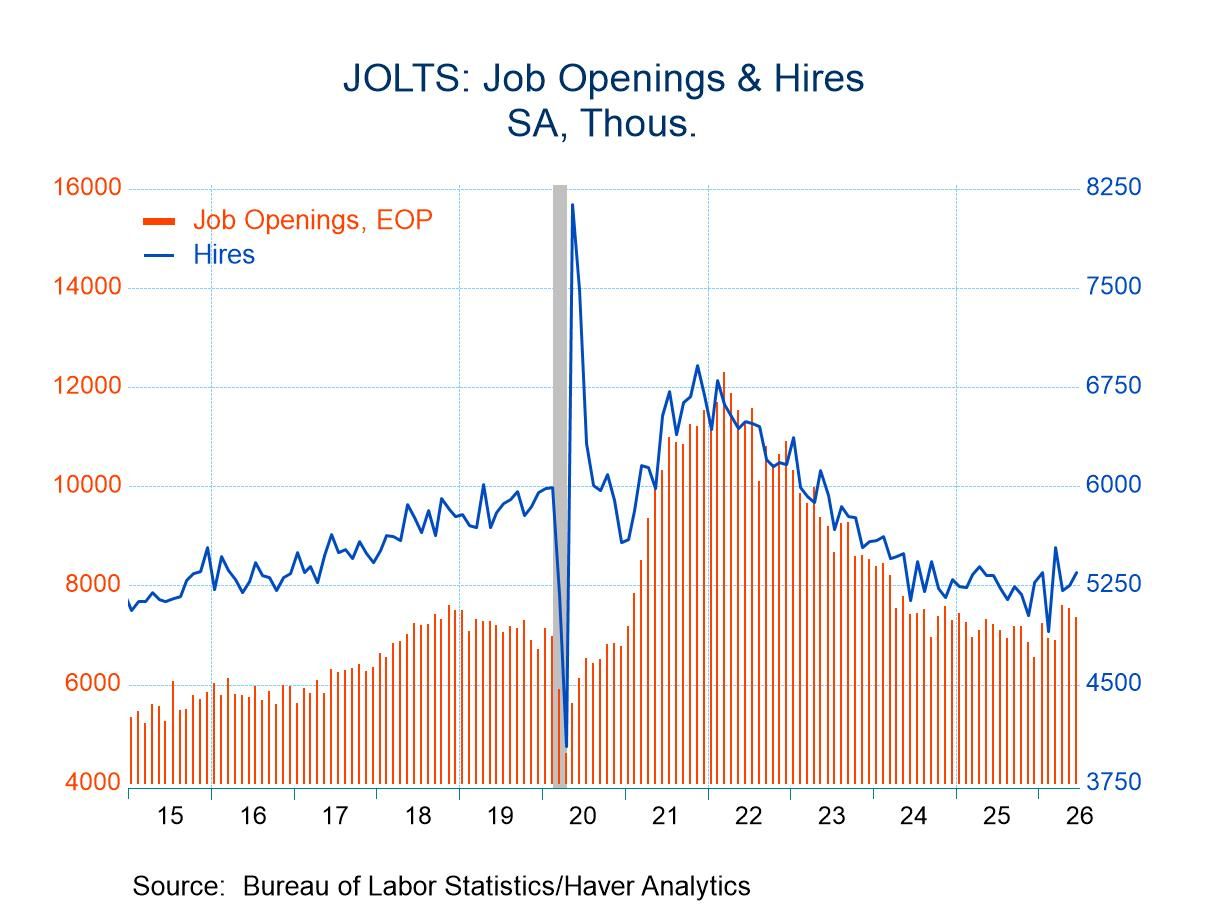
The June Job Openings and Labor Turnover Survey (JOLTS) portrayed less optimism for the U.S. labor demand picture as the second quarter came to an end. After running up to a two-year high in April, total nonfarm job openings fell 178,000 in June after May’s 48,000 decline. This left the current level of 7.359 million up a modest 2.2% compared to a year ago. Looking farther back, job openings loosely traveled in the 7.0-7.5 million range since June 2024. The latest showing reinforced the sideways track for labor demand.
Total nonfarm hires had the same feel to them. Back-to-back moderate gains in May (37,000) and June (96,000) saw hires come in at a 5.348 million rate at second quarter’s end. Hires stood just 0.4% above the June 2025 figure. Relative stability in hires goes as far back as late-2023. The current figure fits within the 5.1-5.6 million range since that point.
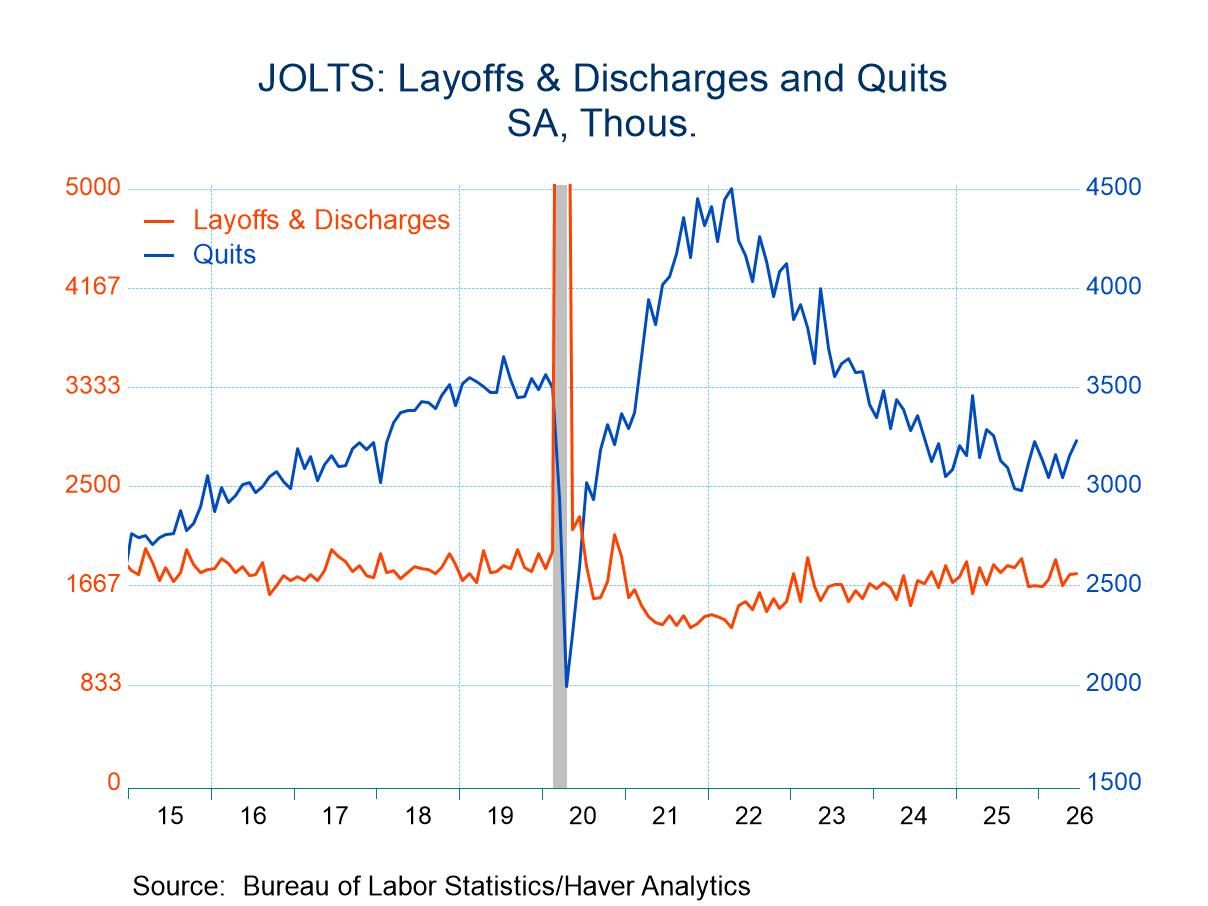
Total nonfarm quits rose 79,000 to 3.232 million in June, up from a downwardly revised 3.153 million in May. The current job openings level is nearly in line with readings from six months ago (December’s 3.225 million) and twelve months ago (June 2025’s 3.254 million). The year-over-year (YoY) rate of -0.7% was still in the red, though.
To be sure, since September 2022, quits have posted 43 YoY declines over a 46-month span. The compression streak continues to stand figuratively above (but literally below) the other two longest since the December 2000 inception of the series: 26 of 27 months from December 2001 to February 2004 and 33 straight from June 2007 to February 2010. Quits’ persistent compression translates to persistent wage disinflation impulses from this cyclical money grab dynamic.
Nonfarm layoffs were little changed in June, rising a mere 5,000 following May’s 94,000 advance. This left the YoY comparison at -4.2% in June. For perspective, the current 1.766 million level of layoffs nearly bisected the 1.6-1.9 million range that has been in place since July 2024. Since bottoming in 2022, nonfarm layoffs have moved in a similar manner to the higher frequency series, weekly continuing claims. JOLTS layoffs lag continuing claims, but the sideways movement at least through June is not suggestive of a notable improvement in the news from pink slips anytime soon.
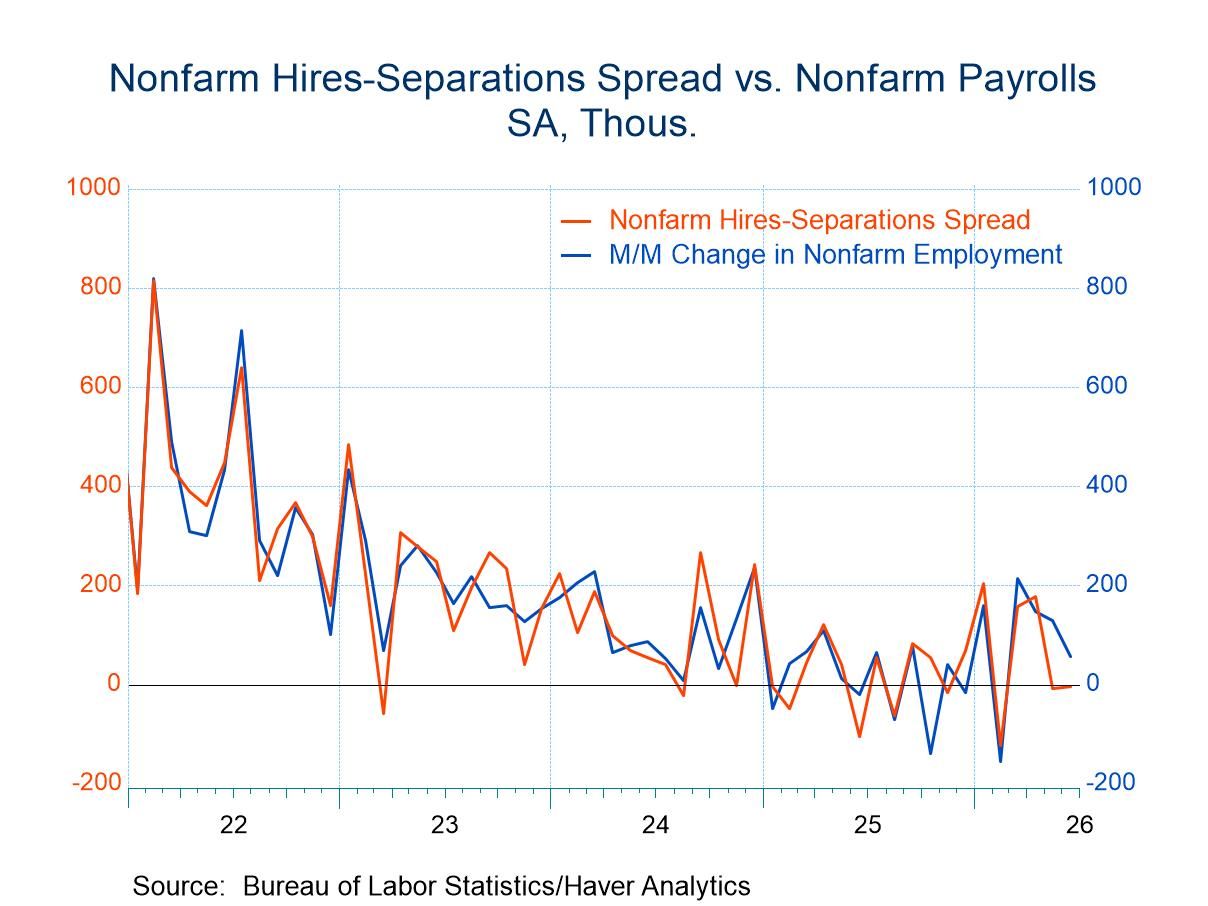
The nonfarm hires-separations spread acts as a channel check for the monthly change in nonfarm payroll employment (NFP). The JOLTS report implies that NFP revisions for May and June could disappoint significantly to the downside. The hires-separations spread in May and June was -8,000 and -3,000, respectively. This compares with respective monthly NFP gains of 129,000 and 57,000.
Were this risk realized, it would be the first back-to-back net NFP downward revisions since November and December 2025. This would change the tone of recent revisions back to pessimism from optimism as three of the four months from January to April saw net upward adjustments. In every month of 2025, NFP monthly changes were revised down from the first print to the third print. This would makes the January to April 2026 stretch look more like an aberration than a trend.
The Job Openings and Labor Turnover Survey (JOLTS) data are available in Haver’s USECON database.

Jonathan Basile
AuthorMore in Author Profile »Jonathan Basile is Street veteran of more than three decades with extensive experience analyzing the global macro environment from the perspectives of sell-side economist, sovereign analyst, and buy-side strategist. He joined Danielle DiMartino Booth at Quill Intelligence in June 2025 as Director of Research where he regularly taps his assets for the firm’s key products, Weekly Quill, Saturday Intelligence Briefing, and Daily Feather.
The prior 11 years were spent at AIG’s and Corebridge Financial’s Investment arms as Head of Global Macro Strategy where his macro and market knowledge were utilized by key stakeholders, like the CIO teams, portfolio managers and third-party clients. Before the Corebridge spin-off from AIG, he built the Global Macro desk from scratch to become an integral part of the active investment process. He streamlined investment practices by steering a centralized monthly global macro discussion allowing subsequent asset-class meetings to be focused on strategy. Jonathan’s tactical rate views were frequently employed by public credit portfolio managers and traders. His storytelling prowess was displayed in a colorful weekly rant whose internal distribution grew steadily and organically.
Jonathan’s past experience with the likes of Dr. Lacy Hunt, Christopher Low, Ian Shepherdson, Elliott Platt, Dr. Neal Soss, and Kathleen Stephansen (twice) prepared him for almost anything thrown his way from the economy and the markets. His years at HSBC, DLJ and Credit Suisse combined saw him cover the economies of the US, Canada, Japan and the UK. He has been recognized as a four-time winning team member of the Marketwatch US Forecaster of the Month and was ranked by Bloomberg as a top forecaster of the Canadian economy.
Jonathan is married with three children – one of which is a Red Sox fan in a Yankees household. You can find Jonathan running or biking on weekends or catching for his men’s baseball team during the spring and summer. He holds a BA in Economics from Princeton University.
More Economy in Brief
 Global