German PPI Shows Pressure, But It’s Limited
German inflation in August saw the headline pop while core remained copacetic. The difference between the two trends is like night and day.
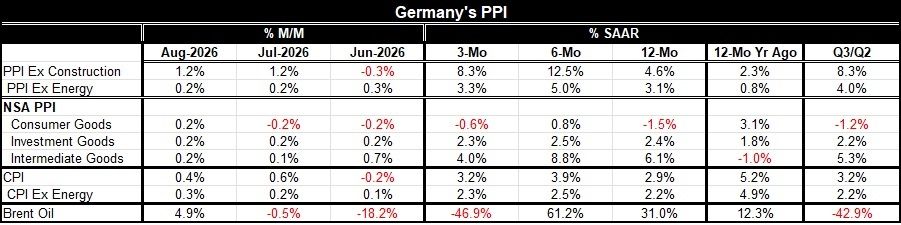
Headline PPI Germany’s PPI spurted for the second consecutive month, rising by 1.2% in both July and August. These jumps followed a drop of 0.3% in June. The German headline PPI is up by 4.6% over 12 months, up by 12.5% at an annual rate over six months, and up at an 8.3% annual rate over three months. Those gains are largely driven by energy trends.
The core is a different story The PPI excluding energy in August gained by 0.2%, the same as in July, after a 0.3% rise in June. Sequentially, the ex-energy PPI rose 3.1% (SAAR) over 12 months, at a 5.0% annual rate over six months, and at a 3.3% annual rate over three months. That’s still excessive, but much less worrisome.
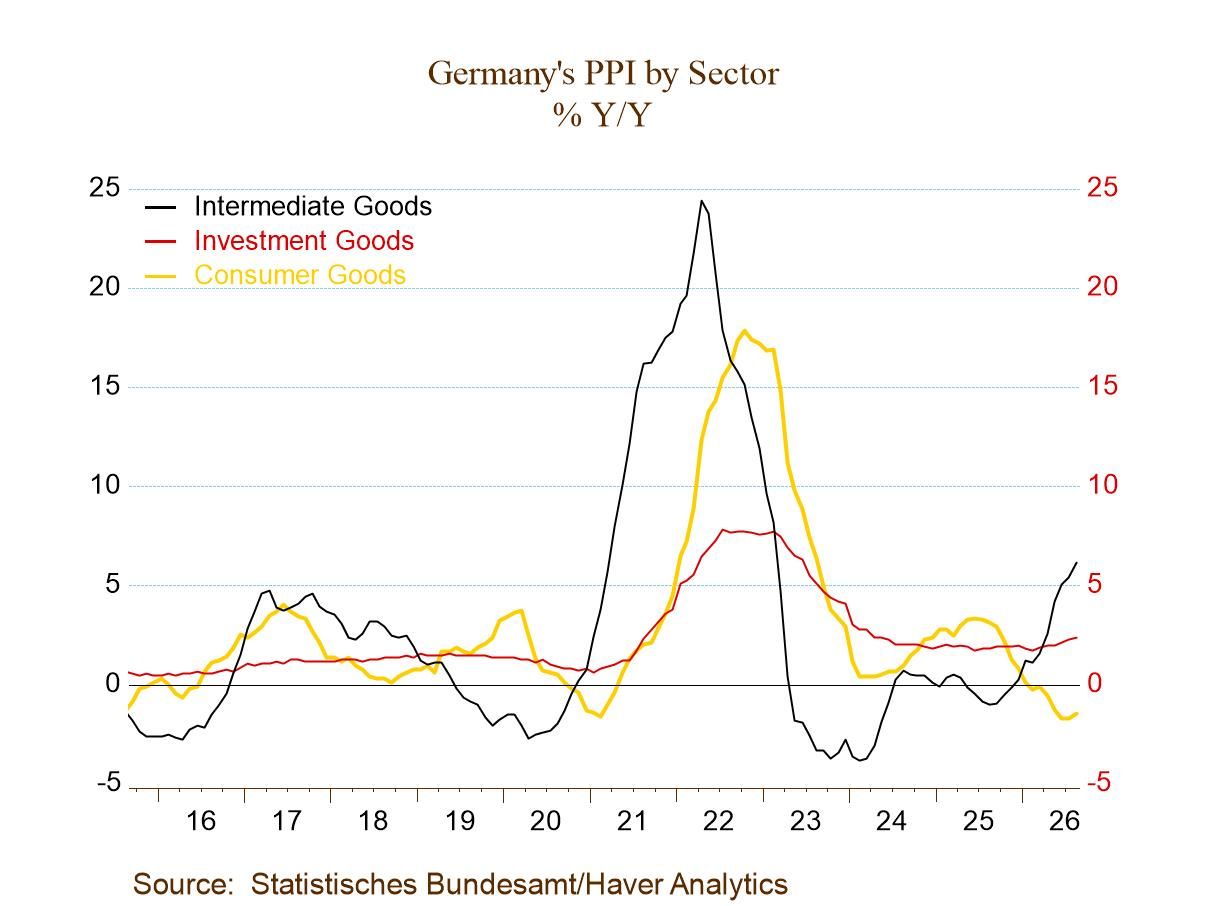
Sector stories The sectors, using unfortunately NSA data, show consumer prices moving lower over three months, with very mild, near-target overshooting for investment goods, while intermediate goods bear the burden of pressure. These observations are for the three-month annualized growth rates but apply equally to the 12-month growth rates.
The CPI for reference German CPI inflation, included in the table as a reference, shows roughly the same patterns as the PPI, with the headline growing in excess of the ECB’s EMU-wide target pace, overshooting by about a percentage point, while the CPI ex-energy skims along at a nearly acceptable pace of overshoot that ranges from 2.2% to 2.5% over three months, six months, and 12 months.
Inflation forces present but surprisingly contained Clearly, inflationary pressures are present in Germany and just as clearly, they are not spreading but have done their damage by the weight of energy in each sector. This does not mean there will not be progression or knock-on effects, just that, so far, they have not appeared. And part of this is because of ongoing economic weakness in Germany.
QTD Quarter to date (QTD), the German headline two months into Q3 has risen at an 8.3% annual rate as the ex-energy PPI runs at a pace of 4%. Both are too hot. Sector inflation rates on NSA data are acceptable except for intermediate goods where the pace rises to 5.3% in the quarter (energy, again). The CPI on a quarterly basis also generates a 3.2% headline gain against a core pace of just 2.2%.
The rocky road ahead Brent oil prices have been somewhat wild recently, with action in the Strait of Hormuz on a volatile path. The Saudis just announced that they would be shipping no oil to Europe over the next few months as they have refinery repairs to conduct. The Houthis and the Saudis are going at it again. It’s hard to establish an outlook with this much geopolitical chaos. Best to just go day by data. My reading of the war is that the U.S. blockade has become more effective and is putting Iran under strain. Stories report that Iranian oil shipments to China have been mostly stopped. Maybe the U.S. approach finally has teeth. Will it work, or will it cause a counterattack by a trapped and pressured regime? Is a real truce between these enemies who can’t trust one another even possible? With that admitted, it is hard to see a stable end-game.

Robert Brusca
AuthorMore in Author Profile »Robert A. Brusca is Chief Economist of Fact and Opinion Economics, a consulting firm he founded in Manhattan. He has been an economist on Wall Street for over 25 years. He has visited central banking and large institutional clients in over 30 countries in his career as an economist. Mr. Brusca was a Divisional Research Chief at the Federal Reserve Bank of NY (Chief of the International Financial markets Division), a Fed Watcher at Irving Trust and Chief Economist at Nikko Securities International. He is widely quoted and appears in various media. Mr. Brusca holds an MA and Ph.D. in economics from Michigan State University and a BA in Economics from the University of Michigan. His research pursues his strong interests in non aligned policy economics as well as international economics. FAO Economics’ research targets investors to assist them in making better investment decisions in stocks, bonds and in a variety of international assets. The company does not manage money and has no conflicts in giving economic advice.
More Economy in Brief
 Global