U.S. ISM Manufacturing PMI Declines in November; Price Index Edges Higher
by:Tom Moeller
|in:Economy in Brief
Summary
- Decline is to lowest level since July.
- New orders, employment & supplier deliveries drop.
- Despite a small gain, price index remains near ten-month low.
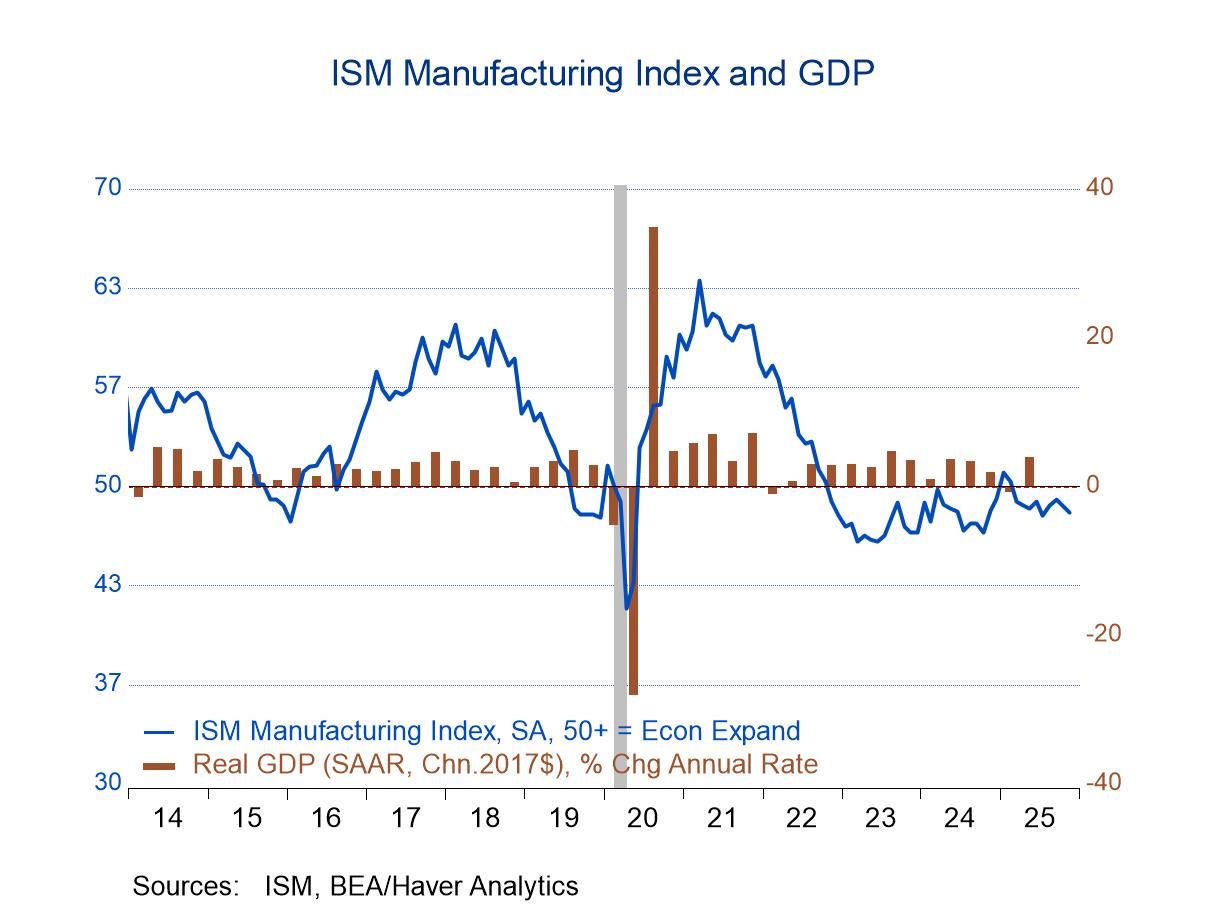
Factory sector activity remains under pressure. The ISM U.S. manufacturing PMI slipped to 48.2 during November following a decline to 48.7 in October after rising to 49.1 during September, according to the Institute for Supply Management. These figures are below the 50 expansion-contraction dividing line. As a result, they indicate that U.S. manufacturing sector activity contracted for the ninth consecutive month. Nevertheless, the reading in November stood above a low of 46.9 in October of last year. A November index of 49.1 had been expected in the Action Economics Forecast Survey.
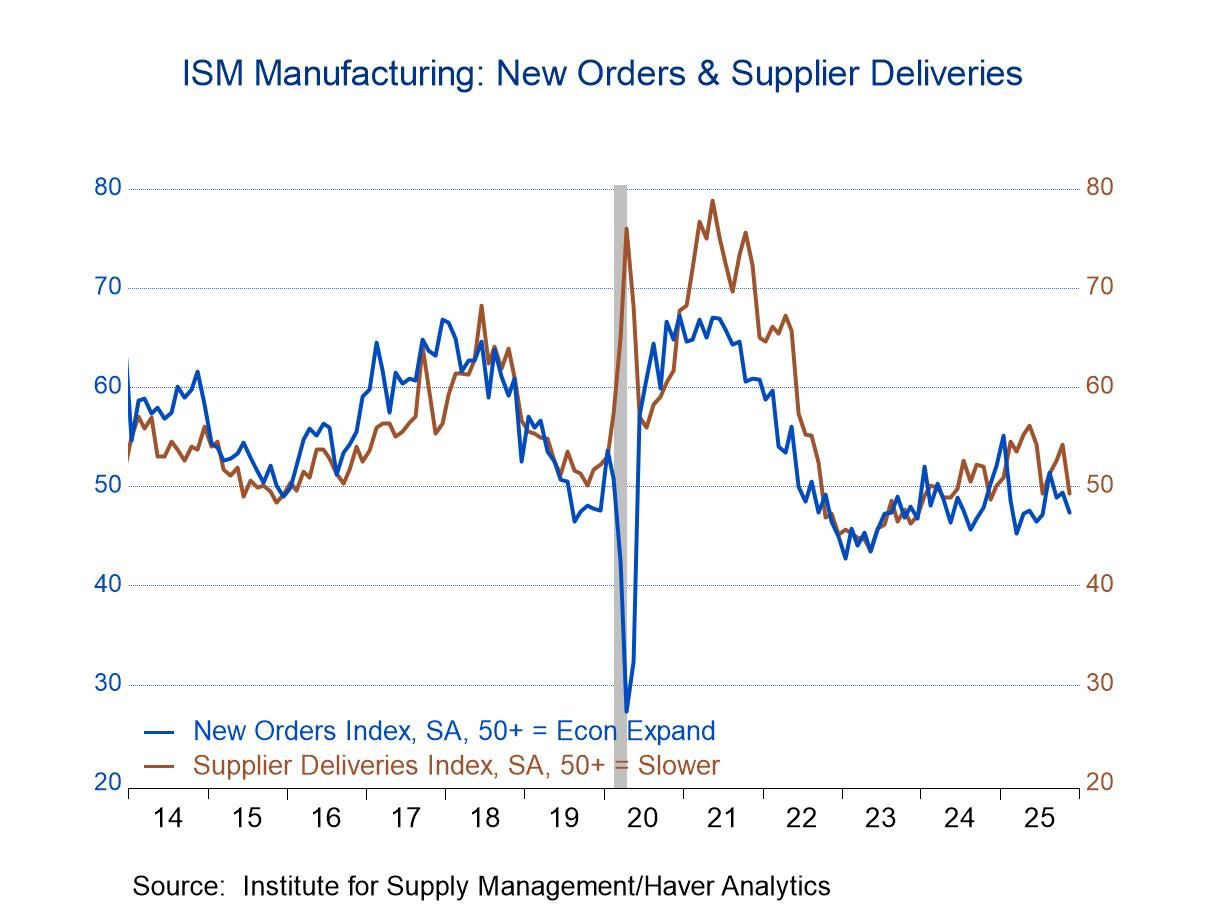
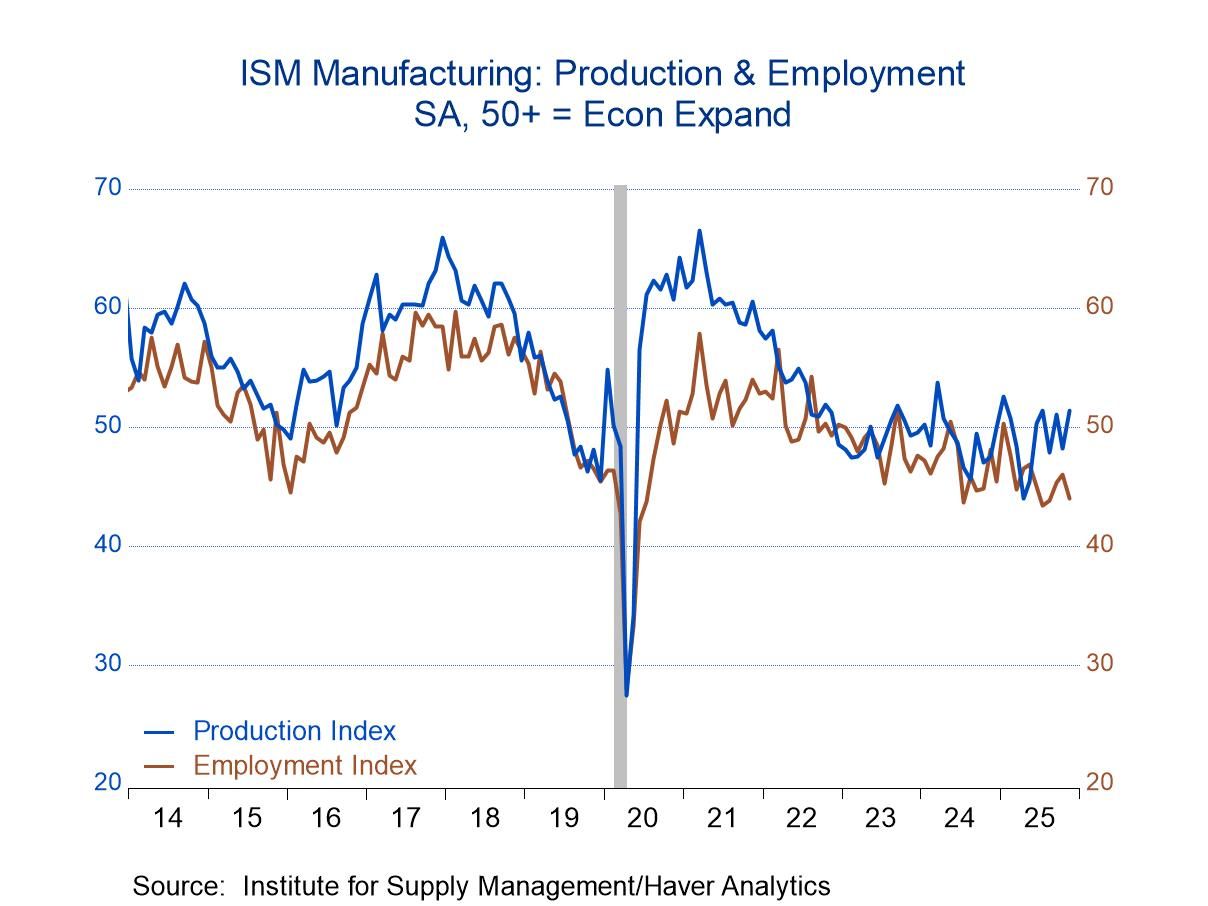
Declines amongst the component series were widespread last month. The new orders component declined to 47.4 after rising to 49.4 in October. It was the lowest level since July, down from a January high of 55.1. A slightly higher 20.7% (NSA) of respondents reported higher orders while an increased 28.4% reported them lower. The employment reading fell to a three-month low of 44.0 from 46.0 in October. A lessened 10.8% (NSA) of respondents raised hiring while a higher 25.1% reduced it. The supplier deliveries index dropped sharply to 49.3 from 54.2. A greatly lessened 6.1% (NSA) of respondents reported slower delivery speeds while a higher 7.6% reported faster speeds.
Working higher, the production index rose to 51.4 during November and reversed its October decline to 48.2. An increased 22.8% (NSA) of respondents reported higher production while a lessened 19.8% reported a decline. The inventories index increased sharply to 48.9 last month after falling to 45.8 in October. A slightly increased 14.4% (NSA) of respondents reported higher inventories while a lessened 17.7% reported them lower.
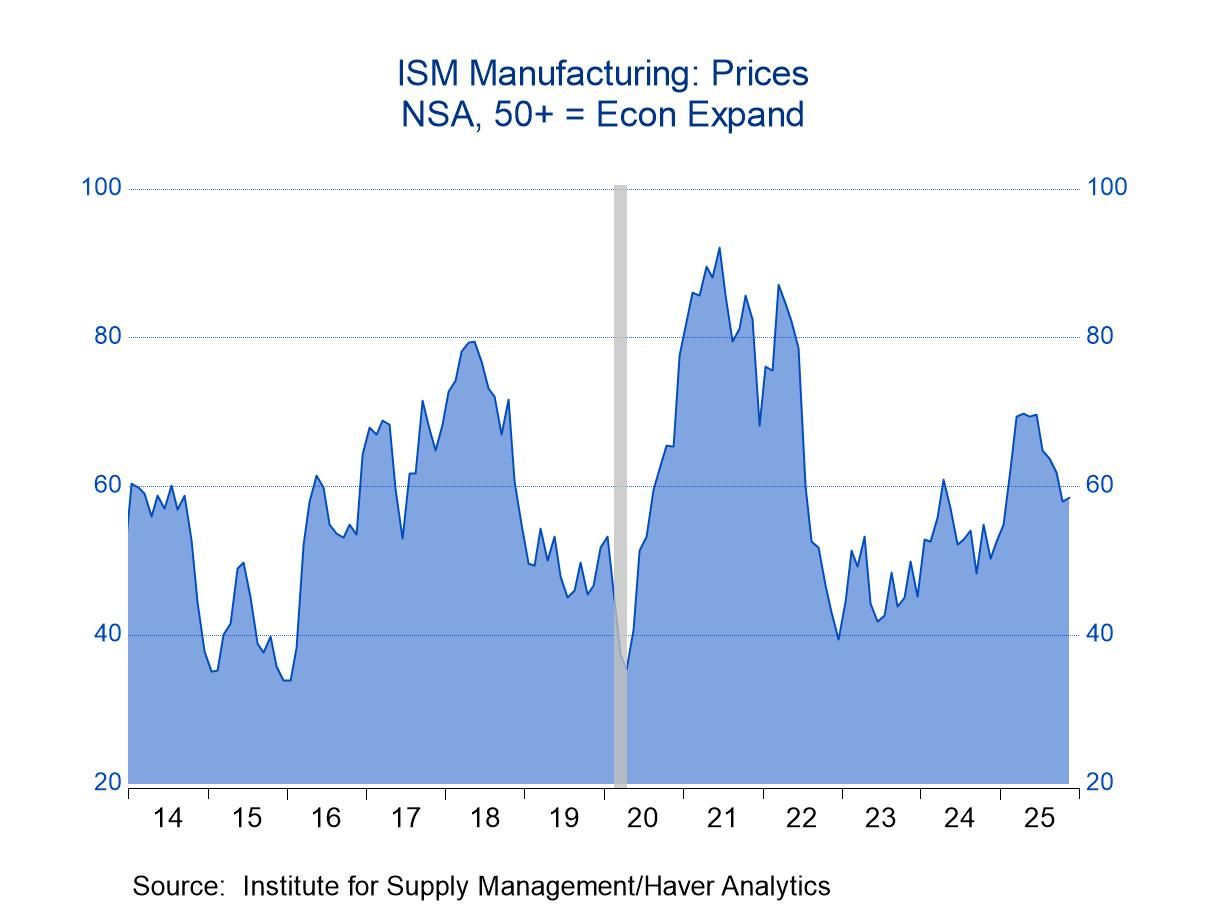
The prices index edged higher to 58.5 (NSA) during November after falling to 58.0 in October. It remained below a high of 69.8 in April, but remained well above its low of 39.4 in December 2022. A roughly steady 27.2% of respondents reported higher prices, a ten month low, while a lessened 10.2% reported prices lower.
In other series, the export orders index rose to a seasonally adjusted 46.2, a three-month high, in November after rising to 44.5 in October. It remained up from a 40.1 May low. The imports index surged to an eight-month high of 48.9 last month from 45.4 in October. Nevertheless, the orders index remained below a high of 52.6 in February. The order backlog series fell to a seven-month low of 44.0.
The ISM figures are based on responses from over 400 purchasing and supply executives from 18 industries, which are weighted according to each industry’s contribution to GDP. These data are diffusion indexes where a reading above 50 indicates expansion; below 50 indicates contraction. The ISM Manufacturing PMI is a composite index based on the diffusion indexes of five of the indexes (seasonally adjusted) with equal weights: New Orders, Production, Employment, Supplier Deliveries, and Inventories. The figures from the Institute for Supply Management can be found in Haver’s USECON database; further detail is found in the SURVEYS database. The expectations number is available in Haver’s AS1REPNA database.

Tom Moeller
AuthorMore in Author Profile »Prior to joining Haver Analytics in 2000, Mr. Moeller worked as the Economist at Chancellor Capital Management from 1985 to 1999. There, he developed comprehensive economic forecasts and interpreted economic data for equity and fixed income portfolio managers. Also at Chancellor, Mr. Moeller worked as an equity analyst and was responsible for researching and rating companies in the economically sensitive automobile and housing industries for investment in Chancellor’s equity portfolio. Prior to joining Chancellor, Mr. Moeller was an Economist at Citibank from 1979 to 1984. He also analyzed pricing behavior in the metals industry for the Council on Wage and Price Stability in Washington, D.C. In 1999, Mr. Moeller received the award for most accurate forecast from the Forecasters' Club of New York. From 1990 to 1992 he was President of the New York Association for Business Economists. Mr. Moeller earned an M.B.A. in Finance from Fordham University, where he graduated in 1987. He holds a Bachelor of Arts in Economics from George Washington University.
More Economy in Brief
 Global