U.S. Initial Claims for Unemployment Insurance Fall Sharply in Latest Week
by:Tom Moeller
|in:Economy in Brief
Summary
- Decline in initial claims at lowest level since January.
- Continuing claims edge lower; jobless rate steadies.
- State unemployment rates vary.
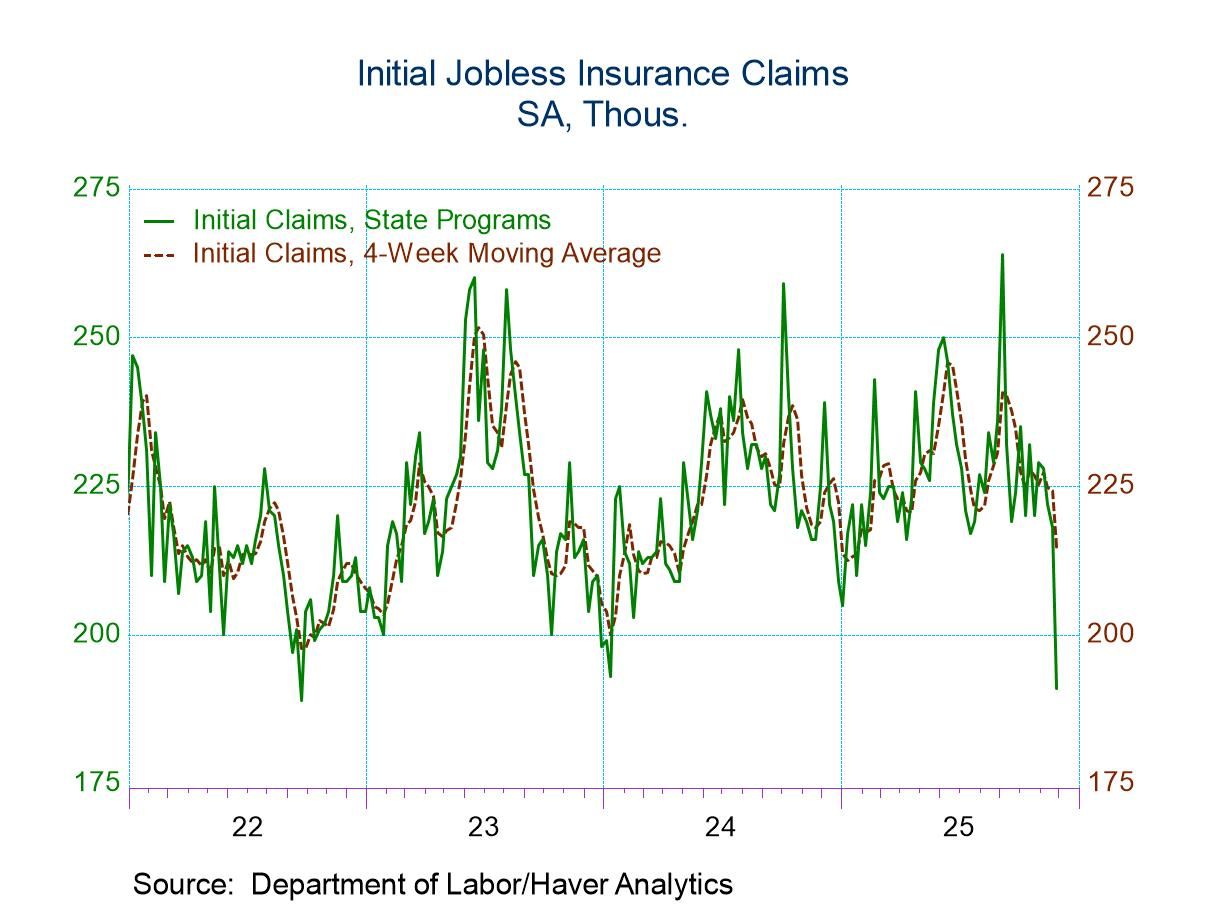

Initial claims for unemployment insurance declined to 191,000 (-15.1% y/y) during the week of November 29 after easing to 218,000 during the prior week, revised from 216,000. The four-week moving average of initial claims fell to 214,750 from 224,250. It was the lowest level since January 2025, down from a high of 245,750 in the second week of June.
Federal government employees initially filed 1,125 (NSA) jobless insurance claims in the week ended November 22 after 1,724 in the prior week. These figures are increased from 588 at the end of September.
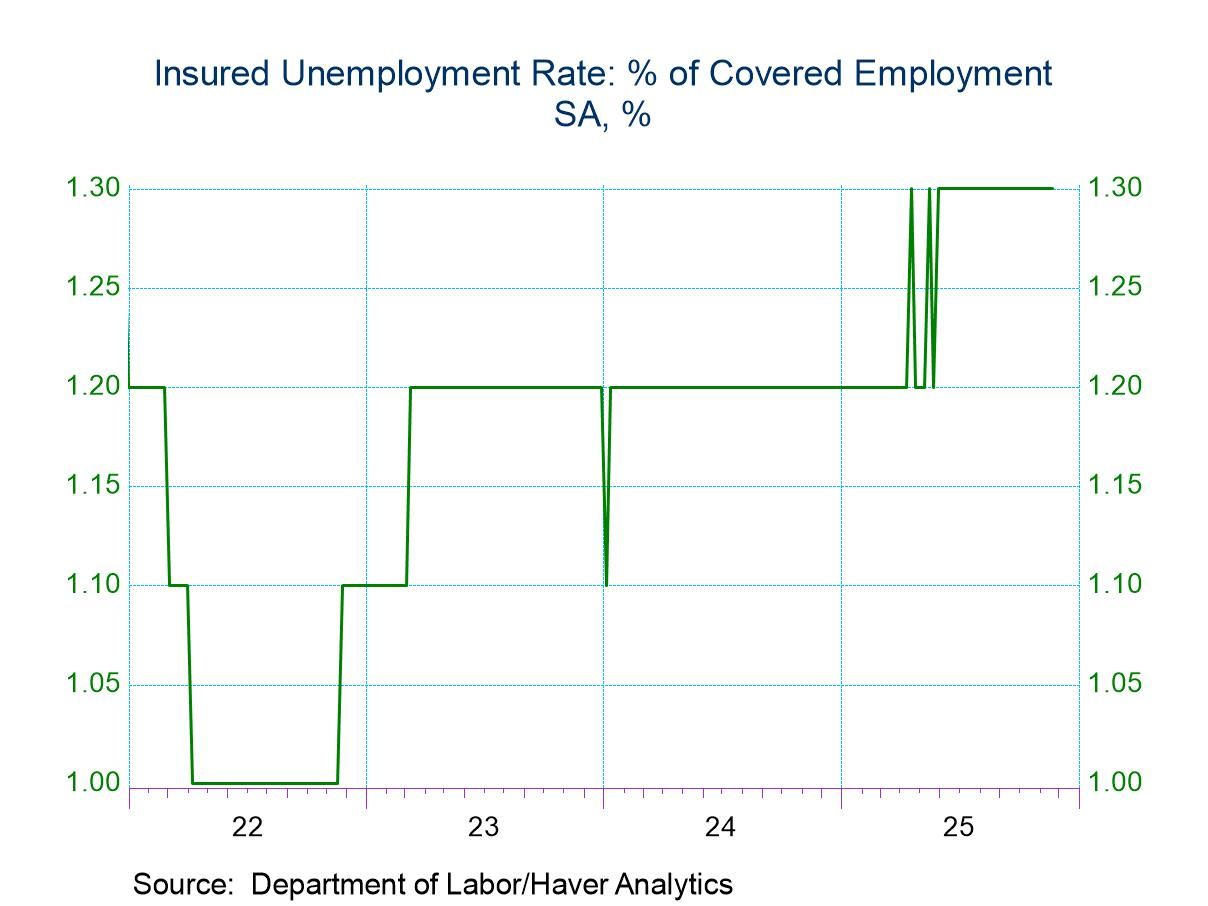
Continuing claims for unemployment insurance eased to 1.939 million (+3.6% y/y) in the week ended November 22 from 1.943 million in the prior week. The four-week moving average fell to 1.945 million from 1.951 million. It was the lowest level in five weeks.
Federal government employees continuing benefits fell to 17,851 in the week ended November 15 from 33,085 in the prior week. These figures are increased from 8,678 at the end of September.
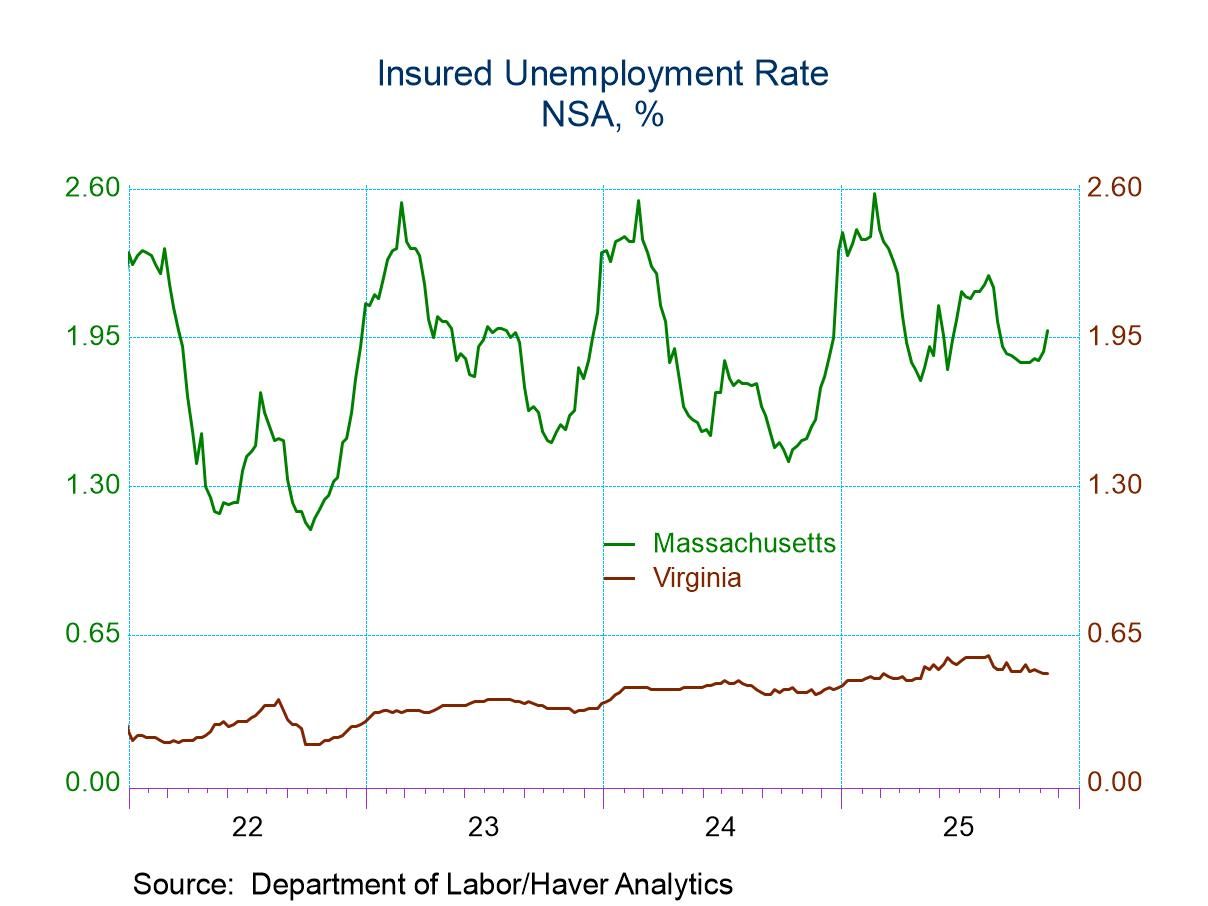
The insured unemployment rate varied greatly across individual states and territories. In the week ended November 15, the highest unemployment rates were in New Jersey (2.26%) and Washington (2.26%), California (2.01%), Massachusetts (1.98%), the District of Columbia (1.76%) and Connecticut (1.75%). The lowest were in South Dakota (0.32%), Florida (0.33%), Louisiana (0.42%), Nebraska (0.46%) and Virginia (0.48%). Rates in other notable states include New York (1.65%), Illinois (1.53%), Pennsylvania (1.45%), and Texas (1.12%). These state data are not seasonally adjusted.
Data on weekly unemployment claims are from the Department of Labor itself, not the Bureau of Labor Statistics. They begin in 1967 and are contained in Haver’s WEEKLY database and summarized monthly in USECON. Data for individual states are in REGIONW back to December 1986.

Tom Moeller
AuthorMore in Author Profile »Prior to joining Haver Analytics in 2000, Mr. Moeller worked as the Economist at Chancellor Capital Management from 1985 to 1999. There, he developed comprehensive economic forecasts and interpreted economic data for equity and fixed income portfolio managers. Also at Chancellor, Mr. Moeller worked as an equity analyst and was responsible for researching and rating companies in the economically sensitive automobile and housing industries for investment in Chancellor’s equity portfolio. Prior to joining Chancellor, Mr. Moeller was an Economist at Citibank from 1979 to 1984. He also analyzed pricing behavior in the metals industry for the Council on Wage and Price Stability in Washington, D.C. In 1999, Mr. Moeller received the award for most accurate forecast from the Forecasters' Club of New York. From 1990 to 1992 he was President of the New York Association for Business Economists. Mr. Moeller earned an M.B.A. in Finance from Fordham University, where he graduated in 1987. He holds a Bachelor of Arts in Economics from George Washington University.
More Economy in Brief
 Global