U.S. Factory Orders Unexpectedly Increase in September
by:Tom Moeller
|in:Economy in Brief
Summary
- Shipments are steady.
- Order backlogs post firm increase.
- Both durable & nondurable goods inventories slip.

New orders to all manufacturing industries rose 0.2% (3.6% y/y) during September after increasing 1.3% in August. A 0.8% decline had been expected in the Action Economics Forecast Survey.
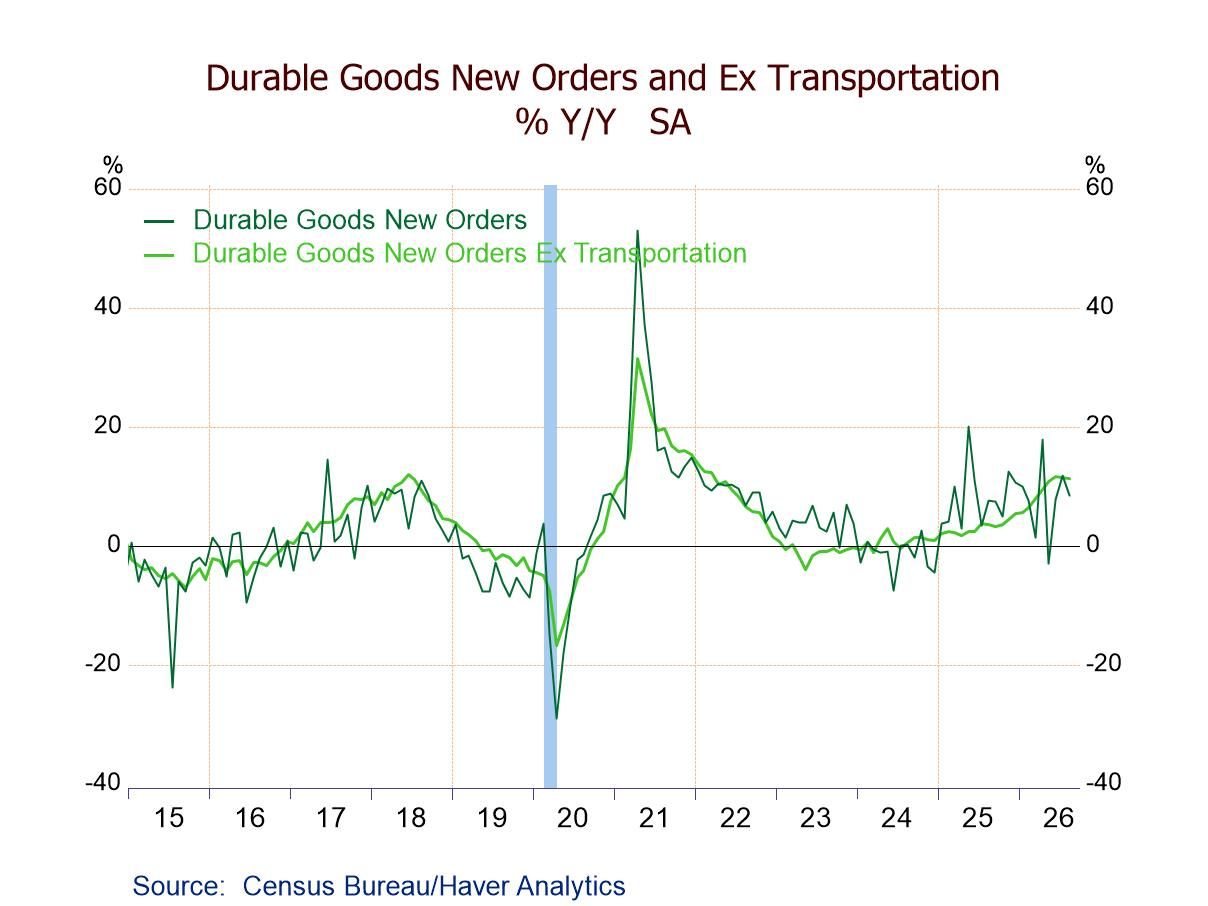
As in the advance report, new orders for durable goods rose 0.5% (7.2% y/y) in September after a 3.0% August jump, which followed a 2.8% July decline. A 0.4% rise (15.9% y/y) in transportation sector orders followed an 8.0% August surge, which was led by commercial aircraft orders. Motor vehicle & parts orders rose 0.2% (4.3% y/y) after falling 0.3% in August. Orders excluding transportation rose 0.2% (1.2% y/y) after a 0.1% decline. Machinery orders eased slightly (+5.9% y/y) in September after a 2.1% rise. Total orders for computers & electronic products rose 0.5% (3.3% y/y) following a 1.1% decline while electrical equipment & appliance orders strengthened 1.7% (6.8% y/y), the strongest of six consecutive increases.
Nondurable goods orders, which equal shipments, eased 0.1% both m/m and y/y. Food product shipments rose 0.1% (0.5% y/y) after easing 0.1%. Textile product shipments rose 0.3% (1.9% y/y) following a 0.2% gain. Apparel shipments held steady (-0.4% y/y) after rising 0.6% in August. Paper product shipments rose 0.3% both m/m and y/y. Chemical shipments held steady (3.1% y/y) after a 0.2% gain while shipments from petroleum refineries fell 1.1% (-6.8% y/y) following a 2.2% decline.
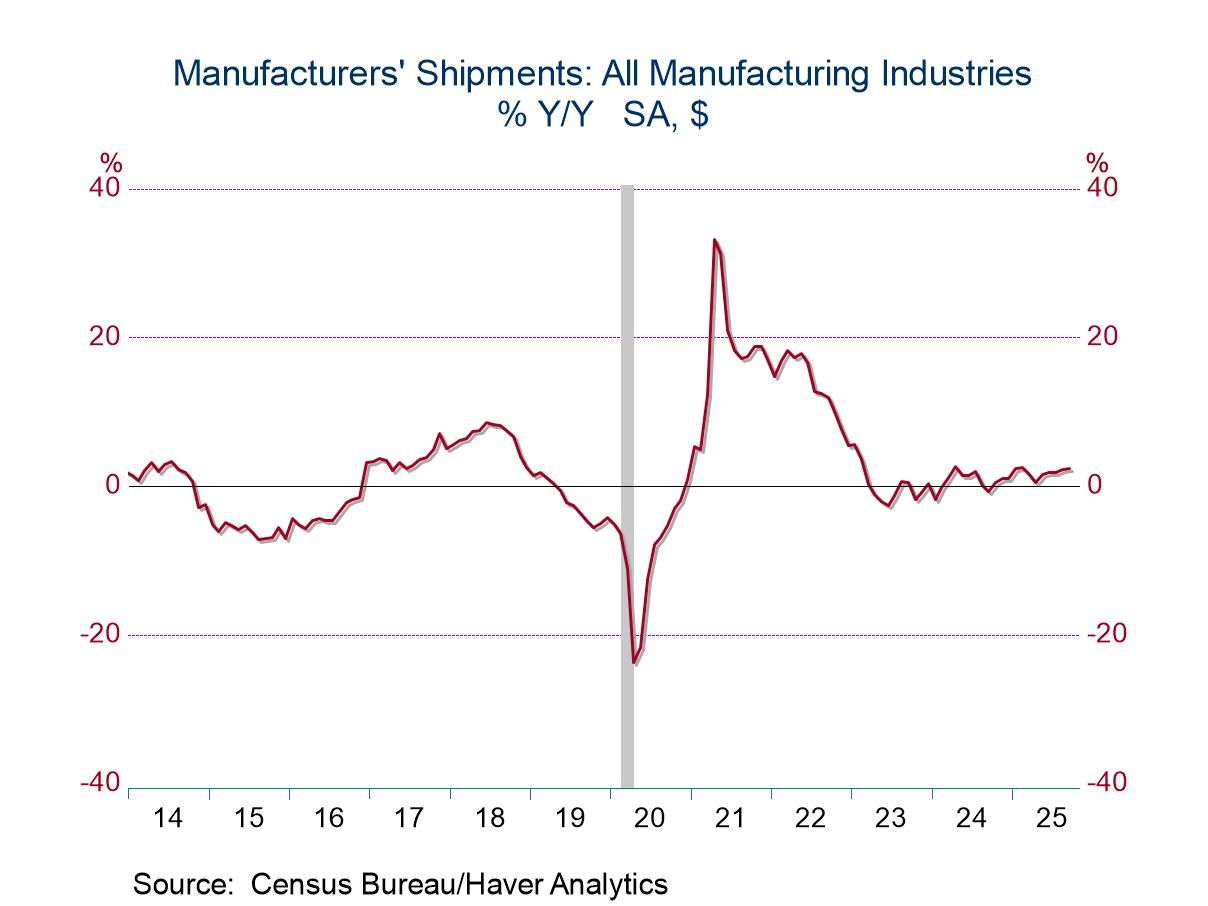
Shipments of all manufacturing industries were little changed in September (+2.3% y/y) after falling 0.3% in August. Shipments of durable goods edged 0.1% higher (4.8% y/y) after easing 0.1%. Machinery shipments increased 1.3% (4.5% y/y) after easing 0.1% while computer & electronic product shipments were off 0.1% (+4.9% y/y) following a 0.2% dip. Electronic equipment, appliances & components shipments rose 0.6% (4.3% y/y) after rising 0.1%.
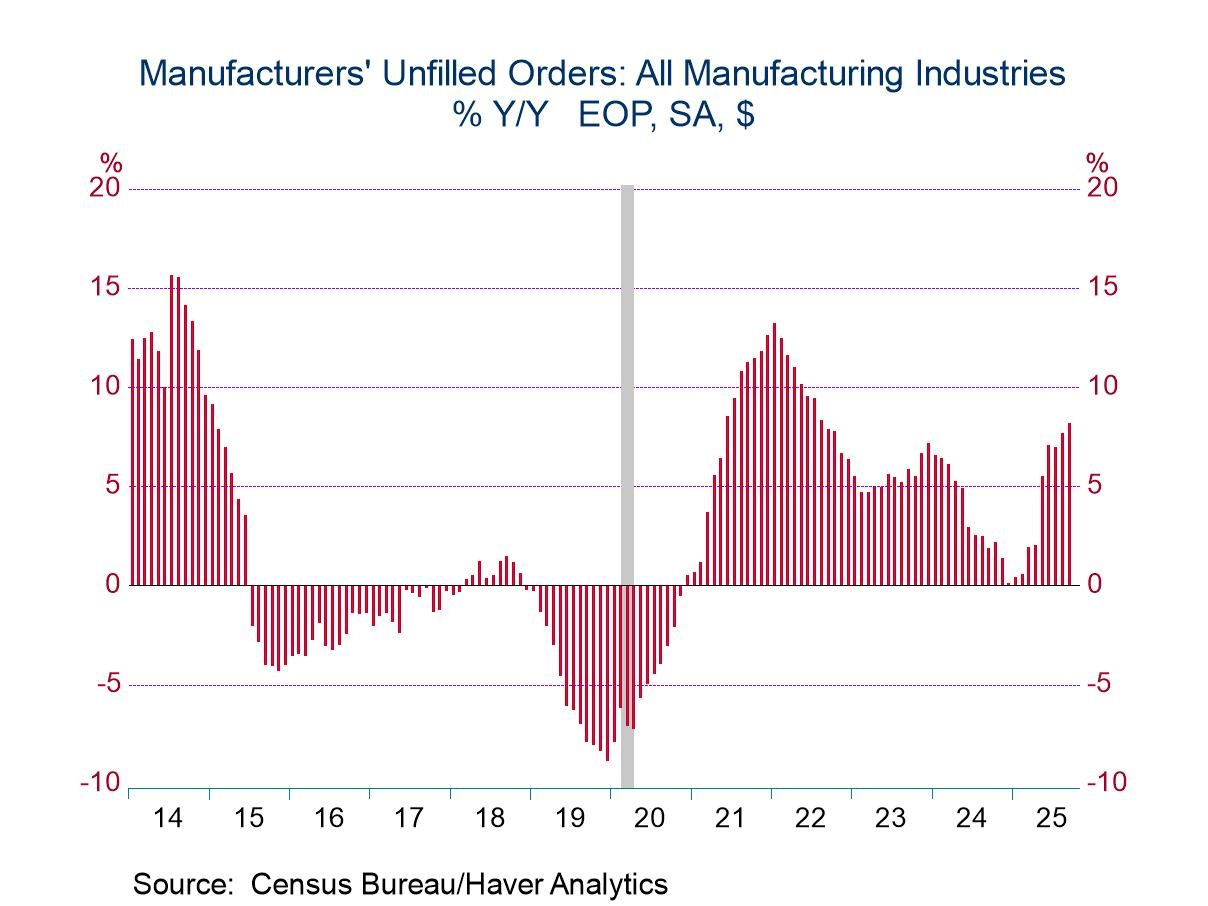
Unfilled durable goods orders increased 0.7% (8.2% y/y) in September for the second month in a row. Excluding a 1.0% increase in transportation, unfilled orders increased a steady 0.2% (0.9% y/y). Unfilled machinery orders edged 0.1% higher (-0.2% y/y) following a 0.5% rise. Unfilled orders for computers & electronic products eased 0.1% (-0.9% y/y) for the second straight month. Unfilled orders for electrical equipment & appliances rose 0.6% (2.1% y/y) after a 0.2% rise. Unfilled orders for furniture rose 0.2% (1.3% y/y) after rising 0.4% in August.
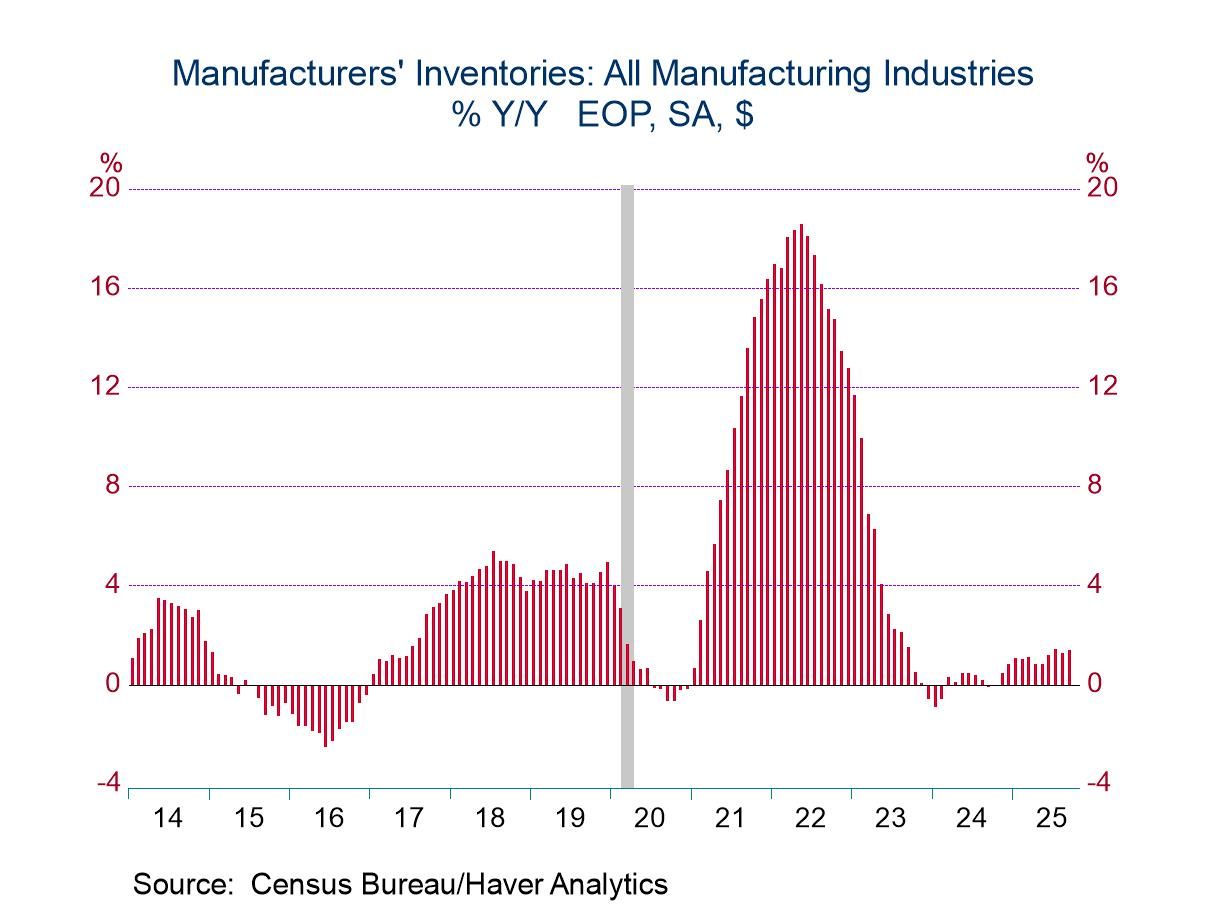
Total factory sector inventories slipped 0.1% (+1.4% y/y) for the second consecutive month. Excluding transportation, inventories rose 0.1% (1.5% y/y) also for a second month. Durable goods inventories slipped 0.1% (+1.9% y/y) for the second consecutive month. Machinery inventories rose 0.4% (3.2% y/y) after easing 0.1%. Computer & electronic product inventories rose 0.2% (1.0% y/y) after gaining 0.1%. Electrical equipment & appliance inventories rose 0.2% (2.8% y/y), the same as in August.
Nondurable goods inventories eased 0.1% (+0.5% y/y) after holding steady in August. Food product inventories eased 0.2% (-1.6% y/y) for a second month. Textile product inventories rose 0.3% (3.2% y/y) following a 0.4% rise. Apparel inventories rose 0.7% (-0.8% y/y) after rising 0.3%. Paper product inventories rose 0.3% (3.2% y/y) following a 0.4% gain. Chemical product inventories eased 0.1% (+1.1% y/y) after holding steady in August while petroleum inventories held steady (-0.5% y/y) after rising 0.3%.
The factory sector data are available in Haver’s USECON database. The Action Economics Forecast Survey is in the AS1REPNA database.

Tom Moeller
AuthorMore in Author Profile »Prior to joining Haver Analytics in 2000, Mr. Moeller worked as the Economist at Chancellor Capital Management from 1985 to 1999. There, he developed comprehensive economic forecasts and interpreted economic data for equity and fixed income portfolio managers. Also at Chancellor, Mr. Moeller worked as an equity analyst and was responsible for researching and rating companies in the economically sensitive automobile and housing industries for investment in Chancellor’s equity portfolio. Prior to joining Chancellor, Mr. Moeller was an Economist at Citibank from 1979 to 1984. He also analyzed pricing behavior in the metals industry for the Council on Wage and Price Stability in Washington, D.C. In 1999, Mr. Moeller received the award for most accurate forecast from the Forecasters' Club of New York. From 1990 to 1992 he was President of the New York Association for Business Economists. Mr. Moeller earned an M.B.A. in Finance from Fordham University, where he graduated in 1987. He holds a Bachelor of Arts in Economics from George Washington University.
More Economy in Brief
 Global