U.S. Energy Prices Are Mixed in Latest Week
by:Tom Moeller
|in:Economy in Brief
Summary
- Gasoline prices fall week-to-week.
- Crude oil prices decline for fourth straight week.
- Natural gas prices move to highest level since February.
- Demand for gasoline & all petroleum products is little changed y/y.
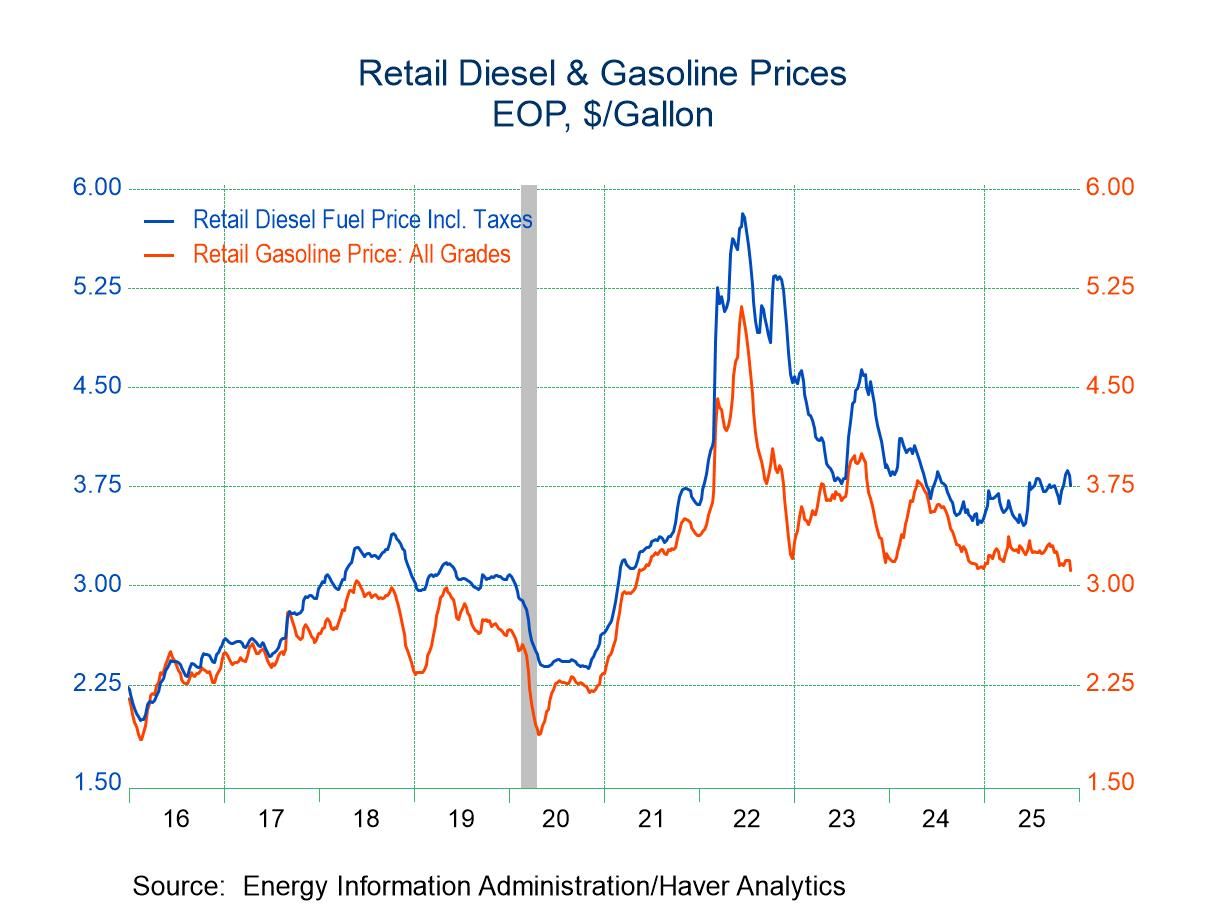
Retail gasoline prices for all grades declined to an average $3.12 per gallon (-1.3% y/y) in the week ended December 1 after holding at $3.19 per gallon for three straight weeks. The recent high was $3.79 in the week ending April 22, 2024. Their all-time high of $5.11 occurred in the week ending June 13, 2022. Haver Analytics seasonally adjusts the retail price of regular grade gasoline. That price declined to $3.17 last week after increasing to $3.21 in the previous week. Diesel fuel prices fell to $3.76 per gallon last week (+6.2% y/y) after falling to $3.83 per gallon in the prior week.
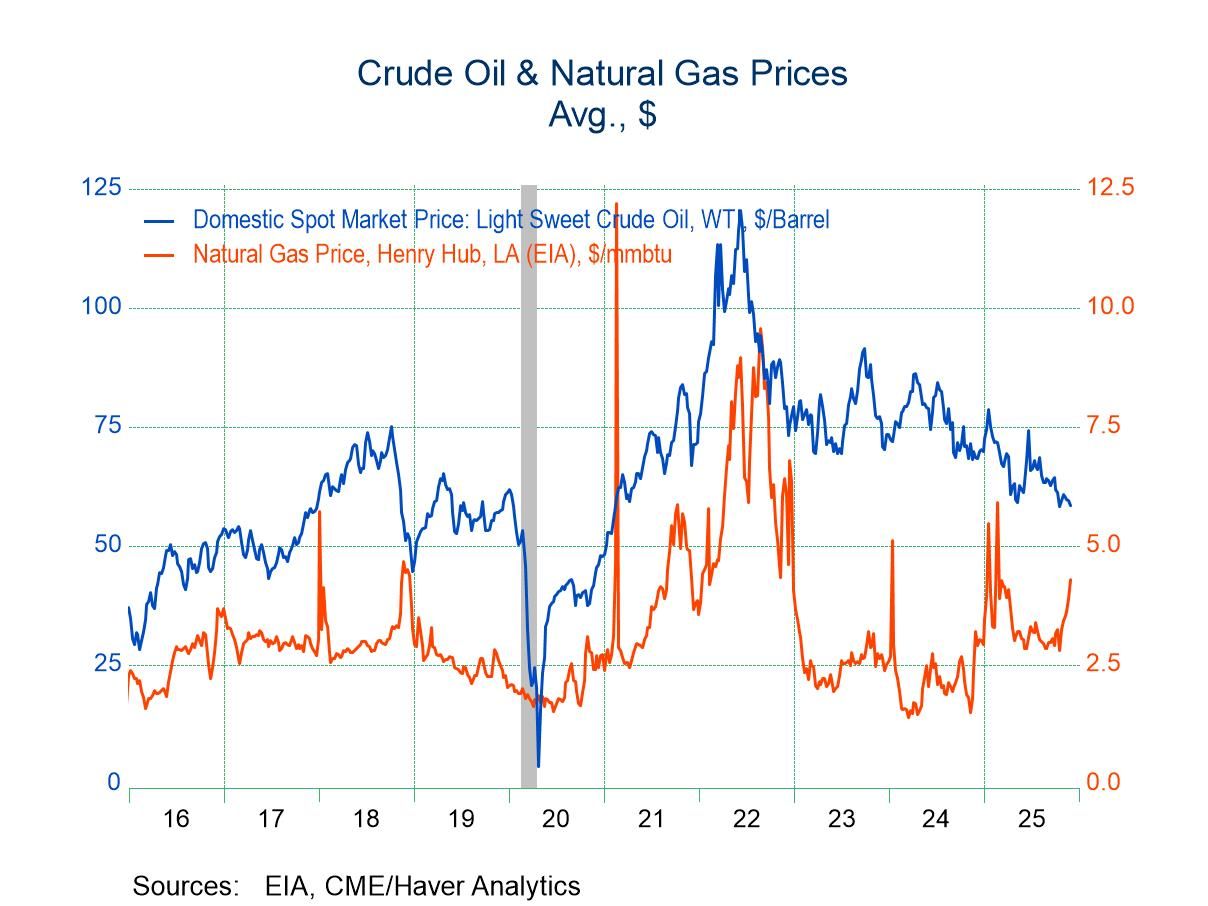
The price of West Texas Intermediate crude oil fell to an average $58.50 per barrel (-14.7% y/y) in the week ended November 28 after easing to $59.46 per barrel in the prior week. At a six-week low, prices remained under recent high of $74.17 during the third week of June. The cost of crude oil peaked at $120.46 in the week of June 10, 2022. Yesterday, the price was $59.32 per barrel. The price of European Brent crude edged higher to $64.27 per barrel (-13.3% y/y) in the week of November 28 after rising to $63.64 in the prior week. Prices remained below a recent high of $95.61 in the week of September 29, 2023 and below a peak of $127.40 in June 2022. Yesterday, the price was $64.22 per barrel.
Natural gas prices strengthened to an average $4.29/mmbtu (34.5% y/y) in the week ended November 28 after rising to $3.89/mmbtu in the prior week. The increase left prices at the highest level since the third week of February and well above the low of $1.40/mmbtu in the week of March 15, 2024. Yesterday, the price was $5.08/mmbtu.
Gasoline demand edged 0.1% higher y/y in the four weeks ending November 21, after falling 1.2% y/y in the prior four weeks. Demand for all petroleum products held steady y/y in the four weeks ending November 21, after easing 0.2% y/y in the previous four-week period. Crude oil input to refineries declined 2.2% y/y in the four weeks ending November 21, after falling 3.8% y/y in the prior four weeks.
Gasoline inventories fell 1.1% y/y in the week ending November 21 following a 0.7% y/y decline in the prior week. Residual fuel oil inventories fell 1.3% y/y in the November 21 week after falling 1.7% y/y in the prior week. Working higher, crude oil inventories rose 2.4% y/y in the week of November 21 after increasing 1.9% y/y in the previous week.
Measured in days’ supply, gasoline inventories rose to 23.9 days in the week of November 21 from 23.5 days in the prior week. The recent low was 22.9 days in the week of November 7, 2024. The supply of crude oil eased w/w to 26.7 days in the week of November 21 from 27.1 days in the prior week. The supply remained below a recent high of 31.9 days in the week of March 3, 2023.
These data are reported by the Energy Information Administration of the U.S. Department of Energy. The price and supply/demand data can be found in Haver’s WEEKLY and USENERGY databases.
Supervision & Regulation is the title of today’s testimony by Fed Vice Chair for Supervision Michelle W. Bowman and it is available here.

Tom Moeller
AuthorMore in Author Profile »Prior to joining Haver Analytics in 2000, Mr. Moeller worked as the Economist at Chancellor Capital Management from 1985 to 1999. There, he developed comprehensive economic forecasts and interpreted economic data for equity and fixed income portfolio managers. Also at Chancellor, Mr. Moeller worked as an equity analyst and was responsible for researching and rating companies in the economically sensitive automobile and housing industries for investment in Chancellor’s equity portfolio. Prior to joining Chancellor, Mr. Moeller was an Economist at Citibank from 1979 to 1984. He also analyzed pricing behavior in the metals industry for the Council on Wage and Price Stability in Washington, D.C. In 1999, Mr. Moeller received the award for most accurate forecast from the Forecasters' Club of New York. From 1990 to 1992 he was President of the New York Association for Business Economists. Mr. Moeller earned an M.B.A. in Finance from Fordham University, where he graduated in 1987. He holds a Bachelor of Arts in Economics from George Washington University.
More Economy in Brief
 Global