U.S. Consumer Confidence Continues Downtrend in July
by:Sandy Batten
|in:Economy in Brief
Summary
- The Conference Board’s measure of consumer confidence fell to 90.8 in July from 92.2 in June, continuing its downtrend since early last year.
- The Present Situation index fell to 114.9, its lowest reading since February 2021. The Expectations index was unchanged at 74.7.
- Inflation expectations one year ahead fell to 4.5% in July from 4.9%.
- The labor market differential fell to 3.1% in July, its lowest level since February 2021, from 3.8%, pointing to further softening of labor market conditions.
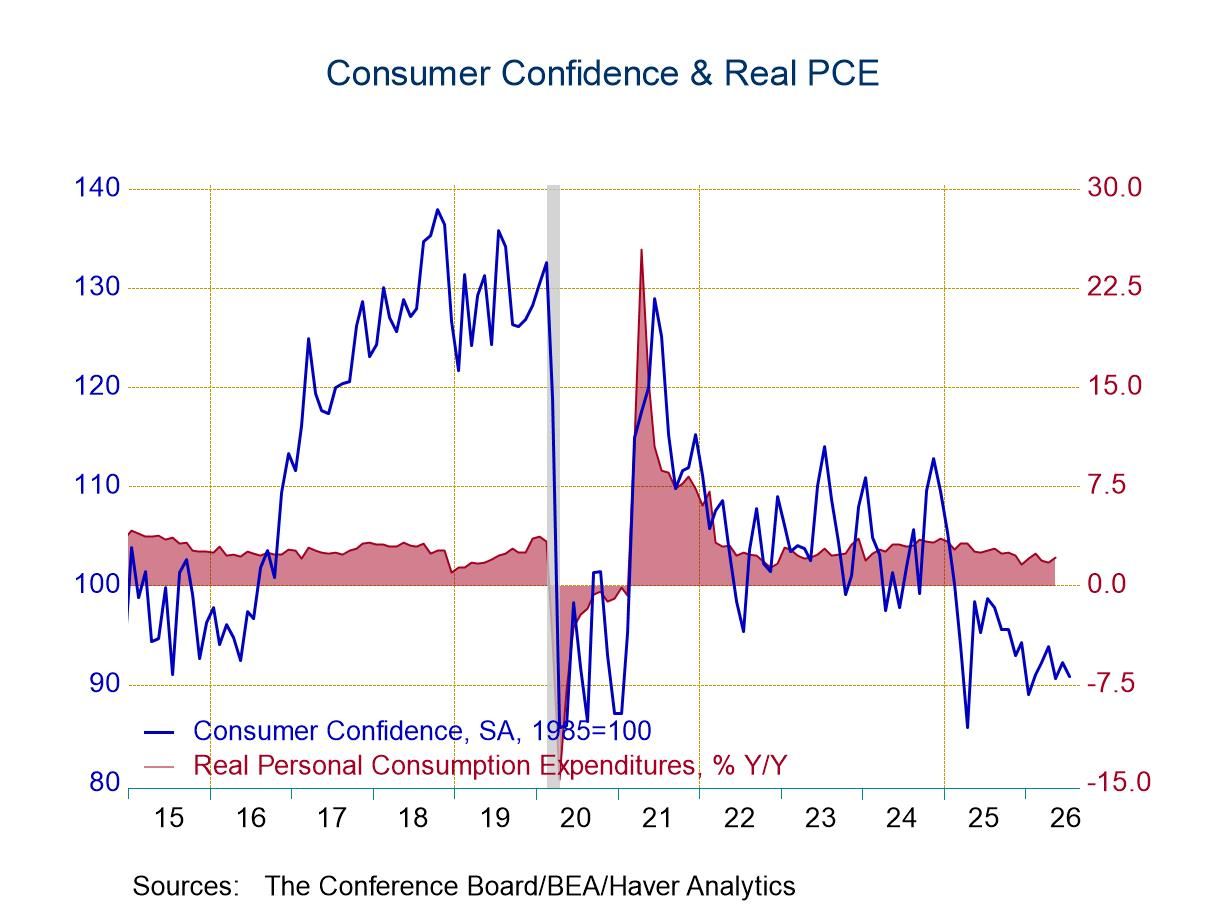
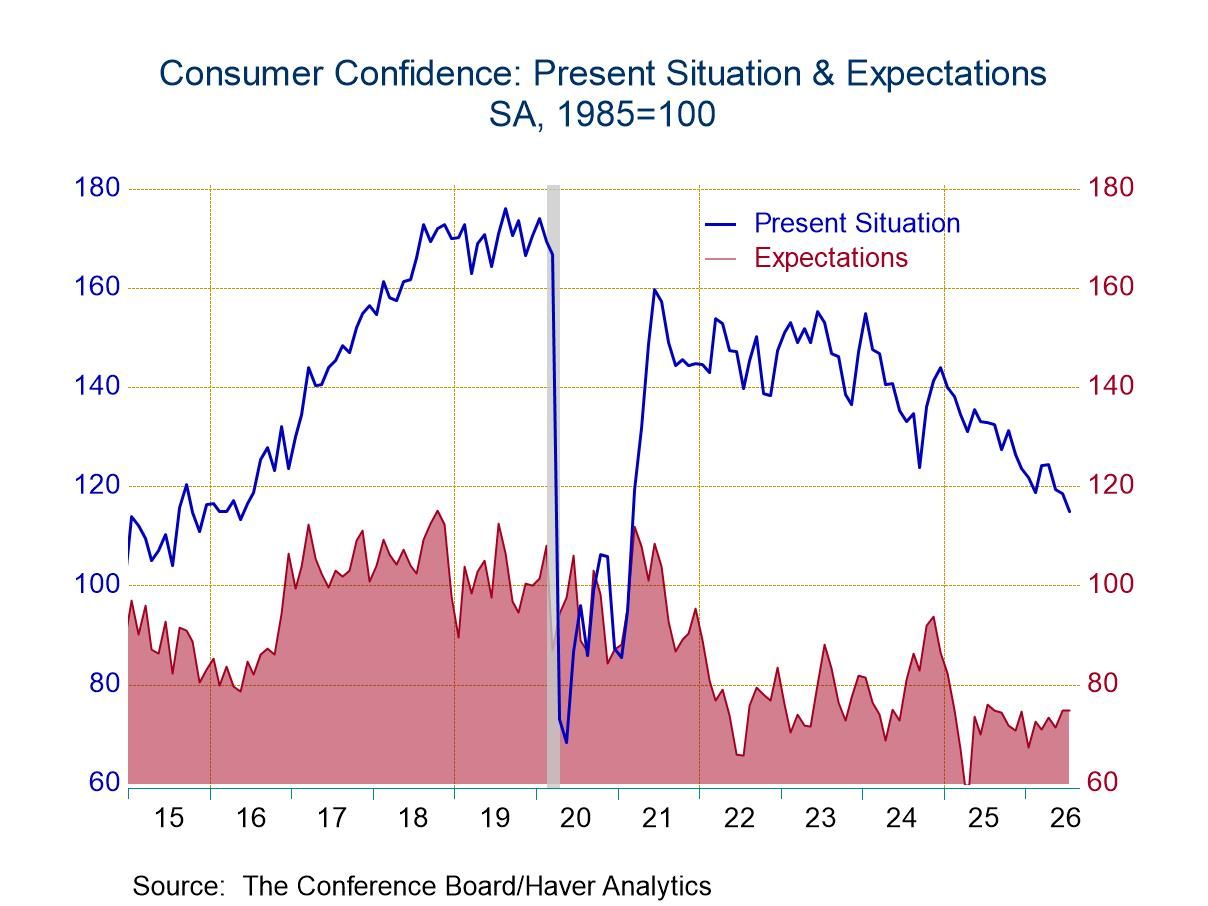
The Conference Board’s index of Consumer Confidence fell 1.4 points to 90.8 in July from an upwardly revised 92.2 in June (previously 91.2). The overall index has generally trended down from a reading of 112.8 in November 2024. The Action Economics Forecast Survey looked for a reading of 92.3 in July. The July decline was due entirely to a gloomier view of present conditions. The Present Situation index fell to 114.9 in July from 118.5 in June, the third consecutive monthly decline and the lowest reading since February 2021. By contrast, the Expectations index was unchanged at 74.7. The survey period for today’s report was July 1-22.
The pessimism over the state of the economy was markedly larger in the under 35 years age group with confidence dropping to 100.7 in July, the lowest reading since January 2021, from 114.1 in June. Confidence also fell in the over 55 years age group, but by much less, slipping to 76.8 from 79.7. By contrast, confidence in the 35-55 years age group jumped up to 97.6 from 90.4 in June, the highest reading since last October.
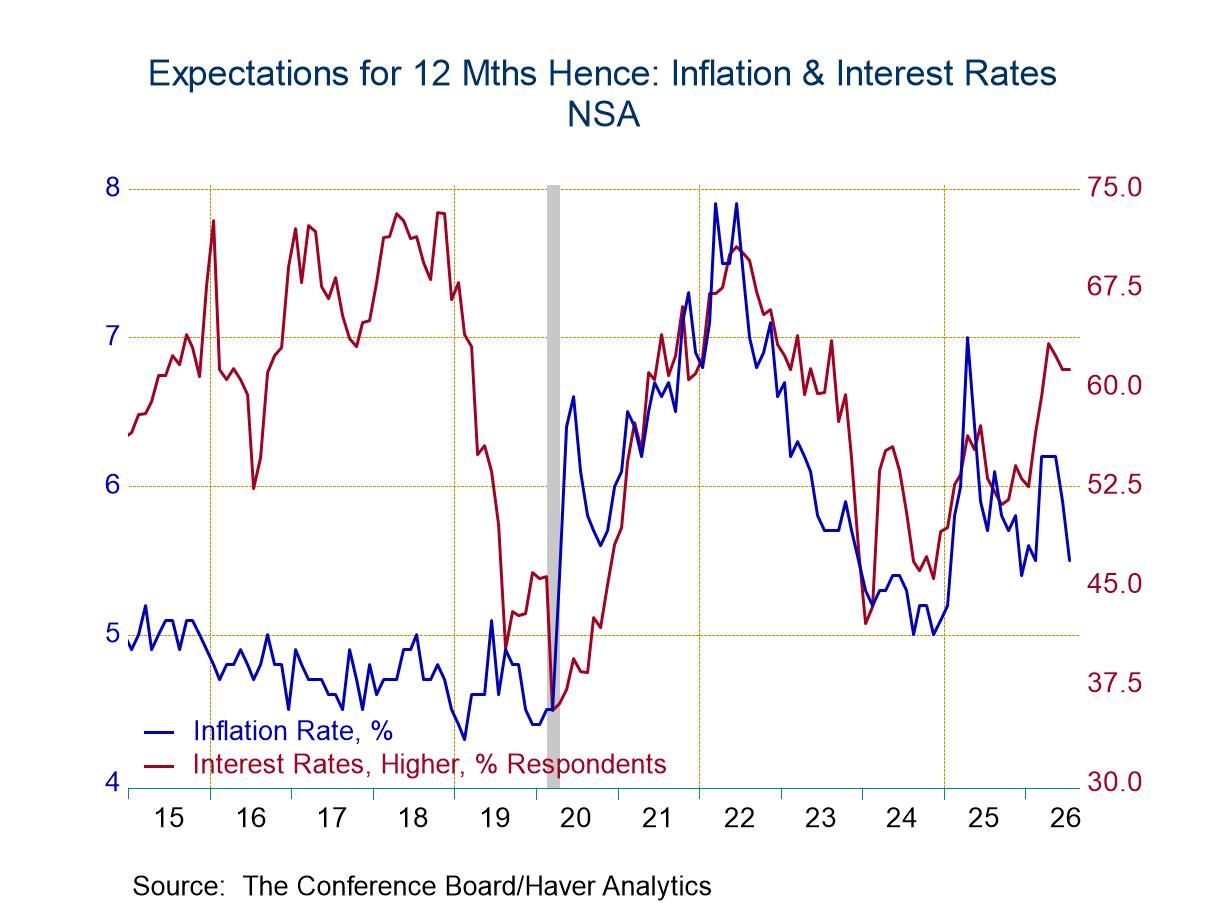
Notwithstanding the breakdown of the Memorandum of Understanding between the US and Iran during July, inflation expectations for the year ahead fell for the third consecutive month to 4.5% in July from 4.9% in June and 5.3% in April, which had reflected the initial escalation of the US-Iran conflict. Inflation expectations had soared to a recent high of 5.9% in April 2025 after significant tariff increases were announced. Prior to the pandemic, inflation expectations were generally around 4%.
Assessment of labor market conditions softened further in July as indicated by a further decline in the labor market differential (the percentage of respondents who think that jobs are plentiful minus the percentage who think that jobs are hard to get). Respondents still have a slightly favorable view of the labor market as the percentage thinking jobs are plentiful (24.6%) still exceeds the percentage thinking that jobs are hard to get (21.5%). However, that differential slumped to 3.1% in July from 3.8% in June and 5.0% in May. This was the lowest reading since February 2021. The correlation between the labor market differential and the BLS’s unemployment rate over the past 15 years has been -0.78. Thus, the recent decline in the labor market differential points to increases in the overall unemployment rate.
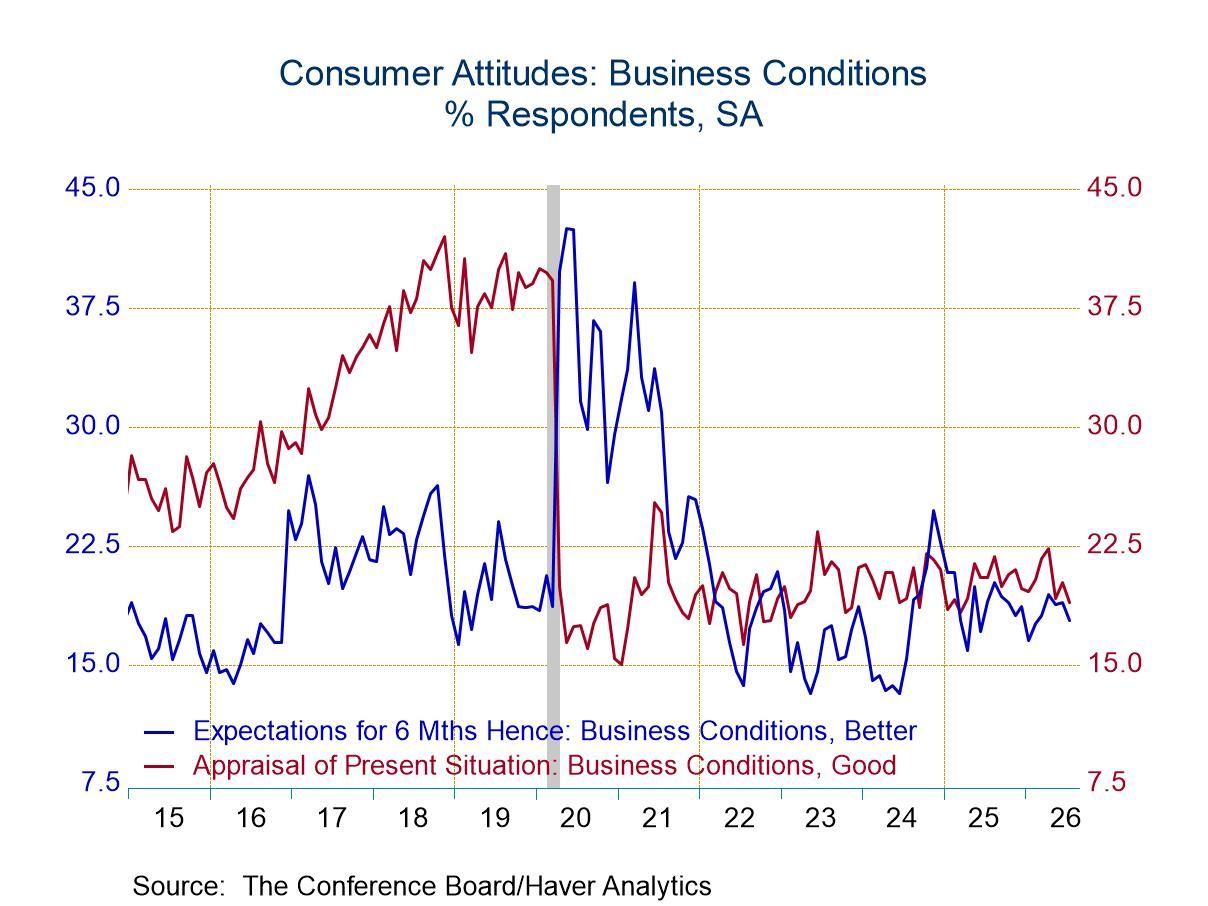
Respondents generally felt that business conditions had deteriorated in July with the percentage considering conditions to be good falling to 18.9% from 20.2% in June while the percentage considering conditions to be bad increasing to 17.8% from 16.5% in June. Furthermore, the respondents expressed similar feelings about the coming six months with the percentage expecting business conditions to improve falling to 17.8% from 18.9% in June while the percentage expecting conditions to worsen rose to 21.1% from 20.7%.
The Consumer Confidence data are available in Haver’s CBDB database. The total indexes, which are indexed to 1985=100, appear in USECON, and market expectations are in AS1REPNA.

Sandy Batten
AuthorMore in Author Profile »Sandy Batten has more than 30 years of experience analyzing industrial economies and financial markets and a wide range of experience across the financial services sector, government, and academia. Before joining Haver Analytics, Sandy was a Vice President and Senior Economist at Citibank; Senior Credit Market Analyst at CDC Investment Management, Managing Director at Bear Stearns, and Executive Director at JPMorgan. In 2008, Sandy was named the most accurate US forecaster by the National Association for Business Economics. He is a member of the New York Forecasters Club, NABE, and the American Economic Association. Prior to his time in the financial services sector, Sandy was a Research Officer at the Federal Reserve Bank of St. Louis, Senior Staff Economist on the President’s Council of Economic Advisors, Deputy Assistant Secretary for Economic Policy at the US Treasury, and Economist at the International Monetary Fund. Sandy has taught economics at St. Louis University, Denison University, and Muskingun College. He has published numerous peer-reviewed articles in a wide range of academic publications. He has a B.A. in economics from the University of Richmond and a M.A. and Ph.D. in economics from The Ohio State University.
More Economy in Brief
 Global