U.S. ADP Employment Declines in November
by:Tom Moeller
|in:Economy in Brief
Summary
- Drop in private payrolls is third in four months.
- Hiring shortfall is led by small business.
- Both service-sector & factory jobs decline.
- Wage growth decelerates.
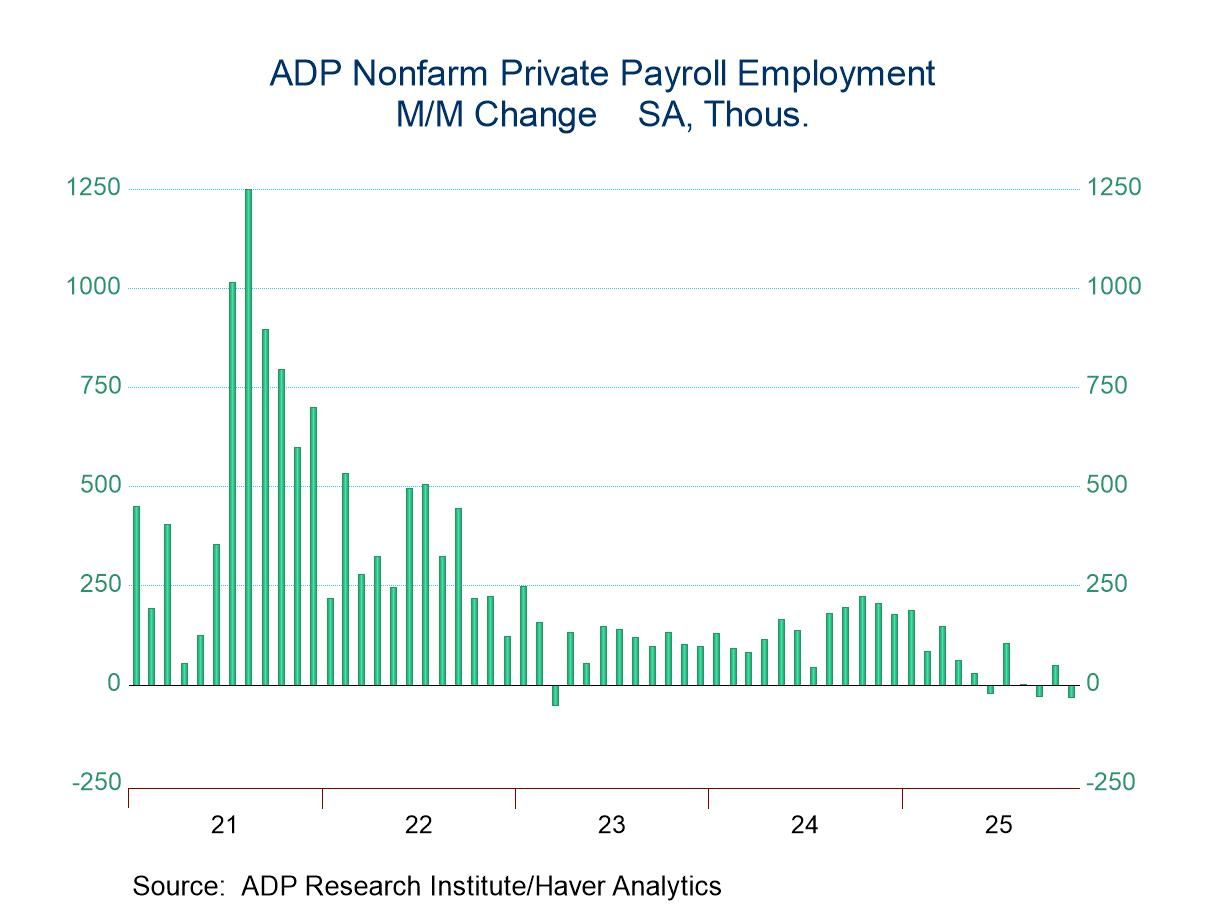
The ADP National Employment Report indicated that nonfarm private sector payrolls during November declined 32,000 (+0.6% y/y) after increasing 47,000 in October, revised from 42,000, following an unrevised 29,000 September decline. The three-month average change of -5,000 compares to +24,000 in Q3’25, 22,000 in Q2 and 139,000 in Q1. The Action Economics Forecast Survey expected a 10,000 increase in November.
Small business hiring (less than 50 employees) declined 120,000 (-0.2% y/y) after weakening 24,000 in October, revised from down 10,000. It was the largest of four consecutive monthly declines. Employment at medium-sized firms (50-499 employees) increased 51,000 (0.7% y/y) after declining 25,000 in October, revised from -22,000, following a 30,000 September shortfall. Large business hiring (500+ employees) rose 39,000 ( 2.1% y/y) last month after a little-revised 73,000 October increase and a 31,000 September rise.
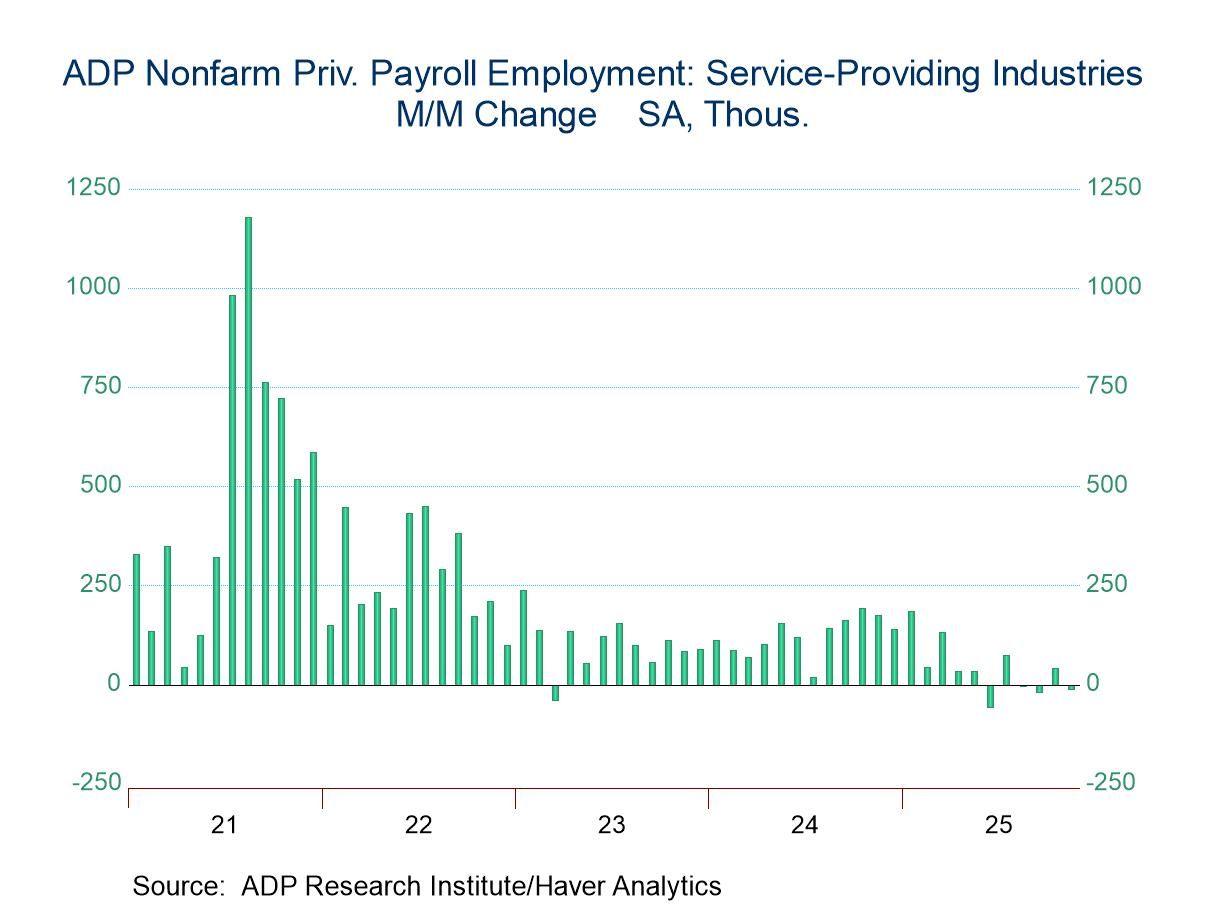
Service-producing jobs declined 12,000 (+0.5% y/y) after increasing 41,000 in October. Changes amongst industry sectors were mixed last month. Information sector employment declined 20,000 (-0.9% y/y) after falling 18,000. Professional & business sector hiring weakened 26,000 (-0.0% y/y), the largest of four straight declines. Financial activities employment fell 9,000 (+1.7% y/y) following a 10,000 increase in October. Hiring in “other” industries weakened 4,000 (+0.4% y/y), down for the fourth straight month. To the upside, education & health services rose 33,000 (0.1% y/y) after increasing 26,000 in October. Leisure & hospitality employment improved 13,000 (1.8% y/y) after falling 8,000 in October. Trade, transportation & utilities employment edged 1,000 higher (0.4% y/y) after rising 66,000.
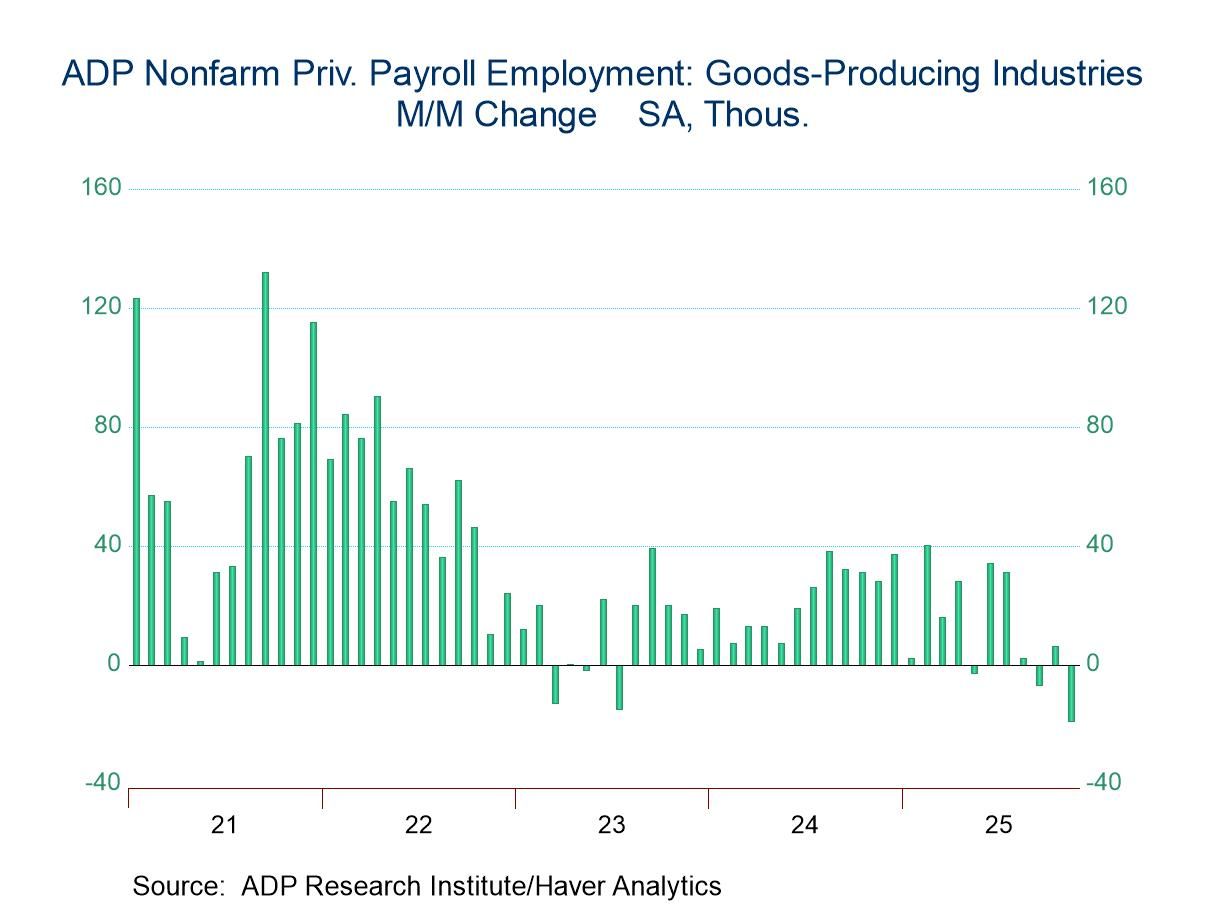
Goods-producing employment weakened 19,000 (+0.7% y/y) in November, following a 6,000 increase, revised from 9,000. Manufacturing jobs fell 18,000 (+0.1% y/y) following a 4,000 decrease. Construction jobs fell 9,000 (+1.3% y/y) after rising 4,000. Natural resources and mining jobs increased 8,000 (2.8% y/y) after increasing 6,000 in October.
By region, the number of jobs fell 99,000 (+0.2% y/y) in the Northeast in November after falling 17,000 in October. In the South, employment fell 44,000 (+0.4% y/y) following a 5,000 October increase. Working higher, the number of jobs in the Midwest rose 45,000 (0.8% y/y) last month after increasing 16,000 in October. In the West, employment improved 67,000 (0.7% y/y) following a 34,000 increase.
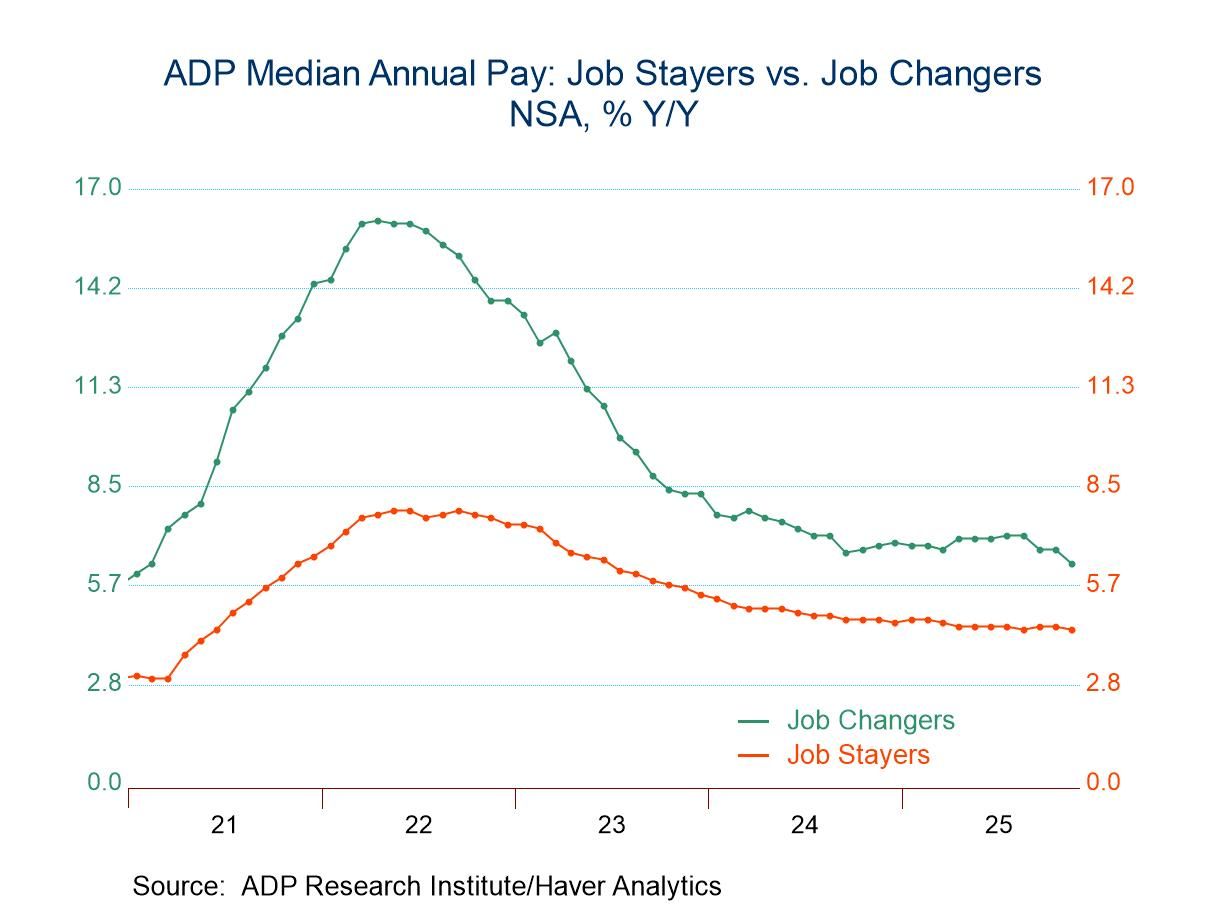
Wage growth for job-changers in November decelerated to 6.3% y/y from 6.7% in October, and stayed well below a high of 16.1% in April 2022. Wage growth for job-stayers eased to 4.4% y/y from 4.5% in October and remained the slowest increase since June 2021. Financial activities pay growth held steady at 5.2%. In manufacturing, earnings growth remained at 4.8% while in leisure & hospitality, it slowed to 4.5%. Education & health services pay decelerated to 4.3% y/y.
The ADP National Employment Report and Pay Insights data can be found in Haver's USECON database. Historical figures date back to January 2010 for private employment. Pay data date back to October 2020. The expectation figure is available in Haver's AS1REPNA database.

Tom Moeller
AuthorMore in Author Profile »Prior to joining Haver Analytics in 2000, Mr. Moeller worked as the Economist at Chancellor Capital Management from 1985 to 1999. There, he developed comprehensive economic forecasts and interpreted economic data for equity and fixed income portfolio managers. Also at Chancellor, Mr. Moeller worked as an equity analyst and was responsible for researching and rating companies in the economically sensitive automobile and housing industries for investment in Chancellor’s equity portfolio. Prior to joining Chancellor, Mr. Moeller was an Economist at Citibank from 1979 to 1984. He also analyzed pricing behavior in the metals industry for the Council on Wage and Price Stability in Washington, D.C. In 1999, Mr. Moeller received the award for most accurate forecast from the Forecasters' Club of New York. From 1990 to 1992 he was President of the New York Association for Business Economists. Mr. Moeller earned an M.B.A. in Finance from Fordham University, where he graduated in 1987. He holds a Bachelor of Arts in Economics from George Washington University.
More Economy in Brief
 Global