U.K. Retail Sales Come Up Lame in September
BOE Decision to Hold Rates in the Face of Inflation Seems Prescient While inflation continued to be a problem as the Bank of England had its last policy meeting, the BOE decided to hold the line on the policy rate despite a slightly worse inflation report than expected just prior to the meeting of the central bank committee. One reason was that inflation, which was flaring because of pressure on oil prices, had not been spreading in the economy. The BOE didn't see a reason to raise interest rates to stop a spread that wasn't occurring, and the MPC knew there was no reason to raise interest rates to roll back oil prices because interest rates would have no effect on oil prices, which were rising globally for completely different reasons.
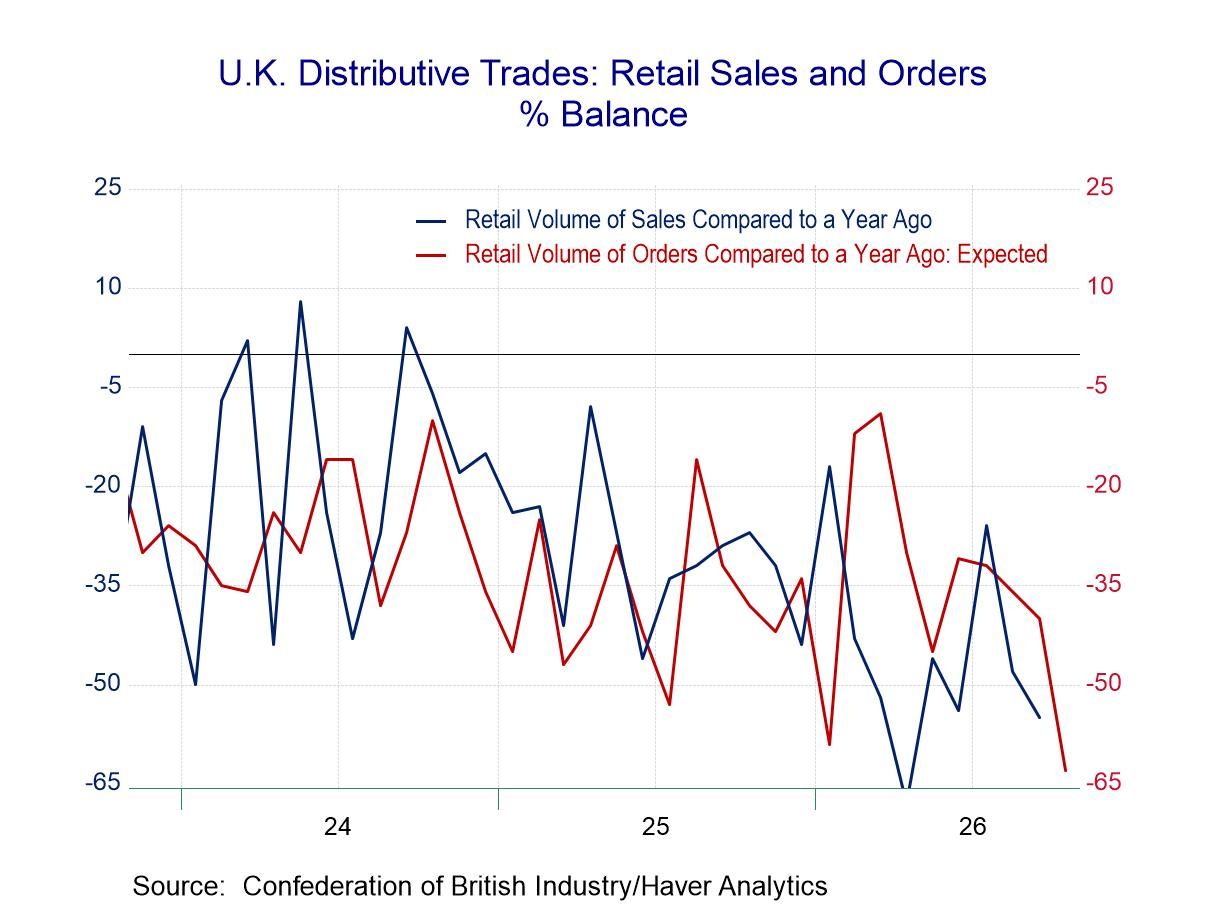
The decision to hold off on interest rates is certainly further justified as the CBI retail sales report for September shows a worsening in sales compared to a year ago, a worsening in orders, a worsening of sales for time of year, and a small pickup in the level of stocks that is arguably involuntary.
The changes on the month are in fact severe, and not technical, with sales compared to a year ago falling to -55 in September from -48 in August, while orders compared to a year ago posted a net reading of -62, down from -29, more than doubling their previous negative value. Sales for the time of year also fell severely to a net reading of -40 in September from -26 in August. These are massive changes in already negative numbers on a monthly basis.
The percentile standings for these values are also extremely low. Orders compared to a year ago are at the lowest value seen in data since December 2001. Sales compared to a year ago have been weaker only 1% of the time. Sales compared to what they normally do this time of year have a 4.4 percentile standing; they are weaker, less than 5% of the time. While the inventory number crawled higher, it has a 21.1 percentile standing. None of these figures inspire any confidence as to the shape of the consumer. And the outlook doesn’t get better either.
A survey of expectations also shows severe deterioration, not just deterioration, for October compared to September. Sales, compared to a year ago, dropped to a net value of -37 in October from -22 in September, carving out a 6.4 percentile standing, another extremely weak standing, this time for expected sales. Orders compared to a year ago logged a reading of -63 in October compared to -40 in September; this is another very sharp deterioration in view of severe weakness the month before. It’s another all-time low for the reading on data since December 2001. Sales for the time of year weakened to a reading of -39 in October from -29 in September, creating a 4.3 percentile standing, yet another bottom 5% standing, this time for expected sales for the time of year.
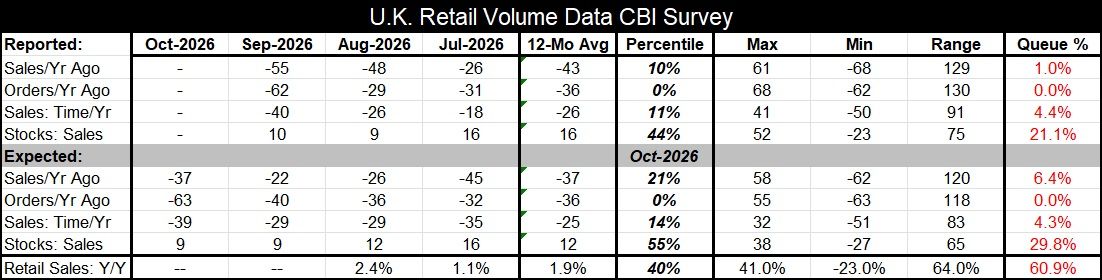
There was nothing redeeming in this survey. There was nothing that put these data in a different context or that made them look better. These are simply extremely weak readings, with two readings that are the weakest we've seen over the comparative timeline.
The U.K. economy is undergoing a number of different stresses. Inflation is one of them; a severely constrained budget is another because the deficit is already large. The debt-to-GDP ratio is high; that’s another one of them. So, the options for stimulating the economy are few. In this environment and particularly with the economic area around the U.K. also weak, there is little to fire up the economy, and the data now strongly suggest that the reason we are not getting knock-on effects from the increase in energy prices is because the economy is simply too weak to generate knock-on effects.
This is certainly one of the issues that the Bank of England has been considering as it met and looked at economic conditions. Three of the Monetary Policy Committee members had wanted to raise rates because they were concerned about the fact that inflation was too high and not falling. But the committee opted to hold its fire because there had been no spread of oil inflation, and certainly the report today shows retail sales volumes are weak and are expected to remain very weak. That observation suggests that this was the right judgment to make, at least for now, because the consumer appears to be quite weakened and on the ropes.

Robert Brusca
AuthorMore in Author Profile »Robert A. Brusca is Chief Economist of Fact and Opinion Economics, a consulting firm he founded in Manhattan. He has been an economist on Wall Street for over 25 years. He has visited central banking and large institutional clients in over 30 countries in his career as an economist. Mr. Brusca was a Divisional Research Chief at the Federal Reserve Bank of NY (Chief of the International Financial markets Division), a Fed Watcher at Irving Trust and Chief Economist at Nikko Securities International. He is widely quoted and appears in various media. Mr. Brusca holds an MA and Ph.D. in economics from Michigan State University and a BA in Economics from the University of Michigan. His research pursues his strong interests in non aligned policy economics as well as international economics. FAO Economics’ research targets investors to assist them in making better investment decisions in stocks, bonds and in a variety of international assets. The company does not manage money and has no conflicts in giving economic advice.
 Global