Global| Sep 23 2026
S&P PMIs Five of Seven Early Reporters Show Stronger Output in September
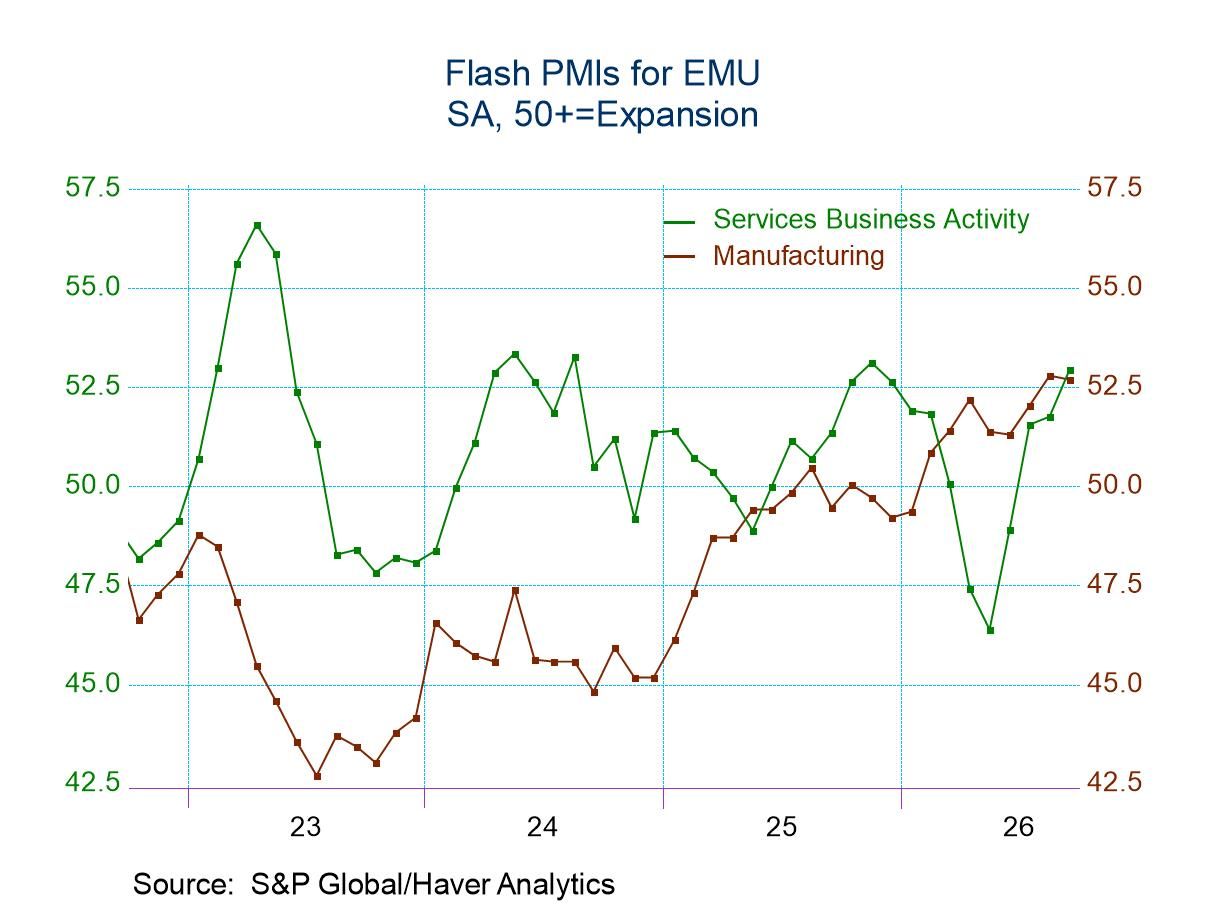
Japan, a usual early reporter, has not reported early this month. But among the seven reporters, five show improved monthly performance in September compared to August. The United Kingdom and Australia are weaker on the month. The euro area, Germany, France, India, and the United States are better on the month. Four of seven reporters show queue standings for monthly readings that are above their averages of the past 4½ years. The U.S. composite queue standing is exceptionally strong, with an 89.7 percentile standing for its composite index in September.
Ironically, India, which has the lowest queue-ranking index, has the second highest diffusion reading among the September reporters, at 56.5. It is second only to the U.S. at 58.4. That result for India simply underscores how well India’s economy has done over the past 4½ years compared to everyone else. To flesh that out, over the past 4½ years India’s composite average has been 58.1; the U.S., 53.6; the U.K., 52.4; the euro area, 51.3; Australia, 51.1; Germany, 50.9; and France, 49.9. France is the only reporter in the table to have averaged a composite index that shows a net decline over the whole period.
These average rankings give you some idea of how weak the past 4½ year period has been. Both Germany and France also log manufacturing readings below 50, indicating manufacturing sector contraction on average. In the euro area, the average reading was 50.9—above breakeven of 50 but by less than one diffusion point—obviously weighed down by France and Germany. Australia is the only country that has an average services reading weaker than its manufacturing reading for the full period.
Sequentially, the manufacturing data are improving from 12 months to six months to three months. Services are close to that same phenomenon but on relatively flat numbers. Over the past three months, the composite index, manufacturing, and services are all steadily progressing higher when a simple average of the seven responses is collected. There are three sectors and seven countries sketching out 21 comparisons each month. August and September each have eight weaker responses out of 21, while July had only three responses of ‘weaker’ out of 21.
The queue standings, which rank the current index levels across sectors for the last 4½ years, show 14 of 21 readings above their respective means, that is, with a standing of over 50%. India’s standing is the weakest with all readings below 50%, but that is much more a statement about past strength than about current weakness. The U.K. and Australia each have two sectors below 50% in standing. For Australia, it is the composite and manufacturing; for the U.K., it is the composite and services. However, for all countries, manufacturing performance in September is worse than it was in January 2021.
As of September, there is still a good deal of manufacturing weakness in play, with four of seven early reporters showing manufacturing weaker monthly in September. Only the U.K. and Australia have weaker service sectors month-to-month.
On balance, the S&P PMI readings show that the global economy is still getting stronger despite inflation, rate hikes, and challenges posed by war and geopolitical tensions. However, we should not assume that progress will continue apace. To some extent growth has been maintained by running down stocks of scarce goods, and some stocks of needed items may now be low. Winter is coming, and with it will come the demand for a winter energy source. It is no time to get complacent.

Robert Brusca
AuthorMore in Author Profile »Robert A. Brusca is Chief Economist of Fact and Opinion Economics, a consulting firm he founded in Manhattan. He has been an economist on Wall Street for over 25 years. He has visited central banking and large institutional clients in over 30 countries in his career as an economist. Mr. Brusca was a Divisional Research Chief at the Federal Reserve Bank of NY (Chief of the International Financial markets Division), a Fed Watcher at Irving Trust and Chief Economist at Nikko Securities International. He is widely quoted and appears in various media. Mr. Brusca holds an MA and Ph.D. in economics from Michigan State University and a BA in Economics from the University of Michigan. His research pursues his strong interests in non aligned policy economics as well as international economics. FAO Economics’ research targets investors to assist them in making better investment decisions in stocks, bonds and in a variety of international assets. The company does not manage money and has no conflicts in giving economic advice.
More Economy in Brief
U.K. Housing Surveys and Consumer Sentiment Support the View of Weak Growth