U.K. Housing Surveys and Consumer Sentiment Support the View of Weak Growth
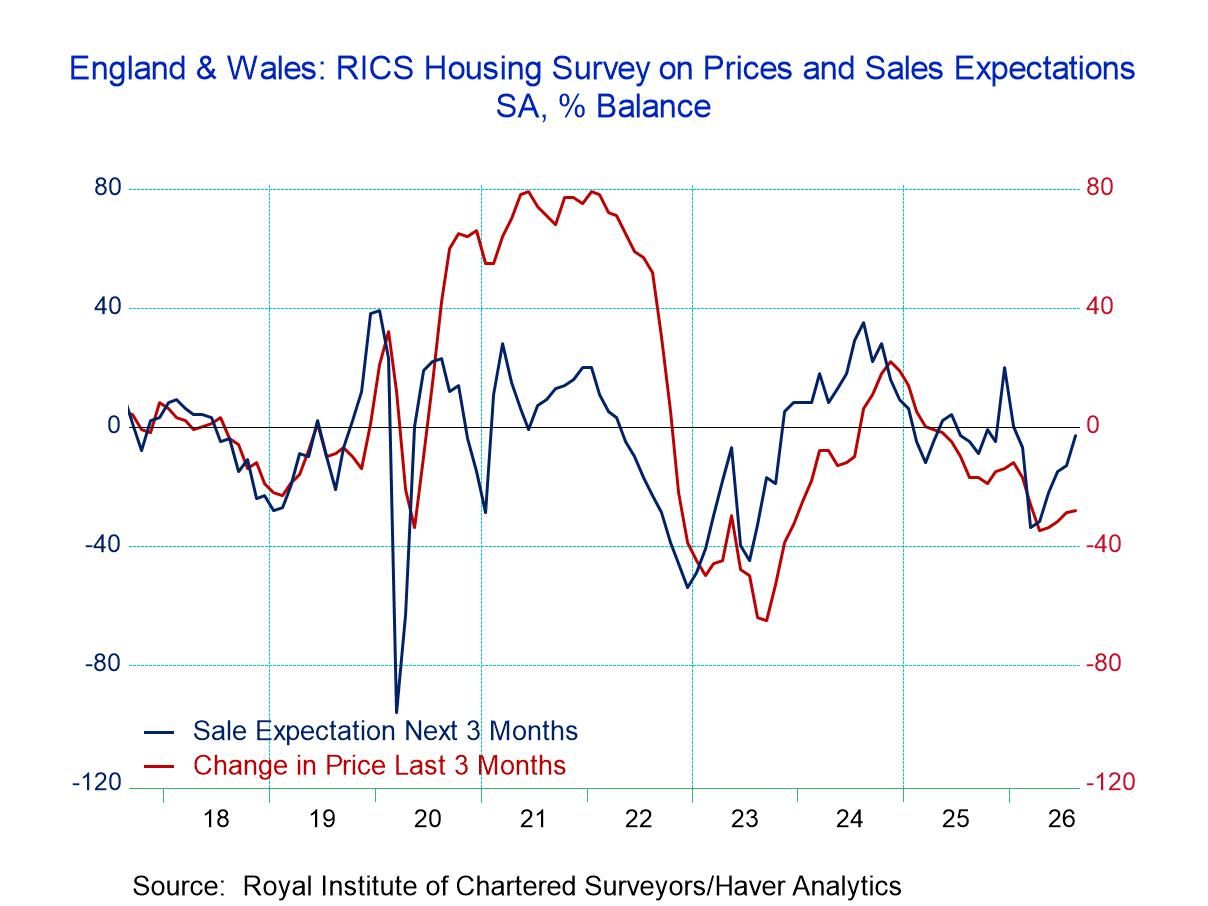
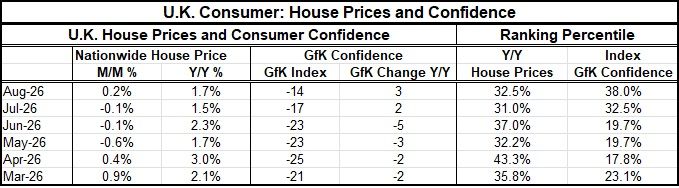
The exhibits in this report feature a graph based on the RICS survey showing U.K. sales expectations for the next three months versus the last three months, while tabular data show Nationwide housing prices and how they are moving month-to-month as well as year-over-year. In addition, the table provides the recent GfK survey results on consumer confidence in the U.K. and presents rankings of housing prices and consumer confidence.
These statistics paint a somewhat mixed picture of the U.K. economy although clearly they paint a picture of an economy that is not firing on all cylinders. The ranking on year-over-year house price changes in the Nationwide survey and the ranking for the GfK consumer confidence index give highly similar relative signals, with both of them around the 30th to 40th percentiles in their historic queues of data extending back to 1992.
Housing prices are still advancing more slowly than they did in previous years. While consumer confidence is still low, it has shown improvement in recent months, and the last two readings showed year-over-year improvement in the monthly data. The RICS chart on the pace of sales shows some improvement, if not yet outright gains. Still, housing conditions are weak, and the question of whether they are limping back into the black, whether prices are holding on for small gains, or whether there is a more solid recovery taking place remain unanswered. So far, at least, it does not look like backsliding.
The Bank of England just met last week. Although the inflation background was poor and the inflation numbers before the BOE meeting were worse than expected, the bank did not move to hike interest rates. In part, the realization is that an interest-rate hike is not going to solve the international problem of high and rising energy prices, but they are still a reality that the central bank has to deal with. The central bank will want to take steps to head off knock-on effects even if it can't push back on the reason that prices are rising. One reason for hesitancy among Bank of England Monetary Policy Committee members is that, so far, they have not seen evidence that oil price effects are broadly being spread through the system, and there's concern about the fragility of the economy. The BOE is being wary about taking steps to stop the spread of inflation that isn't occurring. However, at some point, it may be forced to deal with spreading inflation even if the economy is not on solid footing.
These are the risks that the central bank is dealing with and the sorts of conditions, perceptions, and subtleties that are the bread and butter of monetary policy. Monetary policy is not simply a matter of asking: What's growth? What's inflation? What's the unemployment rate? And here's the solution. Many judgments need to be drawn about these variables and more. It's a central bank’s job to make the best decisions that it possibly can to generate the best of economic environments so that the economy can deliver its top level of performance. The decision made by the Bank of England this week, which you can understand by looking at the 200-word essays made by MPC members after the bank’s meeting, gives you real insight into the conditions that policymakers are dealing with and the difference among monetary policy committee members about how to handle these complexities. Whether the bank needs to deal with the inflation problem now or whether it can kick the can down the road and deal with it later or hope it will not have to deal with it at all, these are the options for action and inaction.

Robert Brusca
AuthorMore in Author Profile »Robert A. Brusca is Chief Economist of Fact and Opinion Economics, a consulting firm he founded in Manhattan. He has been an economist on Wall Street for over 25 years. He has visited central banking and large institutional clients in over 30 countries in his career as an economist. Mr. Brusca was a Divisional Research Chief at the Federal Reserve Bank of NY (Chief of the International Financial markets Division), a Fed Watcher at Irving Trust and Chief Economist at Nikko Securities International. He is widely quoted and appears in various media. Mr. Brusca holds an MA and Ph.D. in economics from Michigan State University and a BA in Economics from the University of Michigan. His research pursues his strong interests in non aligned policy economics as well as international economics. FAO Economics’ research targets investors to assist them in making better investment decisions in stocks, bonds and in a variety of international assets. The company does not manage money and has no conflicts in giving economic advice.
More Economy in Brief
 Asia
Asia