U.K. IP Makes Some Recovery
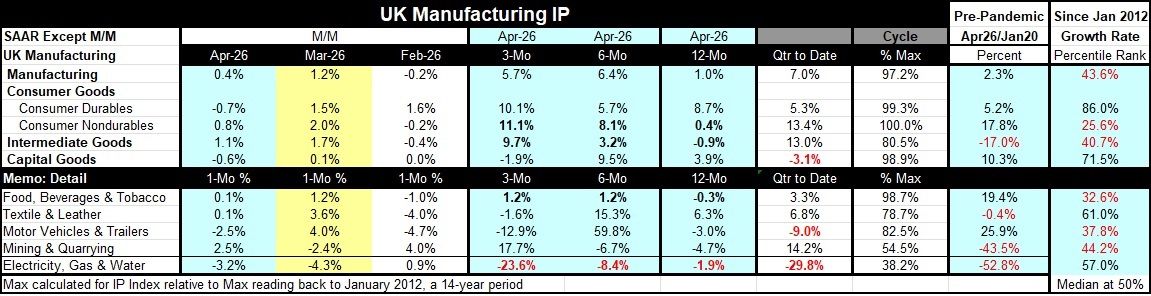
Industrial production in the United Kingdom took another step up in April, rising by 0.4% after gaining 1.2% month-to-month in March. Consumer durable goods production fell by 0.7% and capital goods production fell by 0.6% in April, but nondurable goods production increased by 0.8% and intermediate goods output increased by 1.1%. Given the weighting for these sectors, all that amounted to an overall increase of 0.4% in manufacturing output.
In March, there had been month-to-month increases in each of these sectors. Sector by sector gains were quite substantial in March for all the sectors, except for capital goods output up only 0.1%; capital goods output has been weak over the last several months and has come through a period of some significant volatility.
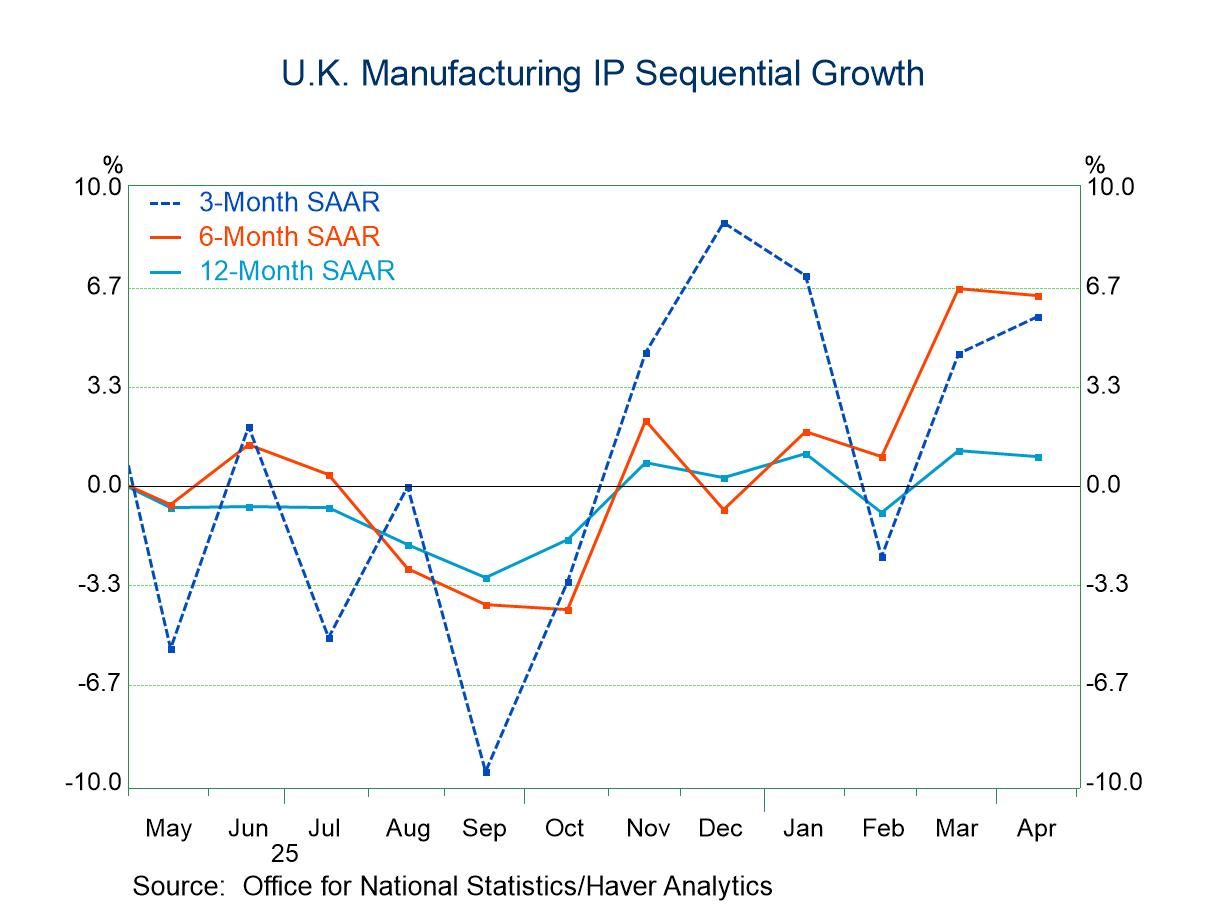
Sequentially, U.K. manufacturing output has registered gains over 12 months, six months and three months. The 12-month gain is only 1%, but over six months output expands at a 6.4% annual rate, and while it stepped back to a 5.7% rate of expansion over three months, there is a hint of acceleration.
Sequential trends in manufacturing output Looking at sectors, there are two that have accelerated over this time span; the output of consumer nondurable goods and the output of intermediate goods. Nondurable goods output rose by 0.4% over 12 months, then stepped up to an 8.1% pace over six months and rose further to an 11.1% pace over three months. For intermediate goods, output declined by 0.9% over 12 months, then switched to post a gain at a 3.2% pace over six months and then again at a 9.7% annual rate over three months. Durable goods output has a hint of acceleration but doesn't quite go over the hurdle as its 8.7% year-over-year growth rate fades to 5.7% over six months but then jumps back to 10.1% over three months. Capital goods output is more indeterminate, with a 3.9% growth rate over 12 months, a very strong 9.5% growth rate over six months, and then a decline of 1.9% at an annual rate over three months.
On a quarter-to-date (QTD) basis, all the sectors are showing increases except for capital goods where output is falling at a 3.1% annual rate. The QTD calculation as of April is only one month into the new quarter; the quarter’s overall output is growing at a 7% annual rate. Manufacturing sectors have recovered fairly well from the difficulties during COVID. The exception is intermediate goods where output as of April 2026 is still 17% below what it was back in January 2020. However, if we evaluate the sectors on their current year-over-year growth rates, we'll find consumer durables has a strong standing at their 86th percentile and capital goods, despite its recent weakness, has a 71.5 percentile standing among its growth rates back to January 2012. However, manufacturing growth overall at 1.0% has only a 43.6 percentile standing. Intermediate goods (that registered a decline over 12 months) have a 40.7 percentile standing. Consumer nondurables, despite their current acceleration string, have only a 25.6 percentile standing, but that's based on the year-over-year growth rate of only 0.4%.
U.K. industries The industry level growth rates and standings for the United Kingdom show more diversity, with current growth rates above their medians for textile & leather as well as for utilities. Food, motor vehicles, and mining generate growth rates below their medians on data back to 2012. However, comparing aggregate levels of output to January 2020 shows three sectors: textile & leather, mining & quarrying, and utilities that report a level of output below where it was over six years ago. The shortfalls in mining & quarrying and in utilities are stunningly weak.
Overall, the manufacturing sector is doing quite well by comparison with past trends. But parts of the U.K. economy are clearly going through some massive changes.

Robert Brusca
AuthorMore in Author Profile »Robert A. Brusca is Chief Economist of Fact and Opinion Economics, a consulting firm he founded in Manhattan. He has been an economist on Wall Street for over 25 years. He has visited central banking and large institutional clients in over 30 countries in his career as an economist. Mr. Brusca was a Divisional Research Chief at the Federal Reserve Bank of NY (Chief of the International Financial markets Division), a Fed Watcher at Irving Trust and Chief Economist at Nikko Securities International. He is widely quoted and appears in various media. Mr. Brusca holds an MA and Ph.D. in economics from Michigan State University and a BA in Economics from the University of Michigan. His research pursues his strong interests in non aligned policy economics as well as international economics. FAO Economics’ research targets investors to assist them in making better investment decisions in stocks, bonds and in a variety of international assets. The company does not manage money and has no conflicts in giving economic advice.
More Economy in Brief
 Global