U.K. IP Continues Its String of Advances
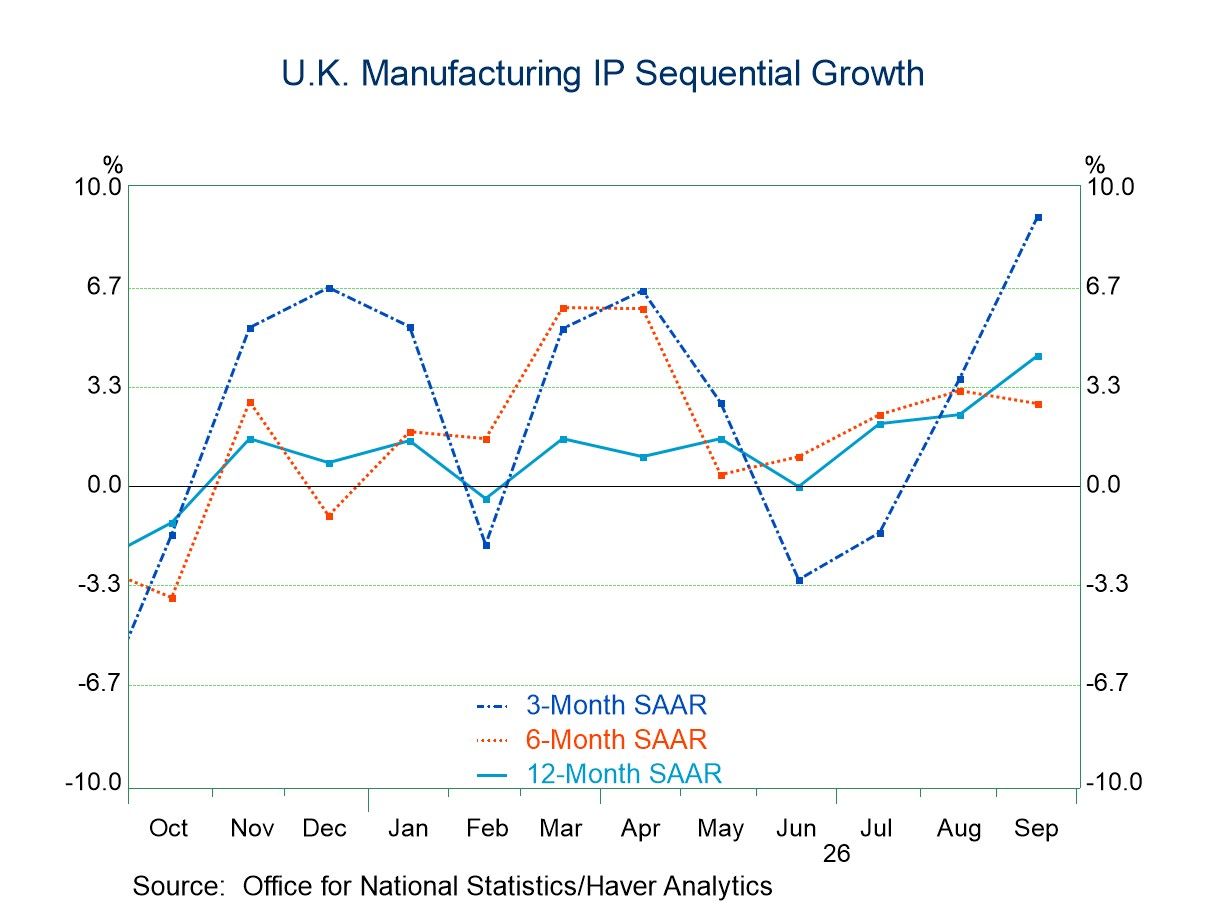
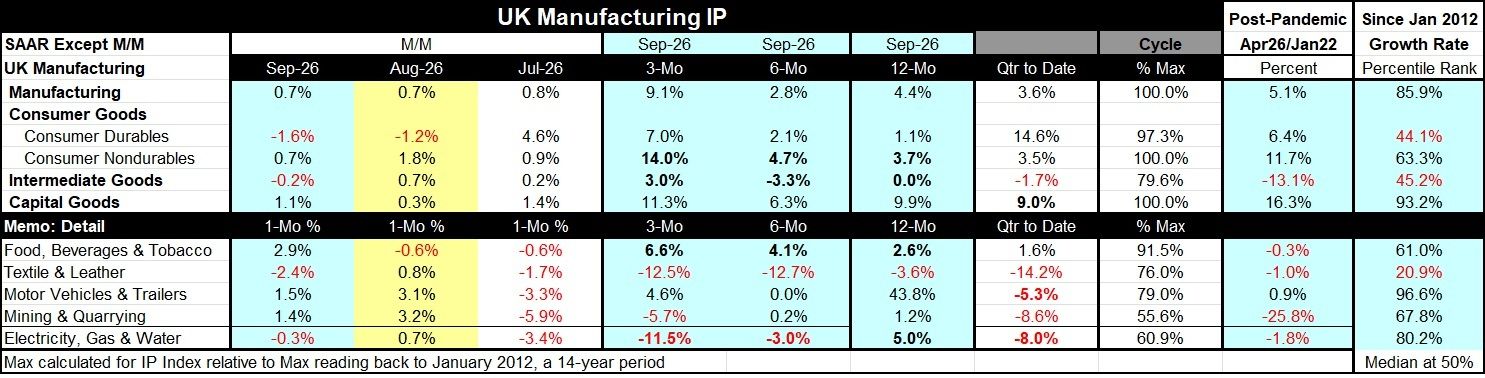
Manufacturing output in the United Kingdom is up for three months running, a nice streak that has boosted three-month growth to an annual rate of 9.1%. That is up sharply from a 4.4% gain over 12 months, but there is slippage in the pace of growth to 2.8% (annualized) over six months that keeps this from being a steady acceleration. Instead, it is a string of output increases, generating an irregular acceleration.
Monthly trends Month-to-month output is lower for consumer durables and intermediate goods, while it is expanding for consumer nondurables and capital goods. In August, output only fell month-to-month for consumer durables, while in July output increased monthly in all four of these sectors. It has been a good run for sector-level output in manufacturing in the U.K.
Uneven at the industry level: Conditions are more equivocal at the industry level where among five industries, three of them show output increases in September, four show increases in August, but all of them show declines, and significant declines, in output in July. Whereas all sectors show output increases over the last combined three months, three of five of these industries show output declines over three months. So, the silver cloud does have some dark linings.
Sequential growth rates Sequential growth trends for sector data show output accelerating from 12 months, to six months, to three months for consumer durables and nondurables, with steady output increases in capital goods industries but not sequentially accelerating. Intermediate goods show no growth over 12 months, a decline in output over six months and a 3% annualized gain over three months. On the whole, it is an impressive underpinning of the expansive trends. I will not try to describe all the industry-level data, but the sequential trends there are quite mixed and not as positive overall.
QTD: Quarter-to-Date To complete Q3, U.K. manufacturing output is up by 3.6% annualized QTD. Only intermediate goods output declines on the quarter. But the industry data show a quarterly increase only for food, beverages & tobacco, with other industries showing shrinkage; each of them shrinks at a 5% pace or faster.
Post-pandemic... Post-pandemic growth rates show all sectors with positive growth from January 2022 to date except for intermediate goods. Industries show output declines on that comparison for all industries except motor vehicles.
Growth ranking For perspective, I rank the September year-on-year growth rate against all annual growth rates back to January 2012. Rankings above 50% show current growth is above its median pace over this 13-plus year period. Sector growth with a sub-median pace registers for consumer durables and intermediate goods. All industries are above their median pace except textiles & leather.
Summing up On balance, U.K. inflation has turned higher, and the BOE is hiking rates. One of the BOE’s MPC members sought a 50bp rate hike at the last meeting, when a hike of 25bp was taken. The economy certainly looks firm enough. In the current quarter, growth climbed to 0.7% after a 0.5% gain in the previous quarter (to an annualized quarterly pace of 2.8% in Q3 from 2% in Q2). The U.K. economy is now seeing some positive impact from AI. Going forward, the question will be about whether AI will continue to boost growth and if it will provide any respite from inflation. And of course, oil prices and geopolitics will remain front and center for policymakers. So stay tuned and stay alert.

Robert Brusca
AuthorMore in Author Profile »Robert A. Brusca is Chief Economist of Fact and Opinion Economics, a consulting firm he founded in Manhattan. He has been an economist on Wall Street for over 25 years. He has visited central banking and large institutional clients in over 30 countries in his career as an economist. Mr. Brusca was a Divisional Research Chief at the Federal Reserve Bank of NY (Chief of the International Financial markets Division), a Fed Watcher at Irving Trust and Chief Economist at Nikko Securities International. He is widely quoted and appears in various media. Mr. Brusca holds an MA and Ph.D. in economics from Michigan State University and a BA in Economics from the University of Michigan. His research pursues his strong interests in non aligned policy economics as well as international economics. FAO Economics’ research targets investors to assist them in making better investment decisions in stocks, bonds and in a variety of international assets. The company does not manage money and has no conflicts in giving economic advice.
More Economy in Brief
 Global