

German CPI Deflates...on Some Metrics—Shows Promise...and in Promise There Is Peril
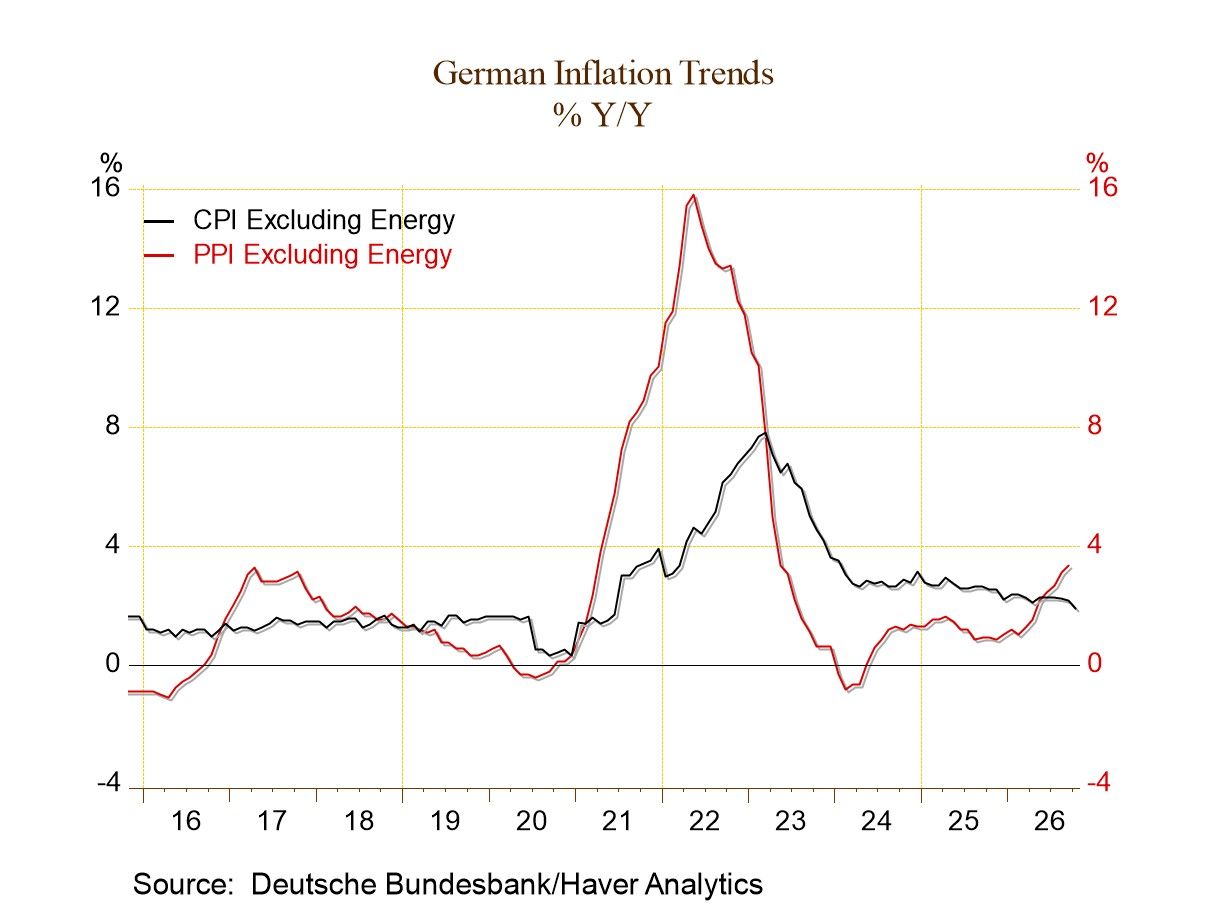
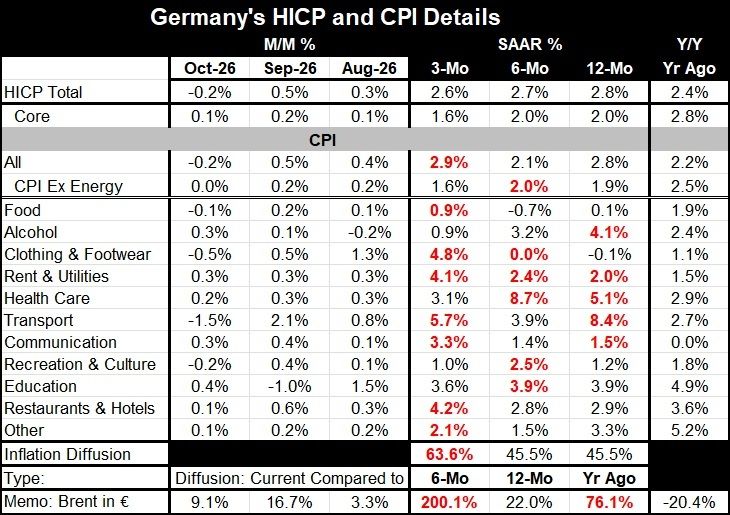
The basic news analysis of the recent German inflation report is that it confirms the preliminary report showing that inflation broke lower, as it did in October. In October, the HICP for Germany fell by 0.2%; the core rose by 0.1%; the domestic gauge showed headline inflation at -0.2%, with the CPI ex-energy flat. These four metrics constitute a good inflation report for Germany on the month. Prices fell month-to-month for food, clothing & footwear, transportation, and recreation & culture.
Sequential inflation HICP However, if we look at sequential trends, a slightly broader look at inflation over 12 months, six months, and three months, we find a slightly different narrative on German inflation. The HICP shows inflation at 2.8% over 12 months, easing to 2.7% at an annual rate over six months and to 2.6% at an annual rate over three months. That’s a clear progression lower and also a very slow progression lower. The core HICP is up 2% over 12 months, up at a 2% pace over six months, and at a 1.6% annual rate over three months. Again, this is a very good sequence of numbers, with the core basically hewing to the pace sought by the European Central Bank and then a three-month growth rate that dips well below it.
Sequential inflation using the domestic gauge The German domestic CPI shows 12-month inflation at 2.8%, decelerating to a 2.1% annual rate over six months, then springing back up to 2.9% at an annual rate over three months, showing a higher inflation rate over three months than over 12 months—goodbye, inflation progress. The domestic CPI excluding energy is up 1.9% over 12 months, about a 2% pace over six months, and up at a 1.6% annual rate over three months. The ex-energy metric continues to perform in line with the ECB guidelines and produces an even weaker inflation rate over three months. So, there is still good news—but mixed news—in the domestic CPI.
Optimism confirmed On balance, there is good reason to be optimistic about German inflation. The October number was strikingly positive good news, and the three-month annual rate, at least for the core or ex-energy versions, is a stellar result. However, if we try to trace this through diffusion statistics, what we see is that inflation diffusion over 12 months is at 45.5%. While that's good news, a diffusion metric at 50% shows as much acceleration as deceleration across categories. So, readings above 50% show relatively more acceleration and readings below 50% show relatively more deceleration. The 12-month inflation rate shows more deceleration over 12 months than there was 12 months ago, but by a small increment. The six-month inflation diffusion metric is also at 45.5%, and this compares six-month inflation to 12-month inflation. Over the three months, however, the diffusion metric is at 63.6%, showing that inflation over three months has suddenly moved up broadly, even though the inflation rate itself remains contained for the core. It is high for the headline, but the diffusion or breadth reading is something that goes across all categories. So, this finding is not confirming the good three-month inflation results.
Encouraging with a caveat German inflation data are certainly encouraging. The uptick in breadth for inflation is something that's somewhat worrisome. But on a monthly or quarterly basis, inflation numbers are almost always going to produce at least one uncomfortable metric when you're trying to assess inflation prospects. Brent, measured in euros, is up by 76% over 12 months; over three months compared to six months, it shot up by 200%.
The great unknown More recently, in markets, Brent has been calming down to some extent. But the outlook for oil prices is one of the great unknowns in putting together a forecast. According to the famous Inspector Clouseau, “I do not know what I do not know.” Now that is a bit of wisdom that economists would do well to remember. Economists nonetheless make forecasts that depend critically on the values and variables whose future they really do not know. This is one of the finest arguments against having forward guidance by central banks and instead looking at scenarios.
Scenarios: the great “What if…” In a scenario, a central bank can posit a value for oil prices and then run another scenario where it posits another value for oil prices. Without having to attach fixed formal probabilities to them, the central bank can say that it finds scenario A or B to be more likely. If scenario B instead of scenario A results, it would make policy somewhat differently and describe that in a way so that we get a better idea of what the central bank is looking at and how it's reacting. The central bank can do that without burning its credibility and putting all of its eggs in one basket, especially at a time when it's not sure which is the right basket to use.
What to reveal? For now, we can say only what we can know about these inflation data; i.e., Germany is showing progress. Many of the metrics are pointing to lower and actually contained inflation; headline inflation is much more nettlesome than core inflation, which is behaving well, and that should be a source of solace. However, diffusion is not all on board with the good news, and the outlook depends importantly on what happens on the geopolitical front, to oil prices, and to the prices of other goods whose supply chains have been interrupted. These are things we really don't know. So rather than doing what most economists want to have the central bank talk about, namely its reaction function, I'd prefer to have the Fed and other central banks talk about their goals. Are they still committed to 2% as a target? Under circumstances in which supply constraints get worse, are they going to allow continued overshooting, or lean hard against it? How do central banks plan to react to the uncertainty of the global economy, and exactly how do they intend to implement their mandates for an inflation target or for a dual mandate? I would find that much more useful than having a central bank make some stab in the dark at what oil prices are going to do and then try to tell us what it expects and how policy in that case will respond. In short, the central bank needs to give us the kind of guidance that makes sense to us, not the kind of forward guidance that academics would like to have and that actually gives us nothing. Those are different things.

Robert Brusca
AuthorMore in Author Profile »Robert A. Brusca is Chief Economist of Fact and Opinion Economics, a consulting firm he founded in Manhattan. He has been an economist on Wall Street for over 25 years. He has visited central banking and large institutional clients in over 30 countries in his career as an economist. Mr. Brusca was a Divisional Research Chief at the Federal Reserve Bank of NY (Chief of the International Financial markets Division), a Fed Watcher at Irving Trust and Chief Economist at Nikko Securities International. He is widely quoted and appears in various media. Mr. Brusca holds an MA and Ph.D. in economics from Michigan State University and a BA in Economics from the University of Michigan. His research pursues his strong interests in non aligned policy economics as well as international economics. FAO Economics’ research targets investors to assist them in making better investment decisions in stocks, bonds and in a variety of international assets. The company does not manage money and has no conflicts in giving economic advice.
More Economy in Brief
 Asia