Japan’s Economy Watcher Index Slips in October; Outlook Fades
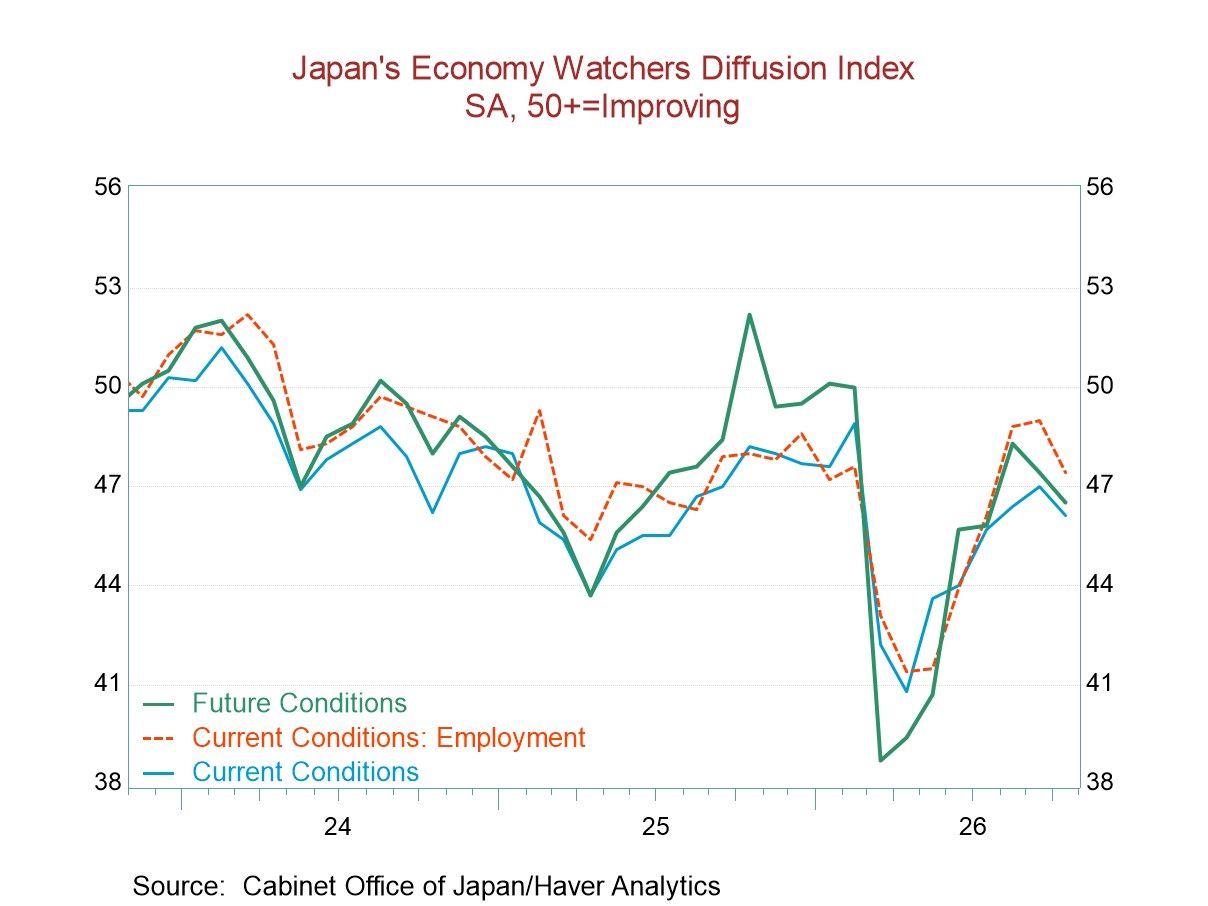
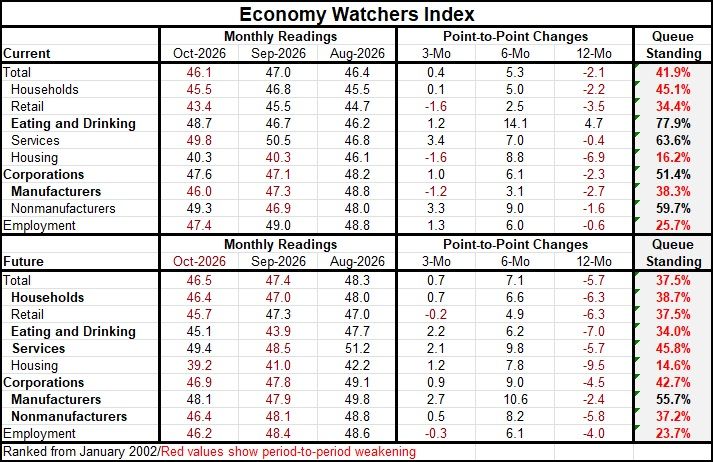
Japan’s economy watchers index slipped in October, falling to a 46.1 diffusion reading from 47.0 in September. Five of the 9 components of the index are weaker in October than in September; improving month-to-month are the assessments for eating and drinking places, for corporations, and for nonmanufacturers. Nonmanufacturers are showing a substantial improvement from September to October.
In September, four of the 9 categories slipped, although the headline improved in September. Over three months and six months, the index shows point-to-point improvement; however, the 12-month change still shows a decline for the headline of 2.1 points and for all the components except for eating and drinking places.
The current assessment from the economy watchers is mixed. Despite deterioration on the month, the period-to-period changes show a slow crawl up to better readings although failing to reach the year-ago mark.
If we look at the rank standings of the indexes, we find that the headline has only a 41.9 percentile standing; any percentile reading below 50% shows a standing below its historic median although four components have readings above the 50th percentiles: eating and drinking places have a 77.9 percentile standing, services have a 63.6 percentile standing, nonmanufacturers have a 59.7 percentile standing, and corporations have a 51.4 percentile standing.
The future economy watchers index slipped in October to a reading of 46.5 from 47.4 in September. It also slipped in September compared to August. In October, three of the 9 components improved: eating and drinking places, services, and manufacturers. In September, with the headline also falling month-to-month, there was only an improvement in retailing, which rose to 47.3 from 47.0 in August; that is thin gruel for good news.
In terms of point-to-point changes, the outlook is a little bit better, with the three-month change in the future index up by 0.7 points. The six-month change is up by a heartier 7.1 points, although the year-over-year change is lower by 5.7 points. Once again, we see this lower year-over-year assessment paired against some more modest increases over the last three and six months.
Over three months, the future index shows deterioration in only two categories, retailing and employment, with the other 7 components showing improvement. The six-month change is defined by a strong 7.1-point gain for the headline and shows positive results across all sectors on that time frame as they all improve, with the smallest improvement being a 4.9-point increase in retailing. The largest improvement is a gain of 10.6 diffusion points for manufacturers. However, the percentile standing results for the future index are poor, with the index headline and all components except one posting standings below the 50-percentile mark.
The levels of the diffusion readings are poor in October. The headline for the future index has a 37.5 percentile standing, with the current index at a 41.9 percentile standing; it also is below its median. Year-on-year, both indexes are lower and both are creeping higher over three months and six months. But the progression to higher ground is slow. The setbacks recorded in October month-to-month only serve to make us more wary about the state of this slow-motion economic recovery.

Robert Brusca
AuthorMore in Author Profile »Robert A. Brusca is Chief Economist of Fact and Opinion Economics, a consulting firm he founded in Manhattan. He has been an economist on Wall Street for over 25 years. He has visited central banking and large institutional clients in over 30 countries in his career as an economist. Mr. Brusca was a Divisional Research Chief at the Federal Reserve Bank of NY (Chief of the International Financial markets Division), a Fed Watcher at Irving Trust and Chief Economist at Nikko Securities International. He is widely quoted and appears in various media. Mr. Brusca holds an MA and Ph.D. in economics from Michigan State University and a BA in Economics from the University of Michigan. His research pursues his strong interests in non aligned policy economics as well as international economics. FAO Economics’ research targets investors to assist them in making better investment decisions in stocks, bonds and in a variety of international assets. The company does not manage money and has no conflicts in giving economic advice.
More Economy in Brief
 Asia