

 Global| Nov 10 2026
The AI Boom and the Price of Permission
by:Andrew Cates
|in:Viewpoints
The AI investment boom has become a source of demand for semiconductor exporters, equipment manufacturers and energy suppliers across the world. Its continued expansion increasingly depends on political consent as well as finance and technology. Resistance to data centres remains a modest immediate constraint, but delays could spread through supply chains and markets whose expectations assume rapid growth. For investors, the vulnerability lies in how widely exposure to the same spending cycle has spread.
The United States remains at the centre of that cycle. Its significance, however, is global. Asian producers supply chips and electronic components; European and Japanese manufacturers provide sophisticated equipment; and utilities and commodity producers are investing to meet the build-out's requirements. Pension funds, insurers and other investors share the financial exposure through global equity portfolios.
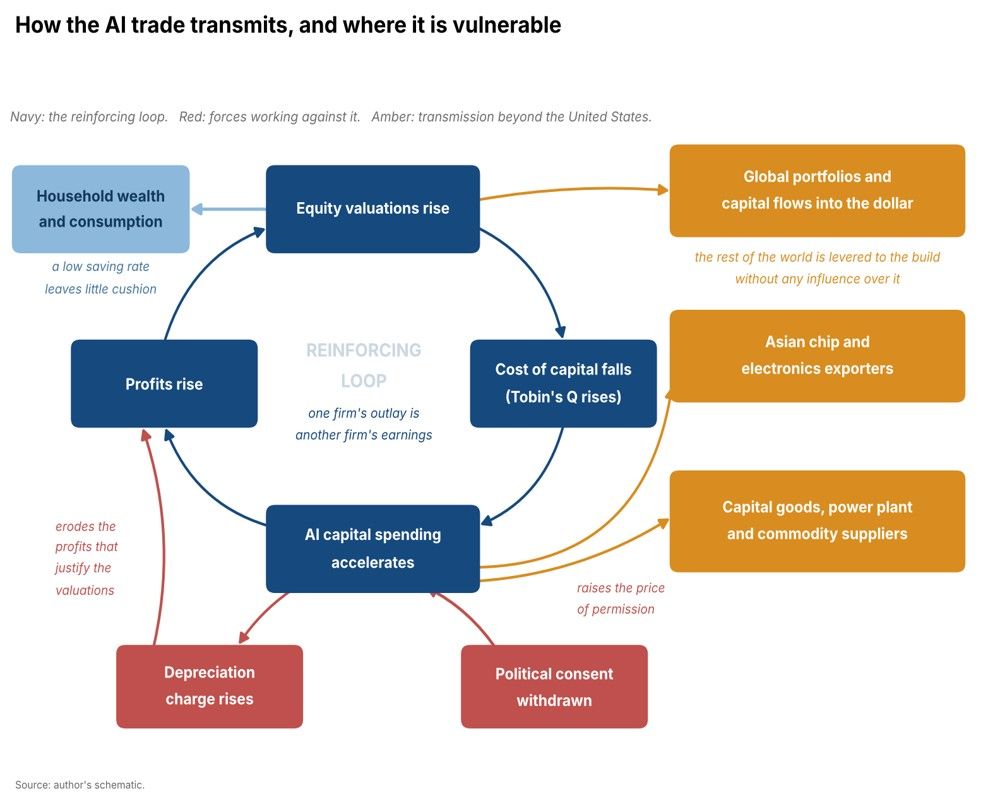
A global investment cycle Four forces reinforce the expansion. Rising equity valuations improve financing conditions. Cheaper capital supports investment. That spending generates revenues and profits for suppliers, helping sustain the valuations that encourage further investment. The schematic traces this loop and the channels through which it reaches the wider economy.
Chart 1 How the AI trade transmits and where it is vulnerable
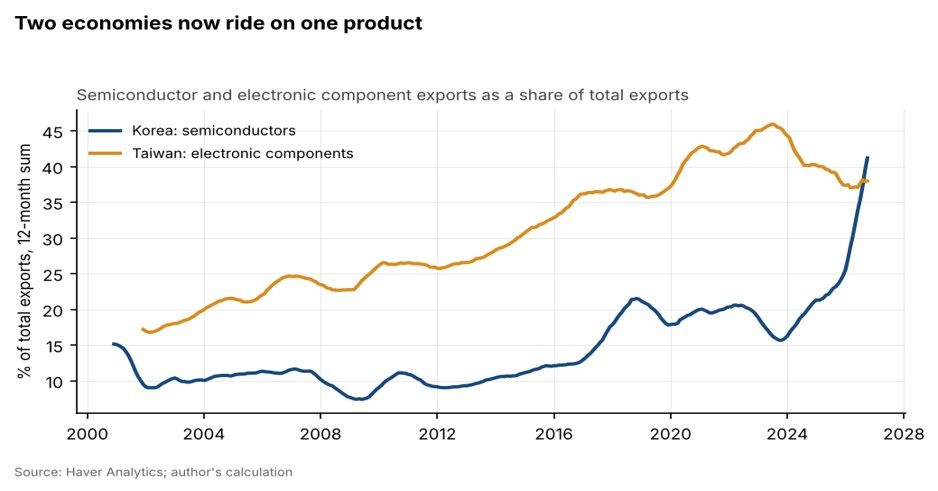
Asia provides the clearest evidence of the international transmission. Semiconductors account for roughly two-fifths of South Korean exports, twice their share four years ago. Taiwan also has substantial exposure. Strong technology demand has supported more optimistic growth forecasts, but it has increased dependence on the investment decisions of a relatively small group of customers.
Chart 2 Semiconductor and electronic component exports as a share of total exports
The supply chain extends well beyond chips. European and Japanese equipment makers benefit from semiconductor investment, while turbines, grid equipment, copper, steel and concrete are needed to build and power data centres. The benefits reach economies with very different industrial structures. Their exposure nevertheless has a common source: expectations that infrastructure spending will keep expanding.
That distinction matters. A slowdown need not involve a collapse in spending. Suppliers can face weaker orders and earnings growth simply because investment ceases to accelerate. Projects elsewhere in the supply chain may then become harder to justify.
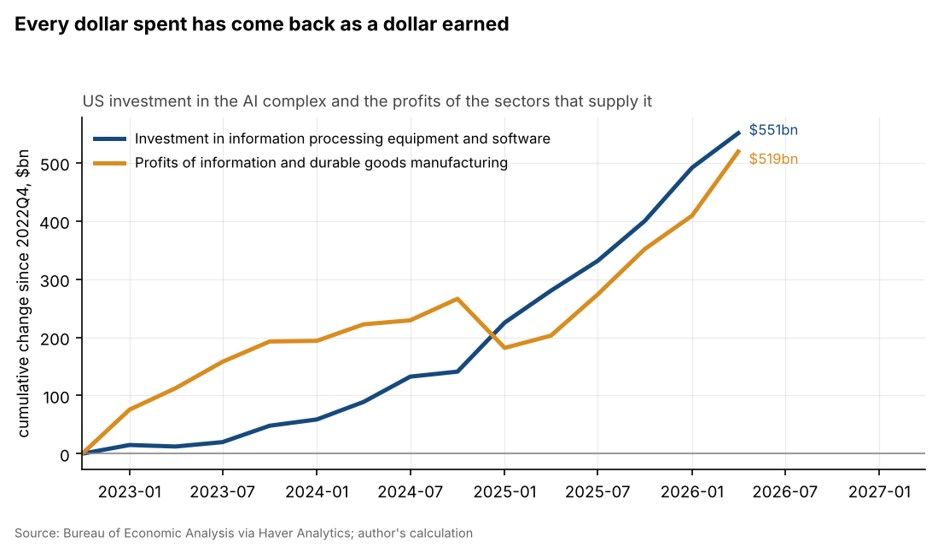
Profits and valuations reinforce the exposure US data illustrate the connection. Since late 2022, additional investment has been closely matched by rising profits in the sectors supplying equipment and services. This is an accounting relationship, not proof that every dollar of spending creates an equivalent profit. It nevertheless shows how closely the investment and earnings cycles have become linked.
Chart 3 US investment in the AI complex and profits of supplying sectors
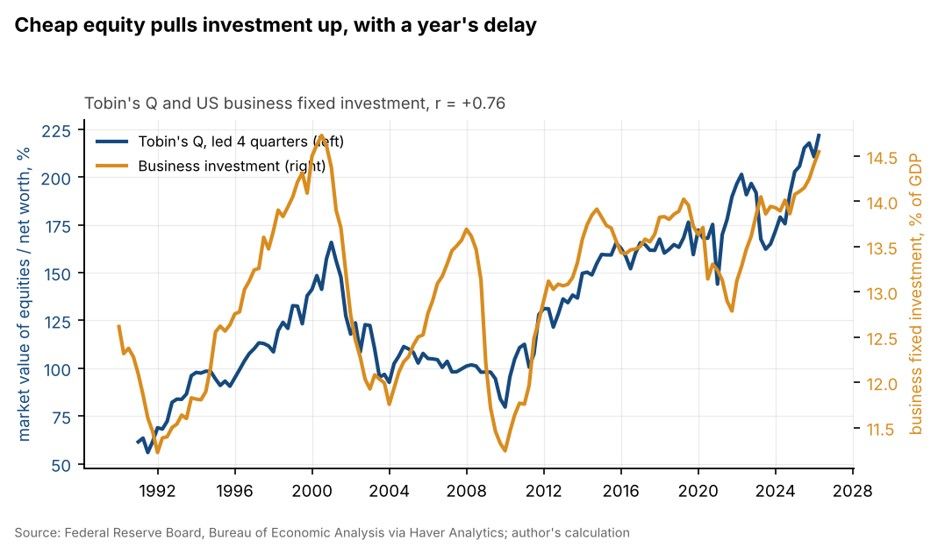
High valuations support the process. Tobin's Q, which compares US equity values with the replacement cost of corporate assets, stands at roughly twice its long-run average. The measure requires caution: conventional replacement-cost estimates omit much intangible capital, and its relationship with investment has weakened as both have become more concentrated. Even so, a sustained market reversal could make further expansion harder to finance.
Chart 4 Tobin’s Q and US business fixed investment
The financial consequences would be international. The weight of US equities in global portfolios exposes institutions and households far beyond America to the same earnings expectations. A correction could therefore weaken wealth and confidence alongside demand for the equipment and materials used in construction.
Consent becomes an economic constraint Political resistance reaches the cycle through a different channel. Restrictions on data-centre construction can delay physical investment before their effects appear in market prices. US local opposition and campaigns in parts of Europe raise a broader question: can the industry secure consent quickly enough to meet its plans?
The immediate threat should not be overstated. Relatively few projects have been delayed, and investment commitments, jobs and financial concessions may yet secure approval. But longer planning timelines and more costly agreements could reduce the pace of expansion even without widespread prohibitions. Financing a project and obtaining permission to build it are separate requirements.
Strong profits offer some protection. Today's boom has a firmer earnings foundation than the late-1990s technology surge. Yet those earnings must remain sustainable, while computing equipment with an economic life of perhaps three or four years brings depreciation costs that will increasingly weigh on reported profits.
The central risk is a mismatch between the timing of AI's benefits and the expectations embedded in current investment plans. Slower spending, weaker supplier earnings and lower equity valuations could reinforce one another, transmitting the adjustment across borders. The scale is uncertain, but the breadth of exposure makes it a global macroeconomic issue.
Technological revolutions can deliver enormous benefits without rewarding every investment. For the world economy, the question is how smoothly the transition from infrastructure spending to broader productivity gains proceeds. Political consent now joins capital, computing power and electricity among the conditions shaping that transition. The benefits of AI may be widely shared; so, increasingly, are the risks of an interrupted build-out.

Andrew Cates
AuthorMore in Author Profile »Andy Cates joined Haver Analytics as a Senior Economist in 2020. Andy has more than 25 years of experience forecasting the global economic outlook and in assessing the implications for policy settings and financial markets. He has held various senior positions in London in a number of Investment Banks including as Head of Developed Markets Economics at Nomura and as Chief Eurozone Economist at RBS. These followed a spell of 21 years as Senior International Economist at UBS, 5 of which were spent in Singapore. Prior to his time in financial services Andy was a UK economist at HM Treasury in London holding positions in the domestic forecasting and macroeconomic modelling units. He has a BA in Economics from the University of York and an MSc in Economics and Econometrics from the University of Southampton.