

India: Stronger Fundamentals, Familiar Fault Lines
|in:Viewpoints
India has confounded expectations, weathering the latest Iran war-induced energy price shock far better than previous crises. Recall 2011–14, when Brent averaged over US$100/bbl for four consecutive years, and 2022, when oil surged to US$123/bbl. Economic growth slowed sharply during both episodes.
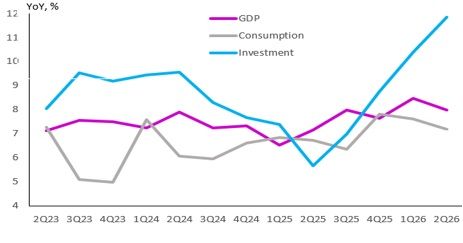
This time, despite some moderation in the second quarter, real GDP growth averaged 8.2% YoY in 1H26, up from 6.8% in 1H25. Consumption remains resilient, investment is accelerating and exports have rebounded (Figure 1).
Figure 1: GDP, consumption and investment
Source: Haver Analytics & Westbourne Research
Fundamentals are considerably healthier. The current-account deficit was running at just 0.7% of GDP in 2Q26, compared with 5% in 2013 and 2.6% in 2022. Foreign exchange reserves stand at US$608bn, providing 8.7 months of import cover. Unlike 2011, when India's credit-fuelled malinvestment bubble was bursting, banks and corporates are in rude health. Non-performing loans are at record lows and corporate leverage is modest.
The question is whether this resilience marks the beginning of a sustainable economic upswing or another government-supported recovery that ultimately runs out of steam.
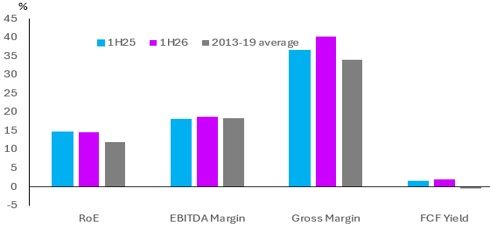
Corporate India is in good shape Our business-cycle indicators have improved. The corporate profit cycle remains firmly in upswing, with listed-sector returns on equity holding above their pre-pandemic seven-year average. Both EBITDA and gross margins are expanding, signalling improving pricing power, operating efficiency and cost control (Figure 2).
Figure 2: Profit cycle metrics
Source: Bloomberg & Westbourne Research
The message from Crisil Ratings is similarly encouraging. Across 7,200 companies, rating upgrades outnumbered downgrades by 464 to 213 in the first half of the fiscal year. Around 40% of upgrades were concentrated in secondary steel, auto components, capital goods and infrastructure, supported by stronger order books and improving cash flows.
There are casualties from higher energy costs, weak exports and Chinese competition, notably ceramics, polyester textiles and selected engineering businesses. Airlines, speciality chemicals and flexible packaging are also vulnerable should the energy shock persist.
Nevertheless, corporate balance sheets remain robust. Crisil expects interest coverage ratios to hold at a healthy 5.2 times this fiscal year. Revenue prospects are particularly strong in renewables, defence, data centres and auto components.
Investment is recovering. But who is investing? The most encouraging development is the acceleration in real investment spending, up 11.8% YoY in 2Q26 following 10.4% in 1Q26. This represents the strongest first-half investment performance since 2022.
Manufacturing capacity utilisation has reached 76%, industrial production is strengthening, capital goods imports are rising and corporate bank lending is expanding at double-digit rates.
Could this finally be the long-awaited sustainable investment upswing?
We remain unconvinced.
The problem is that government spending continues to do much of the heavy lifting. Delhi has budgeted US$133bn for roads, railways, defence and telecommunications this fiscal year, an 11.5% increase. Including broader capital commitments, spending rises to US$187bn, up 22% YoY.
Frontloaded public investment has generated positive multiplier effects, particularly for infrastructure, capital goods and defence companies. Policy incentives are also encouraging investment in data centres, renewables and other new-generation industries.
But private investment remains narrow, concentrated among a handful of large conglomerates. Traditional capital-intensive industries are still sitting on the sidelines.
Moreover, Delhi's fiscal room for manoeuvre is shrinking. Tax revenues rose just 3.4% YoY in the first eight months of 2026, against expenditure growth of 9%. Persistently high energy prices threaten higher fuel and fertiliser subsidies. Seven states face elections next year, while the Eighth Pay Commission could increase the wage and pension bill for 6.95 million beneficiaries.
Public investment cannot substitute indefinitely for private investment.
The government is trying to crowd in private capital through infrastructure improvements, structural reforms and free-trade agreements with the UK, Oman, New Zealand and European countries. These offer opportunities for manufacturing, services, technology transfer and investment, including EFTA's US$100bn investment target over 15 years.
But trade agreements alone cannot overcome competitiveness constraints, logistical bottlenecks and the reluctance of private businesses to commit capital.
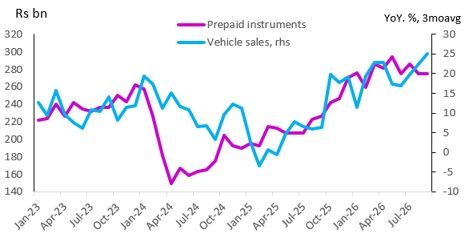
Consumption: The fiscal illusion Indian consumers, meanwhile, continue spending despite rising energy and living costs. Vehicle sales are booming, household credit growth is accelerating and discretionary spending remains surprisingly resilient (Figure 3).
Figure 3: Vehicle sales & pre-paid instruments
Source: Haver Analytics & Westbourne Research
Yet we have consistently resisted chasing consumer stocks. That caution has paid off, with consumer durables and FMCG equities performing poorly this year.
Our concern is straightforward. Investment, not consumption, drives a sustainable economic upswing.
Companies invest when prospective returns justify the risks. Rising profits encourage capacity expansion, job creation and higher wages. Employment security and rising real incomes then sustain consumption and broaden the recovery.
India risks putting the cart before the horse.
The current consumption upswing owes much to fiscal transfers rather than a self-sustaining improvement in household incomes.
Today, 18 states provide cash transfers to households. According to Crisil, a median monthly transfer of Rs1,500 covers 74% of expenditure for the poorest rural households and 51% for their urban counterparts.
Another 813 million people, or 55% of the population, receive free foodgrains, while 90–100 million farmers benefit from annual income support. Several states also provide regular cash payments to women.
Add income-tax cuts introduced in April 2025 and GST rationalisation in September, and it is hardly surprising that consumers have absorbed higher living costs while continuing to spend.
Three consecutive good harvests have helped. But agricultural prospects are deteriorating following deficient monsoon rainfall, depleted reservoirs and weak soil moisture across several important farming states.
More importantly, fiscal transfers cannot deliver permanently accelerating consumption growth. Tax reductions provide an initial boost that fades. Cash transfers redistribute purchasing power but do not themselves generate the productivity, employment and wage growth needed to sustain demand.
And here the outlook is less reassuring.
Rural agricultural and non-agricultural wage growth has slowed, while accelerating inflation is eroding real incomes. Although unemployment has fallen to 4%, labour-force participation remains worryingly low at 41%.
Consumption is holding up. The question is for how long.
Monetary policy adds another headwind Fiscal constraints are tightening just as inflation risks are increasing.
Both headline and core inflation are accelerating, while broad money growth points to further upside pressure. The RBI has struggled to fully sterilise an estimated US$41bn of capital inflows following June's incentives to attract non-resident Indian deposits.
Further monetary tightening looks increasingly likely.
For now, the two-year real cost of capital, at approximately zero, remains comfortably within our normal ±2% range. Corporates and households can therefore absorb some additional tightening.
But higher borrowing costs, weakening real incomes and diminishing fiscal support are hardly conducive to a broad-based private investment and consumption recovery.
Where to invest? Our five-signal business-cycle framework now argues for upgrading Indian equities from underweight to neutral, currency hedged.
The profit cycle remains in upswing, supported by expanding margins and resilient returns. Investment and credit-cycle indicators have improved, real borrowing costs remain manageable and valuations are becoming more attractive.
Yet we are resisting the temptation.
The Cockroach Movement protests raise the risk of wider socio-economic unrest should living costs bite harder. But our principal concerns are economic rather than political: the narrowness of the private investment recovery and the dependence of consumption on fiscal support.
India's fundamentals are stronger than during previous energy shocks. Corporate balance sheets are healthy, investment is accelerating and the government has made meaningful progress on infrastructure and reform.
What remains unproven is whether private investment can take over from government spending and generate the employment, wages and real income growth needed to sustain the expansion.
That is the missing link.
We will therefore hold our underweight position until our November visit to Delhi, when discussions with policymakers, businesses and economists should provide a clearer picture of whether India's investment recovery has genuine staying power.

Sharmila Whelan
AuthorMore in Author Profile »The founder of Westbourne Research (www.westbourne-research.com), Sharmila Whelan is a seasoned Global Geopolitical-Macro Strategist with nearly three decades of experience advising buy-side clients on multi-asset investment strategies and asset allocations. Her career has been defined by her differentiated thinking, a deep understanding of the intricate connections between global geopolitics, macro and policy dynamics, and the Austrian business cycle approach to economic analysis. She has counseled governmental bodies such as the CIA, the US State Department, the British High Commission, DFID, and China’s NDRC.
Sharmila has held prominent roles in both London and Hong Kong, serving as Managing Director at Aletheia Capital, Director at Merrill Lynch Bank of America, Senior Economist at CLSA, and Asia Regional Economist at BP Plc. In 2022, Bloomberg recognised her as one of the UK's "12 New Expert Voices." She is a frequent media commentator on Bloomberg TV and radio, BBC World Business News, and CNBC, and is a sought-after speaker at high-profile events such as the Financial Times Wealth Summit and CFA UK & India conferences. Sharmila also contributes opinion pieces to Financial Times Professional Wealth Management and the Economist Group’s EIU.
 Global