

 Global| Oct 27 2026
Why Central Banks Should Tread Carefully
by:Andrew Cates
|in:Viewpoints
The Federal Reserve, Bank of Canada, European Central Bank and Bank of Japan meet this week against a difficult backdrop. An energy shock has pushed inflation higher just as households and businesses are contending with expensive borrowing. Economic growth has proved resilient, but the question for policymakers is how secure that resilience really is. There is a strong case for caution before tightening monetary policy further.
The immediate dilemma is familiar. Central banks cannot prevent an oil price shock, but they must guard against its spreading into wages, other prices and inflation expectations. At the same time, higher energy bills reduce spending power and raise costs for businesses. Further increases in interest rates could compound that pressure, even as the effects of earlier tightening are still being felt.
For now, there is little evidence that higher energy prices are feeding into broader inflation. The foundations of demand also deserve closer scrutiny. Government borrowing, rising asset values and investment based on expectations of future returns have all supported spending. Those supports may be less durable than the headline growth figures suggest.
The danger is that policymakers mistake this spending for lasting economic strength. Until productivity gains translate into broader income growth, further tightening risks undermining both today’s demand and the revenues needed to justify tomorrow’s investment. That does not mean central banks should overlook persistent inflation. It does mean they should weigh the evidence for it against the fragility of the growth they are seeking to restrain.
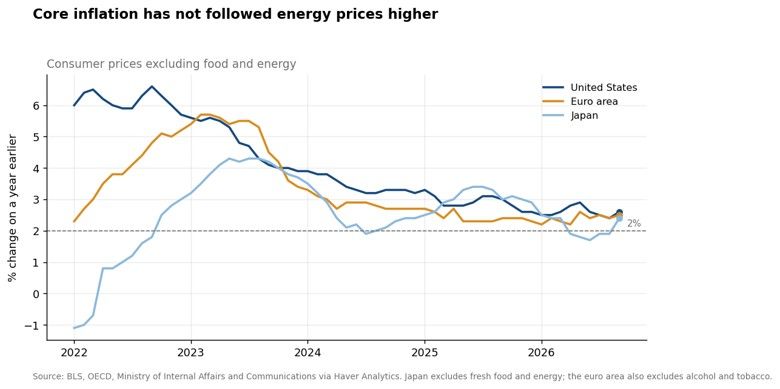
The evidence on inflation Latest data for September show that core CPI inflation, which strips out food and energy, is 2.6 per cent in the United States, 2.5 per cent in the euro area and 2.4 per cent in Japan. None has moved materially higher over the past six months, and the American and Japanese measures are lower than a year ago. So far, the rise in headline US inflation to nearly 4 per cent has not been accompanied by a comparable increase in core inflation.
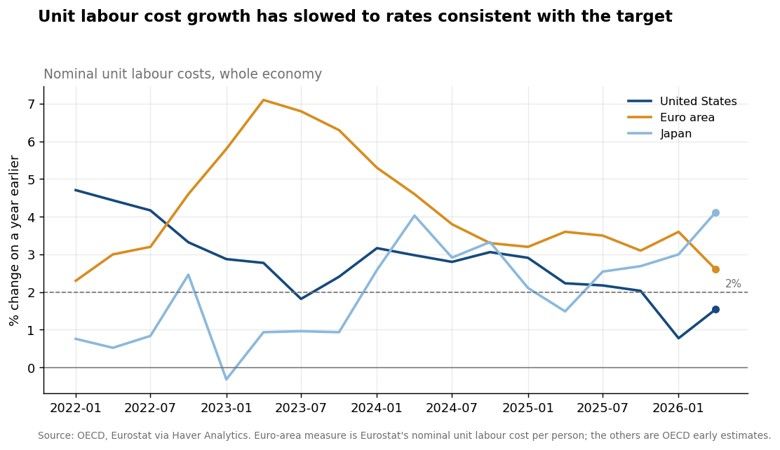
The cost side offers a similar picture. Unit labour costs are rising at a y/y pace of 1.5% in the United States and 2.6% in the euro area, rates close to those consistent with a 2% inflation target. Japan is different: unit labour costs are rising by 4.1 per cent and accelerating, giving the Bank of Japan reason to assess the risks differently. Elsewhere, there is limited evidence so far that the energy shock is feeding into more persistent wage and cost pressures.
There is an important qualification. Weak productivity can itself make inflation harder to contain, so the absence of a productivity boom is not sufficient reason to hold rates. Policymakers must judge whether higher energy costs are spreading into wages, services prices and longer-term expectations. If inflation becomes more persistent, further restraint may be necessary. If it does not, the case for waiting is stronger, particularly when the sources of demand are themselves vulnerable.
The growth foundations are weaker than they look Recent resilience is encouraging, but its foundations matter. An economy supported by public deficits, rising asset values and investment undertaken in anticipation of future profits may respond differently to higher rates from one in which productivity is already lifting incomes across businesses and households.
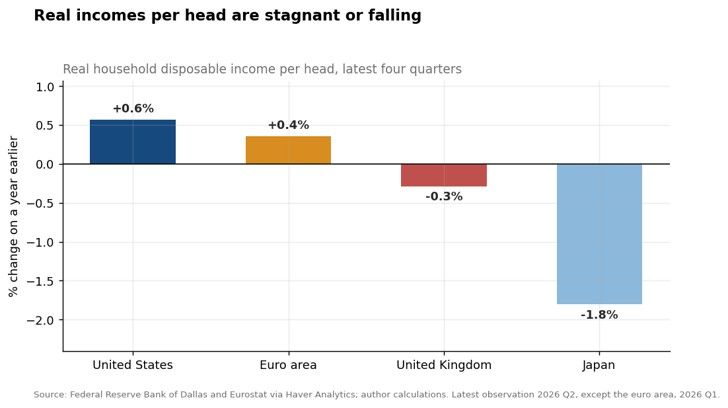
Let’s start with the consumer. Real household disposable income per head is growing by 0.6% y/y in the United States and 0.4% in the euro area. In the UK it is falling by 0.3 per cent and in Japan by 1.8 per cent. Consumption has nonetheless held up more broadly, implying a decline in saving where consumption has grown faster than disposable income.
The role of wealth In the United States, rising asset values appear to have encouraged households to spend a larger share of their income. This need not involve additional borrowing: households can also save less. But spending supported by confidence in wealth is vulnerable to a change in that confidence. Falling markets or weaker employment prospects could encourage households to rebuild saving.
The relationship is in fact quite striking in the US data. When household net worth runs ahead of its trend relationship with income, households tend to save less out of current income; when wealth falls behind, saving tends to rise. Across more than a hundred quarters the correlation is -0.77. The latest observation sits at the far right of the distribution, with net worth some 92 percentage points of disposable income above trend. Almost all of that excess is in equities.
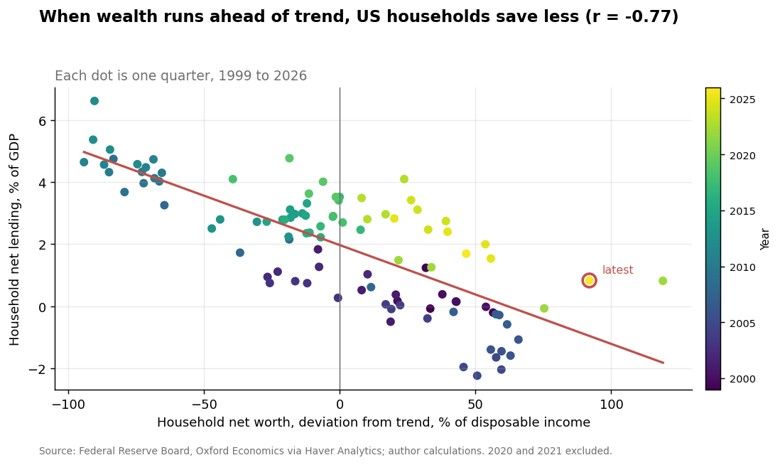
US household net lending against the deviation of net worth from trend, quarterly, 1999 to 2026. Source: Federal Reserve Board and Oxford Economics via Haver Analytics; author calculations.
This leaves consumption more exposed to asset valuations. A fall in equity prices would reduce wealth and could encourage households to save more out of current income, adding to the pressure on demand.
The investment boom is narrow AI investment has provided another support. Spending on data centres, computing equipment and electricity infrastructure generates activity now, against the expectation of substantial returns later. As I argued last week in “AI’s costs are arriving before its benefits”, those returns ultimately depend on customers able to benefit from using the technology and willing to pay for it. The industry’s investment plans are therefore partly a claim on the future incomes of the wider economy.
What is striking is how concentrated that investment has become. Since the end of 2023, real spending on information processing equipment and software has risen by 41% while all other business investment has fallen by 1%. That category now accounts for 44% of real business investment, against 31% before the pandemic, and for roughly half the increase in real GDP over the past year. This is a concentrated capital spending cycle.
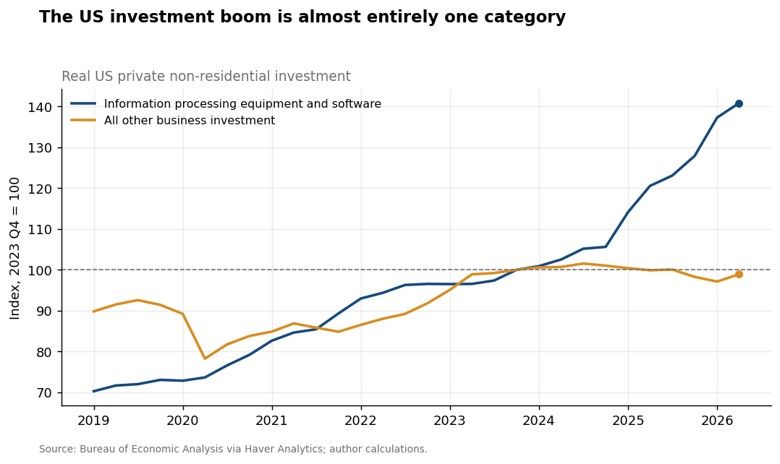
Productivity is central to the argument. If AI allows businesses to produce more efficiently, it can support profits, real incomes and further investment. But while those gains remain concentrated or uncertain, infrastructure spending can run ahead of the customer revenues needed to sustain it. Confidence in future income is supporting expenditure before that income has arrived.
Fiscal policy is already stretched Let’s look finally at fiscal policy. Government borrowing has supported incomes and employment through a succession of shocks. And that support has been valuable. But some of the spending sustaining activity depends on deficits that governments may eventually seek to reduce. Rising interest costs make the choice harder: maintaining support becomes more expensive, while withdrawing it risks weakening growth.
Growth does not require every sector to borrow more. But if households seek to save more, businesses restrain investment and governments reduce deficits together, another source of spending must offset them if demand is to hold up. Otherwise sales, employment and incomes may weaken. Financial balances help reveal where the adjustment may occur; they do not make a downturn inevitable. The vulnerability is that several important sources of spending could retreat at once.
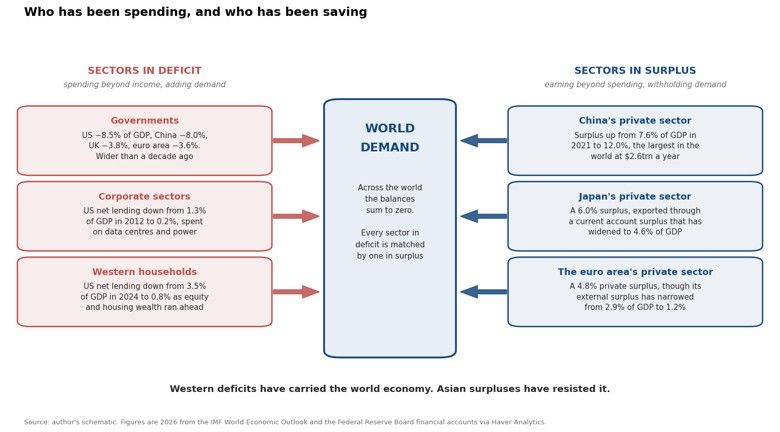
Who has been spending, and who has been saving. Source: IMF World Economic Outlook October 2026 and Federal Reserve Board via Haver Analytics; author calculations.
The exhibits above and below illustrate how saving and spending differ across economies. China, Japan and the euro area have private sectors that save more than they invest, while government borrowing absorbs part of those surpluses. For the global outlook, the question is how domestic demand evolves across these economies as spending elsewhere slows.
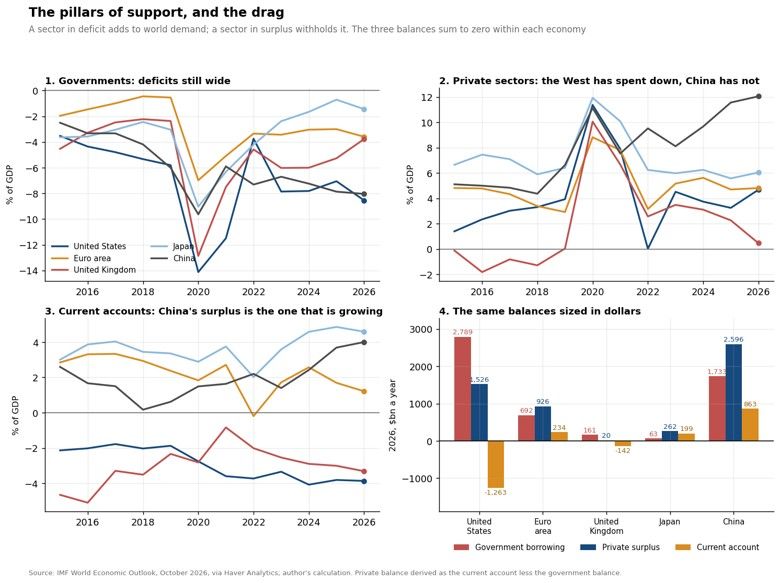
Government, private and current account balances, and the same balances in US dollars. Source: IMF World Economic Outlook October 2026 via Haver Analytics; author calculations.
How tightening could expose the weakness Higher interest rates could accelerate that retreat. They raise financing costs, squeeze borrowers’ disposable incomes and can weigh on asset prices. They also affect prospective customers of the AI industry. A business facing weaker sales and expensive finance may postpone the integration, training and organisational changes needed to adopt AI. Spending on the technology could fall short just as providers need revenues to validate their investment.
The consequences could extend beyond technology. Disappointing revenues could weaken infrastructure investment and equity valuations, with further effects on employment, household wealth and consumption. Central banks would then be restraining an economy whose apparent strength had depended partly on expectations their decisions were helping to unsettle. Further tightening therefore needs a clear justification in the inflation evidence.
Resilience is not the same as durability The balance of risks will differ across economies. Fiscal restraint could reinforce monetary restraint, while stronger domestic demand or more persistent inflation elsewhere could justify a different response. The relevant test is both whether spending is pressing against productive capacity and how durable that spending is. A shared energy shock does not require an identical interest rate decision.
A more secure expansion would see productivity gains translate into stronger real incomes and profitable investment across a wider range of businesses. That would help customers afford the technology and validate the infrastructure being built to supply it. Until those gains spread, growth remains exposed to shifts in borrowing, saving and confidence in future returns. Central banks should take that fragility very seriously before tightening further.

Andrew Cates
AuthorMore in Author Profile »Andy Cates joined Haver Analytics as a Senior Economist in 2020. Andy has more than 25 years of experience forecasting the global economic outlook and in assessing the implications for policy settings and financial markets. He has held various senior positions in London in a number of Investment Banks including as Head of Developed Markets Economics at Nomura and as Chief Eurozone Economist at RBS. These followed a spell of 21 years as Senior International Economist at UBS, 5 of which were spent in Singapore. Prior to his time in financial services Andy was a UK economist at HM Treasury in London holding positions in the domestic forecasting and macroeconomic modelling units. He has a BA in Economics from the University of York and an MSc in Economics and Econometrics from the University of Southampton.