

 Global| Oct 20 2026
AI’s Costs Are Arriving Before Its Benefits
by:Andrew Cates
|in:Viewpoints
The AI boom faces a problem beyond the technology itself: its prospective customers must be able to afford it. Investment in computing capacity is adding to demand for power, equipment and capital before comparable productivity gains have spread across the economy. If those pressures weaken customers’ spending power, they may also constrain the revenues needed to justify the build-out. AI can fulfil its technical promise while disappointing those who finance it.
This helps explain why weakness outside technology should concern technology investors. The immediate beneficiaries of infrastructure spending are easy to identify. The eventual returns depend on a much broader group of businesses earning enough from AI to pay for its services. Those two stages need not proceed at the same pace.
The costs arrive first Every investment boom creates demand before it creates productive capacity. For AI, the timing matters because several essential inputs are slow to expand. Power stations, grid connections and transformers take years to deliver. A well-funded buyer can secure priority without increasing what is immediately available to everyone else.
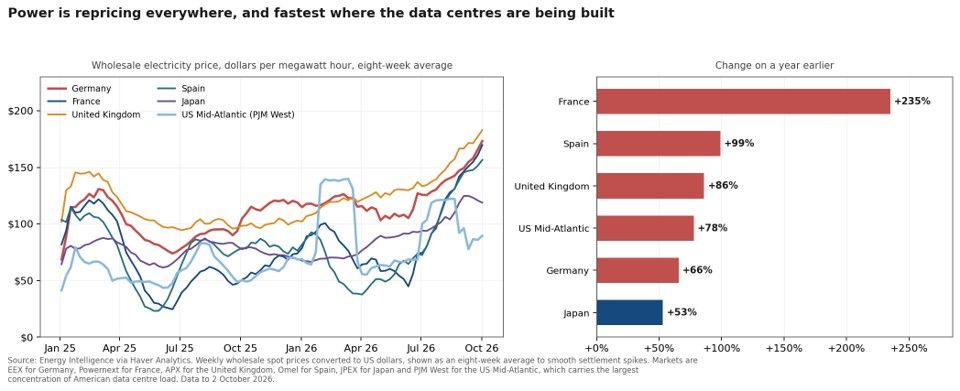
Electricity makes the constraint tangible. Data centres add demand to networks already serving competing needs. Fuel prices, weather and available generating capacity also matter, so rising power costs cannot simply be attributed to AI. Nevertheless, the build-out can intensify local shortages. For other users, the consequences include higher operating expenses and delays to investment, even if they have yet to adopt the technology.
Finance adds another hurdle. Infrastructure must earn enough to cover depreciation and the cost of capital as well as operating expenses. Wider technology credit spreads suggest greater scrutiny of that calculation. Broader corporate spreads have remained comparatively stable: evidence of a general AI-driven credit squeeze is still lacking. The immediate concern is that substantial commitments are being financed before their customer revenues are secure.
The customer must earn a return For an adopting business, the relevant calculation extends beyond the subscription. Integration, training and organisational change require money and management time. The savings or additional sales must justify the full cost. A company facing weak demand or pressure on margins has reason to proceed cautiously, negotiate harder or defer spending.
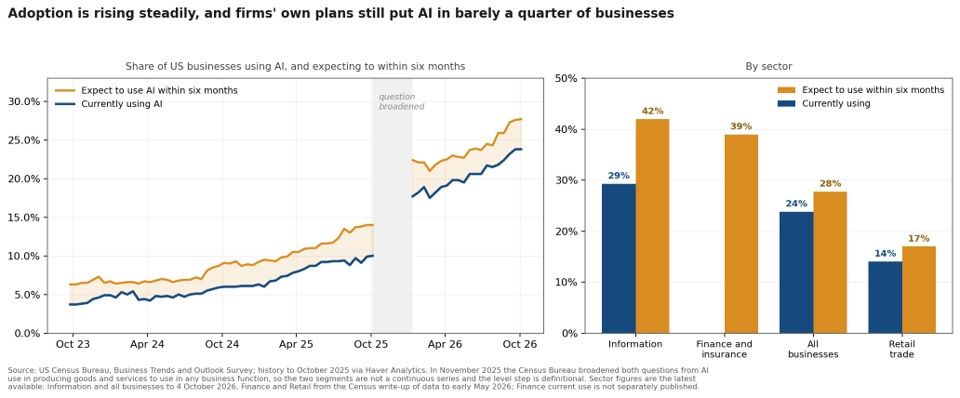
There is encouraging evidence of diffusion. Reported AI use among US businesses rose from below 18% in January to almost 24% in early October. But adoption often remains confined to a limited range of functions. Growing use does not yet establish how much customers will spend, or how profitable that spending will be for suppliers.
Productivity growth and subdued unit labour costs leave room for optimism. Benefits may already be emerging. The uncertainty concerns their breadth and timing relative to the capital committed. Strong orders within the infrastructure supply chain cannot indefinitely substitute for returns earned by eventual users.
The test for markets The potential feedback is therefore clear. An investment surge puts pressure on scarce inputs. Some prospective customers face higher costs before enjoying the savings. Their caution then constrains suppliers’ pricing and revenues, just as those suppliers must service a larger capital base. This is a vulnerability to test, rather than an established explanation for recent market weakness.
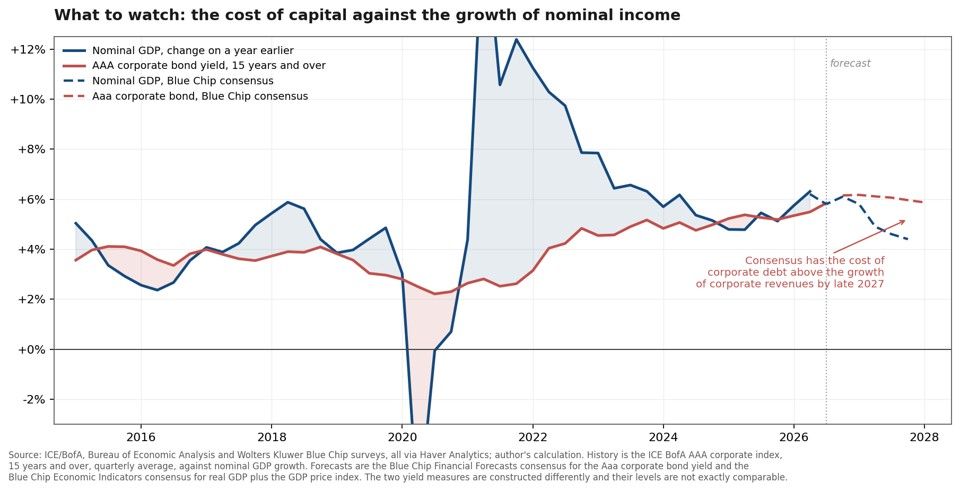
The financing outlook could make that test harder. Blue Chip forecasts envisage Aaa corporate yields above 6% through much of 2027 while nominal GDP growth slows towards 4.5%. This comparison is no direct measure of corporate profitability. It nevertheless points to a less forgiving environment for projects whose returns arrive late.
The decisive evidence will be measurable savings for users and sustained cash generation for providers. Those gains would strengthen customer spending and validate the infrastructure. Weak margins and disappointing monetisation would expose the gap between investment commitments and the income available to support them. AI’s capabilities may be extraordinary. Its financial returns still depend on customers with the means and incentive to pay.

Andrew Cates
AuthorMore in Author Profile »Andy Cates joined Haver Analytics as a Senior Economist in 2020. Andy has more than 25 years of experience forecasting the global economic outlook and in assessing the implications for policy settings and financial markets. He has held various senior positions in London in a number of Investment Banks including as Head of Developed Markets Economics at Nomura and as Chief Eurozone Economist at RBS. These followed a spell of 21 years as Senior International Economist at UBS, 5 of which were spent in Singapore. Prior to his time in financial services Andy was a UK economist at HM Treasury in London holding positions in the domestic forecasting and macroeconomic modelling units. He has a BA in Economics from the University of York and an MSc in Economics and Econometrics from the University of Southampton.