

Labor’s Share of Income Falls to All-Time Low in Third Quarter
by:Joel Prakken
|in:Viewpoints
I, and many others, have argued that following the AI buildout, investments in AI will eventually undermine labor's share of income as the declining cost of AI encourages firms aggressively to substitute computers and software for humans in the workforce.
The Bureau of Labor Statistics (BLS) will not release its estimates of third-quarter productivity and costs - including labor's share of Gross Value Added (GVA) - until Thursday of this week. However, if one knows where to look in last week's preliminary estimate of the National Income and Product Accounts for the third quarter, one can calculate the most recent share for the business sector by subtracting from total compensation of employees both the compensation of general government employees and the compensation paid by private households and nonprofit institutions serving households, and then divide the residual by the GVA of the business sector.
The recent history of that calculation is depicted in the chart. Following the introduction of ChatGPT in late 2023 there was no immediate decline in labor's share of income. However, in 2025 that share began slipping, and by the third quarter of 2026 it dropped to 49.1%, the lowest reading recorded in the quarterly data back to 1947.
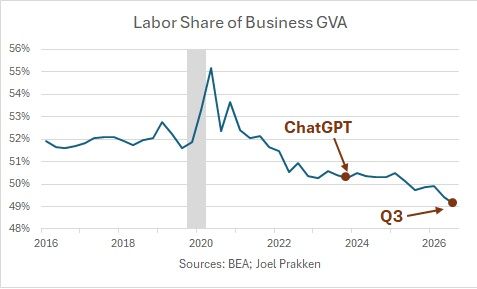
Granted, this is short interval and other factors might be at work. However, while certainly not definitive, these latest numbers at least hint at the emergence of the impact of AI in the aggregate macro data other than in the obvious facets of AI buildout. Let’s see what the BLS reports on Thursday.

Joel Prakken
AuthorMore in Author Profile »Joel Prakken is former Chief US Economist of S&P Global and IHS Markit, co-founder of Macroeconomic Advisers, and past president and director of the National Association for Business Economics. He has served as an outside advisor to the Congressional Budget Office, on the Advisory Panel of the Bureau of Economic Analysis, and as a consultant to the Joint Committee on Taxation. He holds a BA in economics from Princeton University and a PhD in economics from Washington University in Saint Louis.
 Global