Global| Nov 02 2026
S&P MFG PMIs Show Modest Global Slowing
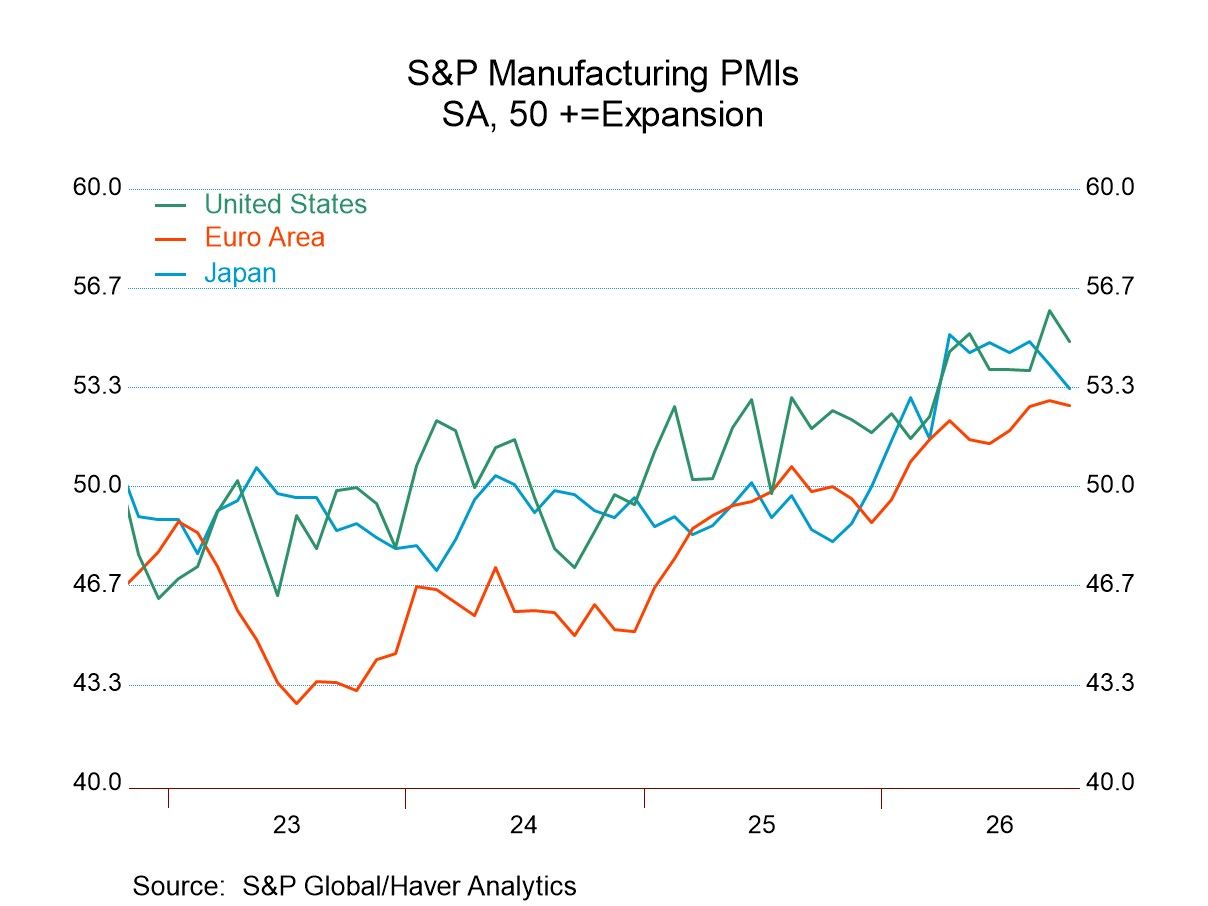
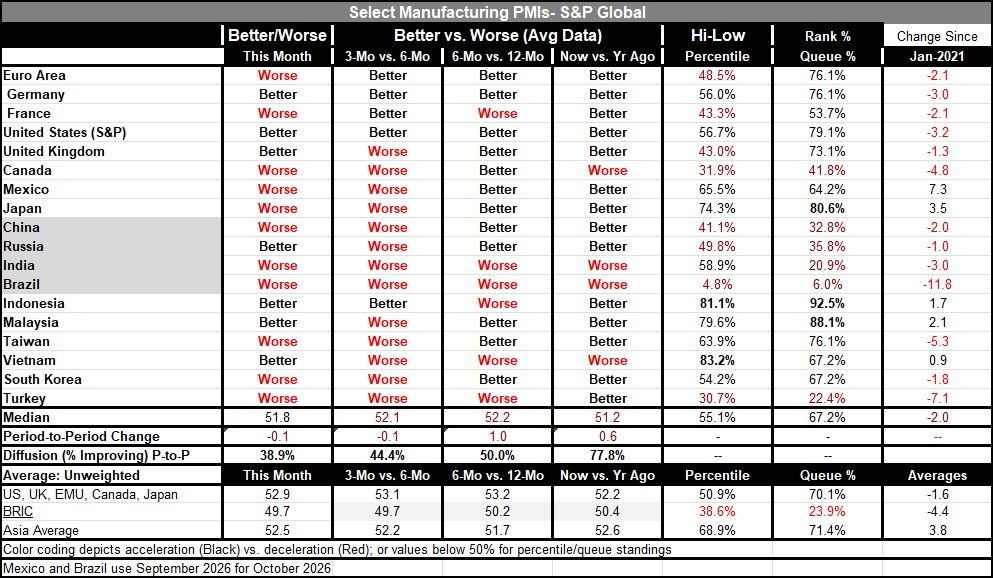
The PMI story for October shows PMIs weakening in 11 of the 18 countries that report manufacturing data. The manufacturing PMIs ticked down only slightly month-to-month, falling in 11 of eighteen reporters in October. The median reading over 12 months, six months, and three months progresses from 51.2 over 12 months to 52.2 over six months to 52.1 over three months. There's really not much change there to base a lot of analysis on; conditions have been substantially the same across this broad group of countries.
Sequentially the PMI data show that over three months 13 of the 18 early reporting countries have lower PMI values with only 5 showing better values. Over six months, six countries show worsening results with 12 showing improvement. Over 12 months, only four countries show worsening results with 14 showing improvement. As we look at the breadth of improvement versus deterioration from 12 months to six months to three months, there's a narrowing, a clear narrowing, in terms of the breadth of countries showing conditions getting better compared to those showing conditions getting worse. However, that statement also exists in the same world where the median for the group hasn't changed very much over any of those horizons.
Understanding this period – is it representative? To get a broader perspective, we can look at the rank or queue percentile standings that give us a percentile standing for each of the reporting countries or areas on data back to January 2021, a relatively broad period. However, it's not a time span in which activity was particularly strong. Still, using the EMU Commission readings on the EMU as a benchmark, the average back to 1990 shows the ranking of the current period average assessment as nearly normal; the reading for October is about 3% below the EMU mean on data back to 1990. So, the rankings over this period may also be a reasonable proxy for longer term rankings in the broadest sense.
There was some strength in the recovery and the immediate post-COVID period. And then there was the invasion of Ukraine that really knocked things back down. Subsequently there were U.S. tariffs imposed that created another international kerfuffle, and then the attack by Hamas on Israel, and the subsequent attempt to rein in Iran by the U.S. and Israel with significant knock-on effects that are largely still in place involving the difficulty for oil and other commodities to pass safely through the Strait of Hormuz. So, rankings on this timeline are not for a period of robust growth, but then that is not unusual, statistically. Part of that is that our period begins on a post-COVID high with activity having rebounded. The median percentile standing for this group on data back to January 2021 is a 67.2 percentile standing, which places it just barely into the top third of all observations on this timeline. Only three countries log percentile standings in the top 20% of all their observations during this span. They are Japan, Indonesia, and Malaysia, all Asian economies. The weakest readings on the period, at readings of around 25% and lower, include India at a 20.9 percentile standing, Turkey at a 22.4 percentile standing, and Brazil at a very weak 6th percentile standing. The grouping of these weakest economies includes two BRIC economies plus Turkey.
The large economies are doing well compared to their performance over this timeline, with the euro area economies having a 76.1 percentile standing, Germany, in particular, having a 76.1 percentile standing, the U.S. having a 79.1 percentile standing, the U.K. having a 73.1 percentile standing, and Japan having an 80.6 percentile standing. However, in contrast, France, with all of its fiscal trouble, has only a 53.7 percentile standing over the same period. Oil prices are shooting up again as the U.S. midterm elections draw near. There is a creeping rumor mill of commentary that suggests that the U.S. will be increasing hostilities against Iran after the midterm elections. That buzz has markets on edge and oil prices are moving higher again.
To be sure, the outlook is quite uncertain and the potential for things to go wrong and to get worse is certainly present. Markets are largely undisturbed, perhaps because fiscal policy globally remains supportive and expansive and then, in the U.S., because the tremendous amount of investment in AI is underpinning growth and the buildout of data centers is helping to generate more income and support consumer spending. However, if things go very wrong in global politics, it's unclear that the tech revolution in the United States is going to be enough to support conditions, and that's where the problem breaks out.
Concerns about growth might be greater than what market momentum would seem to suggest. Bond markets are certainly wary about inflation and some of the recent talk about monetary policy has made it clear that central banks may not have as firm of a grip on what inflation is or on how to deal with it, particularly in an era where we're getting repeated supply shocks. Monetary policy is not geared up to deal with supply shocks. That really falls into the realm of fiscal policy, but fiscal policy has its hands tied in many places because it's been so overused.
There is a clear lesson here, but I'm not sure we're going to learn it. Fiscal policy has to be used sparingly. If fiscal policy is not brought back down to normal levels of spending and if it just ratchets up during the business cycle, countries find themselves at an extreme part of the business cycle, as we are now, with high debt-to-GDP ratios and suddenly very worried about what's going to happen to that ratio if growth falls short. Monetary policy has coddled the inflation rate to preserve employment which also has developed, not surprisingly, in an era with so much excess fiscal policy. But doing so allows even more inflation to get out of control and then that might require a much more crushing increase in interest rates which, given the high debt levels, would have an even more crushing impact on the economy. So, what have we learned here? Anything?
Monetary policy has played the same game that fiscal policy has. It has been inattentive to the underlying inflation pace in the U.S., in particular. Inflation has overshot its target for five and a half years. Inflation in other countries has been too high for too long as well, now with another surge of inflation coming in the guise of another supply shock. Central banks aren't even sure what they're supposed to do with supply-shock inflation. In some quarters, economists think they should do very little, except that inflation is already excessive; a central bank that doesn't do anything to an inflation rate that accelerates when it's already over target is going to have huge credibility problems.
While these issues may seem mundane at the moment, the debt-to-GDP ratio is not exactly the stuff of headlines, but maybe it should be. What if it puts us in an era of fiscal dominance and tries to subvert monetary policy? We could wind up in a situation that is less like the Great Inflation of the 1970s and more like the downturn of the Great Depression. You can't dig yourself out of depression if you've already racked up too much debt and if monetary policy is hamstrung because the inflation rate is too high. We've kicked the can far too hard, and far too far, down the road. That does not go on forever. We're beginning to see the cul-de-sac at the end, and we don't have any plans for what to do when we get there.

Robert Brusca
AuthorMore in Author Profile »Robert A. Brusca is Chief Economist of Fact and Opinion Economics, a consulting firm he founded in Manhattan. He has been an economist on Wall Street for over 25 years. He has visited central banking and large institutional clients in over 30 countries in his career as an economist. Mr. Brusca was a Divisional Research Chief at the Federal Reserve Bank of NY (Chief of the International Financial markets Division), a Fed Watcher at Irving Trust and Chief Economist at Nikko Securities International. He is widely quoted and appears in various media. Mr. Brusca holds an MA and Ph.D. in economics from Michigan State University and a BA in Economics from the University of Michigan. His research pursues his strong interests in non aligned policy economics as well as international economics. FAO Economics’ research targets investors to assist them in making better investment decisions in stocks, bonds and in a variety of international assets. The company does not manage money and has no conflicts in giving economic advice.
More Economy in Brief