Inflation in the Euro Area Gets Worse
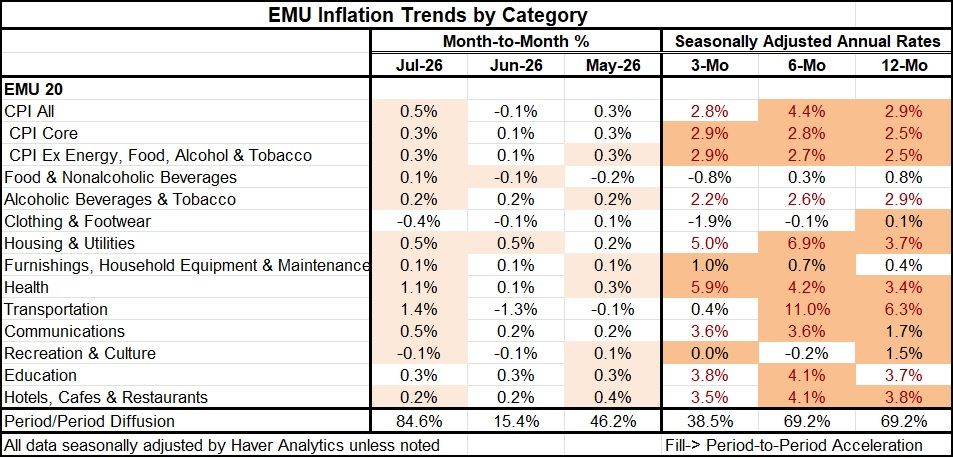
Inflation in the Euro Area Inflation in the euro area was up in July, rising 0.5% month-to-month after prices fell by 0.1% in June. Core inflation notched up, increasing 0.3% in the month after rising by just 0.1% in June. Core inflation is steadily ramping up. Headline inflation ramps up but eases off over three months compared to six months.
Month-to-month inflation in July accelerated in over 84% of the categories. June was an anomaly with inflation accelerating in only 15% of the categories after accelerating in 46% of the categories in May. Sequential diffusions find inflation higher over three months than over six months in 38.5% of the categories, and in 69% of the categories over six months compared to 12 months. Inflation rates over 12 months are higher than 12 months ago also in 69% of the categories.
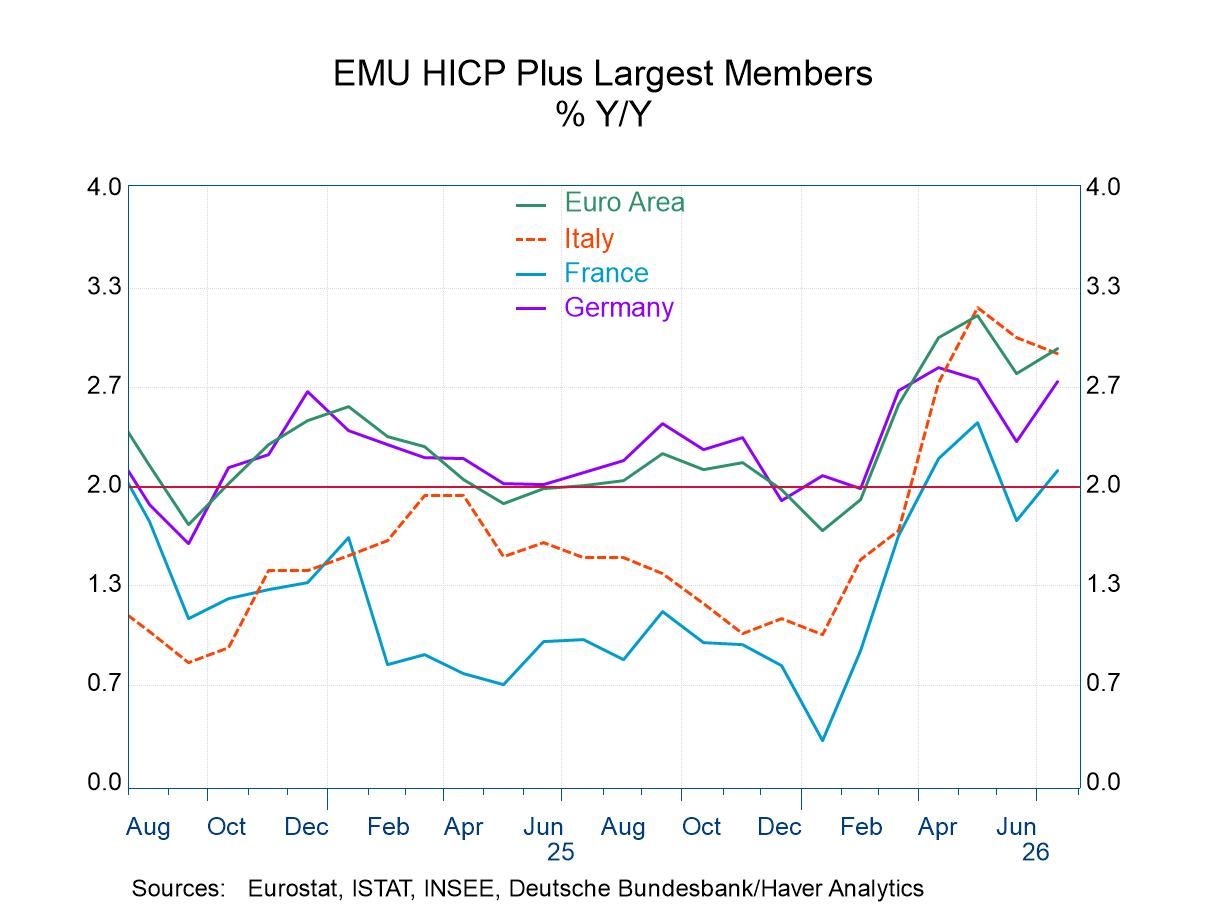
At 2.9% over 12 months, ECB inflation is above its targeted pace of 2%. At 2.5%, core inflation is also overshooting but not as badly. The graphic shows that inflation is overshooting in each of the four largest monetary union members. Food inflation is below 2% (0.8%), annual clothing & footwear inflation is low (0.1%), furnishing & household equipment inflation is low (0.4%), and communications inflation (1.7%) and recreation & culture inflation (1.5%) are both still within the bounds sought by the ECB. That’s five of eleven categories below 2%, running at their own individual paces. Housing & utilities costs and transportation are both logging inflation numbers far above the 2% mark; both are affected by rising energy costs. Education and hotels & restaurants are showing strong pressure for an assortment of other reasons.
Clearly, the way forward for the ECB is going to depend a great deal on developments in the Middle East and the ease of traffic flow through the Strait of Hormuz. However, Europe has even deeper energy problems. Its inventories have been run down and are low. Those countries using nuclear power have found that drought conditions in Europe have reduced the flow of water across their major waterways and led to a reduction in nuclear power output or in some cases a shuttering of nuclear facilities because not enough cooling water can be obtained for reactors. Not only that, but transportation has been choked, supply lines interrupted, and deliveries delayed.
Come winter, Europe may have more power issues, as it will be depending on LNG shipments for its winter power.
Europe faces challenges. The inflation picture, previously benign, has become acute or at least difficult. Europeans can be angry at the U.S. for backing Israel and participating in an attack on Iran, an act that jolted European inflation out of its target path into the danger zone. But the U.S.-Israel joint action did destroy Iran’s nuclear facilities, which it is now rebuilding. It exposed Iran as having longer-range missiles that it denied possessing. While the war, often now referred to as Trump’s war, is unpopular, you can ask yourself: would you really have preferred to let Iran go and develop nuclear weapons and make more long-range missiles so you could have cheap gasoline, for now? Would that world have been safer or better than this world? No one likes war. But Iran, acting through its vassal groups in the region, precipitated all this, starting with the attack on Israel by Hamas. One thing led to another and put us on this path. We cannot go back; time does not rewind. But the way forward now is much harder to see. And the way ahead seems to have a lot more risk, as levels of fiscal debt and the demand for military spending stoke more inflation and push monetary policy to be tighter. The war between Ukraine and Russia continues; Russia may be taking steps to make it broader. It is a series of events now feeding on itself, and it is a difficult and dangerous dynamic. It is no longer just about growth, monetary, and fiscal policy. The whole outlook is much more complicated.

Robert Brusca
AuthorMore in Author Profile »Robert A. Brusca is Chief Economist of Fact and Opinion Economics, a consulting firm he founded in Manhattan. He has been an economist on Wall Street for over 25 years. He has visited central banking and large institutional clients in over 30 countries in his career as an economist. Mr. Brusca was a Divisional Research Chief at the Federal Reserve Bank of NY (Chief of the International Financial markets Division), a Fed Watcher at Irving Trust and Chief Economist at Nikko Securities International. He is widely quoted and appears in various media. Mr. Brusca holds an MA and Ph.D. in economics from Michigan State University and a BA in Economics from the University of Michigan. His research pursues his strong interests in non aligned policy economics as well as international economics. FAO Economics’ research targets investors to assist them in making better investment decisions in stocks, bonds and in a variety of international assets. The company does not manage money and has no conflicts in giving economic advice.
More Economy in Brief
 Global