Germany’s ZEW Survey Sours
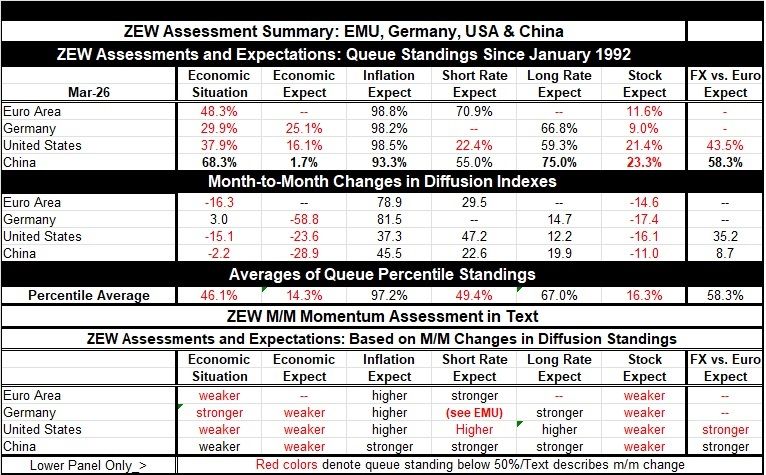
The ZEW survey, which is a survey of German financial experts, showed a weakening in March as the economic situation deteriorated sharply in the wake of the start of the war in Iran. For the euro area, the reading dropped to -29.9 in March from -13.6 in February; for Germany, the reading surprisingly improved a slight bit to -62.9 from -65.9; for the United States, a positive reading of 4.5 was still posted; however, it was down significantly from +19.6 in February. China’s reading fell to -33.7 from -31.5. The rank standings for these readings on data back to late-1992 for most reporters, but only back to April 2021 for China, shows the euro area at a reading near its median over this span. While Germany and the U.S. are substantially below their medians, with percentile standings near 30% for Germany and near the 40th percentile for the U.S. China logs a stronger queue standing above its median at 68.3%.
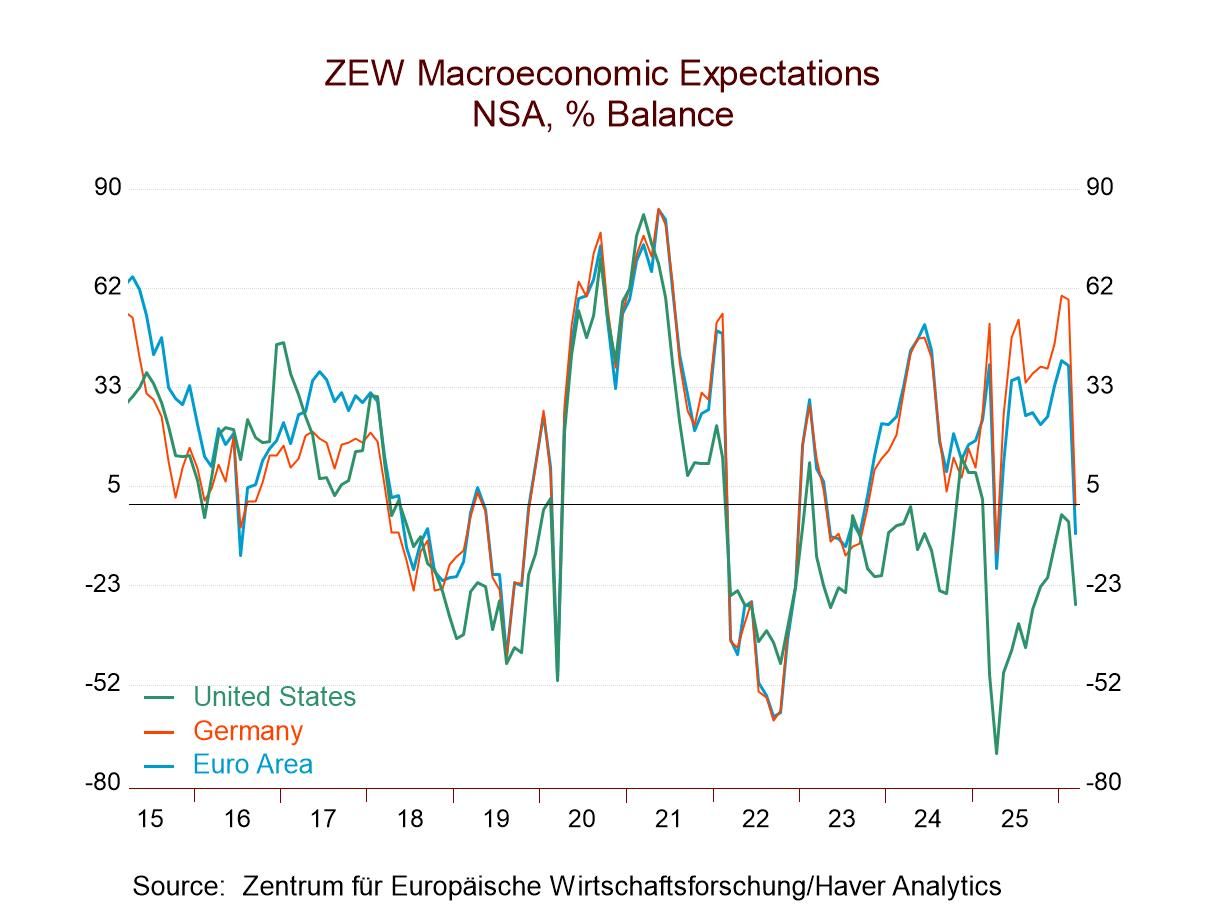
Macro expectations fell more clearly and sharply for all the reporters in March. For Germany, the drop was to -0.5 in March from +58.3 in February, while the U.S. drop was to -28.7 from -5.1 in February. China’s drop was to -15.8 from +13.1 in February. The standings for these March readings place China at a 1.7 percentile standing, the U.S. at a 16.1 percentile standing, and Germany at a 25.1 percentile standing. All of them are quite weak in the lower quartile of their respective queues of data.
With oil prices jumping sharply, inflation expectations have simply skyrocketed on the month. For the euro area, the reading that was near 0 in February jumped to 79 in March. For Germany, a reading of -2.3 in February surged to 79.2 in March. For the U.S., an inflation expectation of 43.1 in February nearly doubled to 80.4 in March. For China, a February reading of 10.5 ran up to 56.0 for March. The queue percentile standings for the March readings rose to the 98th percentile for the euro area, Germany, and the U.S., while China's standing also moved up strongly to its 93rd percentile, when ranked over a shorter period extending back to April 2021.
With inflation going up, short-term interest rate expectations rose as well. Those expectations rose in the euro area, the U.S., and China. For each of these reporters, there was a significant increase in the short-term rate expectations. The euro area expectation survey value has a standing in its 70.9 percentile, China’s standing is at its 55th percentile, while the U.S. standing is still below its median at its 22.4 percentile.
Long-term rate expectations moved up in all areas as well, with Germany's new reading having a 66.8 percentile standing, China at a 75th percentile standing, and the U.S. at a 59th percentile standing. Each one of these is above its historic median. Long-term expectations are elevated.
Stock markets in all areas weakened in March compared to February, with most showing declines of about 50% or so in this survey. The queue standings for the new readings are all in the lower 25th percentile of their respective data queues. Some of them are significantly lower, such as Germany, which stands only in its 9th percentile. On balance, the attack in Iran has been a game-changer for economic perceptions and expectations. Markets are wary. And everyone knows the centerpiece is the Strait of Hormuz. But that does not make it much easier to handicap the future.

Robert Brusca
AuthorMore in Author Profile »Robert A. Brusca is Chief Economist of Fact and Opinion Economics, a consulting firm he founded in Manhattan. He has been an economist on Wall Street for over 25 years. He has visited central banking and large institutional clients in over 30 countries in his career as an economist. Mr. Brusca was a Divisional Research Chief at the Federal Reserve Bank of NY (Chief of the International Financial markets Division), a Fed Watcher at Irving Trust and Chief Economist at Nikko Securities International. He is widely quoted and appears in various media. Mr. Brusca holds an MA and Ph.D. in economics from Michigan State University and a BA in Economics from the University of Michigan. His research pursues his strong interests in non aligned policy economics as well as international economics. FAO Economics’ research targets investors to assist them in making better investment decisions in stocks, bonds and in a variety of international assets. The company does not manage money and has no conflicts in giving economic advice.
More Economy in Brief
 Global