German Orders Surge on Domestic Strength
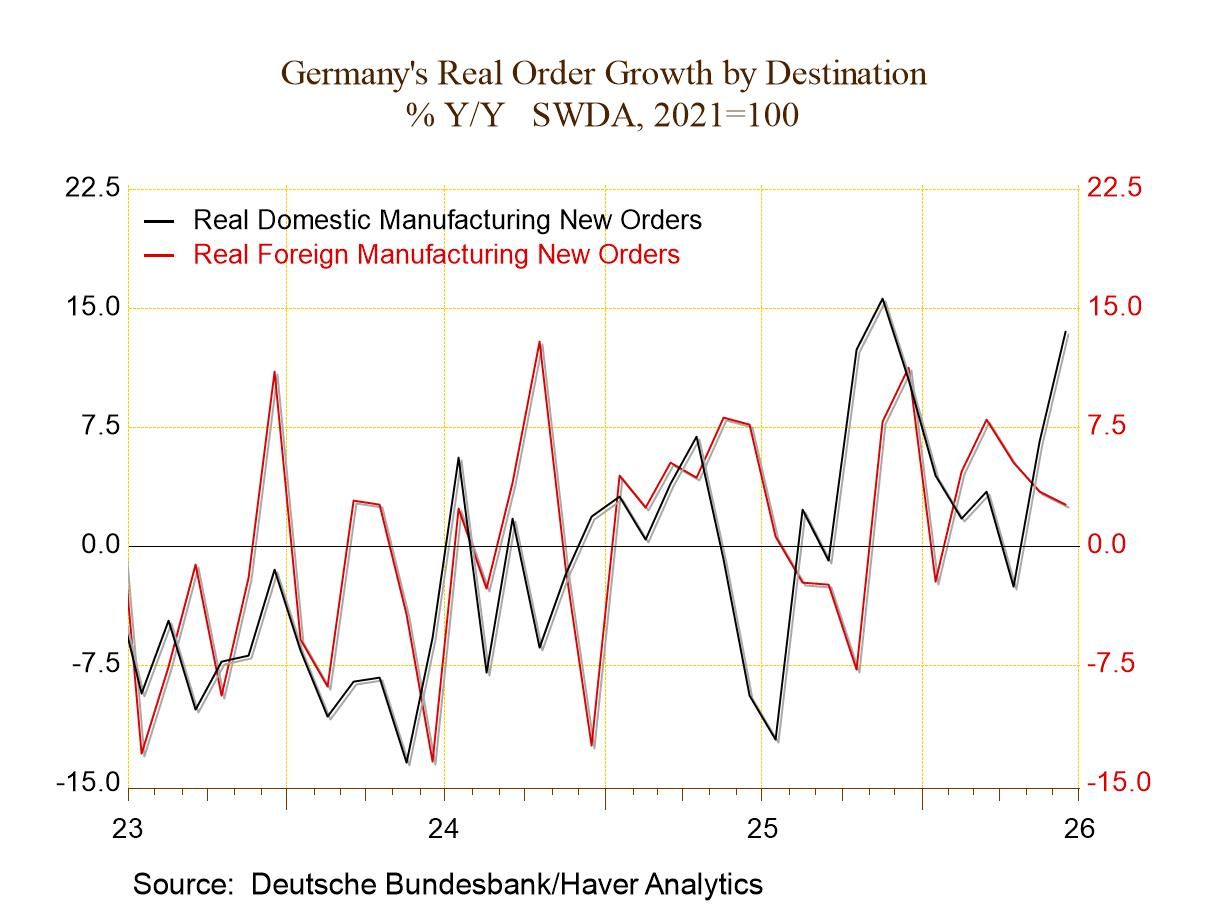
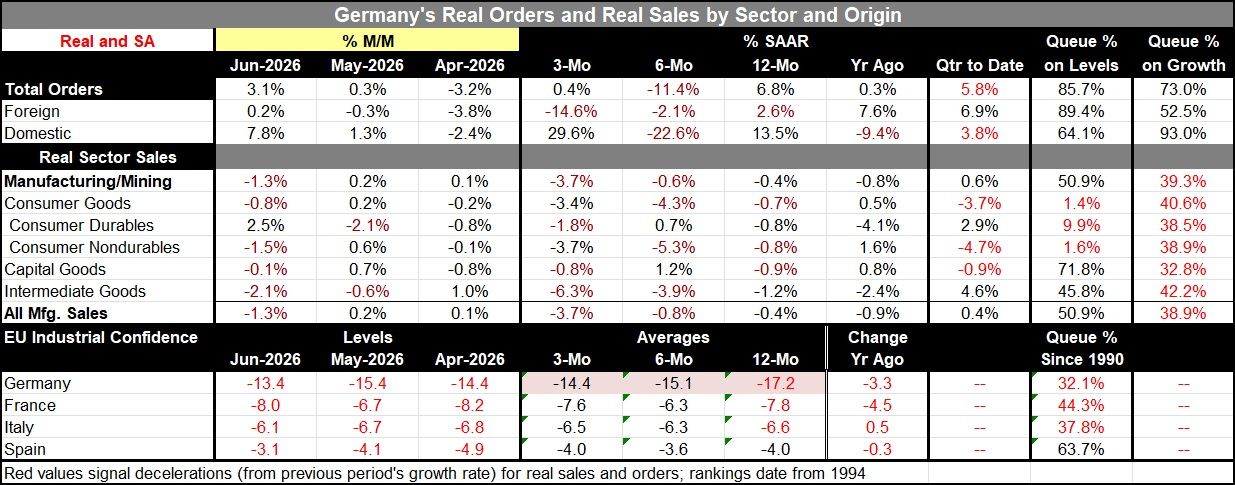
German orders in June rose by 3.1%, after a 0.3% crawl higher in May and a sharp 3.2% decline in April. Domestic orders have been gradually building a head of steam after falling 2.4% in April; they rose by 1.3% in May and surged by 7.8% in June. Over the same timeline, there was a 3.8% decline in foreign orders in April; that decline was trimmed to 0.3% in May and became a tiny 0.2% increase in June. In all cases, there was a progression from relatively deep negative numbers in April in the wake of the start of the attacks on Iran. That weakness led to stabilization and a moderate increase in May, and then to a lot more strength in June as markets and economies became hopeful that the Iran war was winding down as both parties seemed to be getting slightly punch-drunk.
Sequential Growth Patterns The progression of orders from 12 months to six months to three months is not clean, with a lack of overall trend for orders. Foreign orders move to progressive weakness from 12 months to six months to three months. Domestic orders are somewhat chaotic in their pattern but show a 13.5% increase over 12 months and an explosive 29.6% annual rate increase over three months. The foreign orders series is weak and somewhat concerning, but the domestic order series maintains quite reassuring growth over 12 months and three months.
Quarter-to-Date Orders In quarter-to-date (QTD), the data are now complete even if they are preliminary, with total orders rising 5.8%, foreign orders rising 6.9%, and domestic orders rising 3.8%, all at annual rates. The queue standings on the levels of orders as of June show strong 85-to-90-percentile levels of activity for total orders and foreign orders, with domestic orders coming in at a milder, but still above-median 64.1 percentile standing. When we rank orders in terms of their year-over-year growth rates, total orders have a 73.0 percentile standing, with foreign orders at a 52.5 percentile standing and domestic orders at a 93.0 percentile mark. The growth performance favors domestic orders, but the level of orders that is being achieved is better for foreign compared to domestic orders using historic comparison standards.
Sales/Real Sector Sales Turning to sales, we find them somewhat more erratic in June, showing a decline for manufacturing overall, with all manufacturing sectors showing month-to-month drops except consumer durables where sales have a 2.5% gain. Manufacturing sales in real terms rose by 0.2%, with mixed sector performance. In April, all sales made a 0.1% gain in real terms amid convoluted sector patterns. The sequential performance of retail sales by sector shows the overall trend is progressively weakening, with all manufacturing sales falling by 0.4% over 12 months, by 0.8% at an annual rate over six months, and by 3.7% at an annual rate over three months. Sales decline for all categories over three months, for most categories over six months, and for all categories over 12 months. The sales picture is not particularly healthy, but fortunately that's a look back at what consumers and businesses have done, while, presumably, the orders data are more robust and looking ahead. The queue standing levels for real sales are quite weak. In fact, for manufacturing, the overall ranking is just above 50% at a 50.9 percentile standing. Capital goods have a very strong 71.8 percentile standing. Intermediate goods have a standing just short of their median at a 45.8 percentile. But real sales for consumer goods, consumer durables, and consumer nondurables are extremely weak, in the bottom 10-percentile standing or even weaker. Turning to rankings based upon the pace of sales on year-over-year data, all of the metrics for real sector sales are below the 50% mark, which means they are below their respective medians for the period. However, the rankings are generally clustered around a 40-percentile standing, which is moderately weak, within roughly 10 percentile points of the median. While not encouraging, it's not devastating.
Industrial Confidence in Europe Industrial confidence measures for Germany, France, Italy, and Spain, providing a quick look at the large countries in the European Monetary Union, showed negative readings in June for all the countries, with slight progress made in June compared to May in three of the four countries (France being the exception showing slippage). The averages over 36 months and 12 months again show consistently negative numbers, with very little change over three months compared to 12 months. The rankings of the industrial confidence readings, which are diffusion indexes from the EU, show only Spain with a ranking above its 50-percentile, putting it above its past median. However, France has a 44.3 percentile standing, which is close to the median; Italy has a 37.8 percentile standing; and Germany has the lowest standing at its 32.1 percentile.
Summing Up The bottom line is that the European industrial data do not show much momentum; they score out as moderately weak. For the most part, German real sales data are also weak; the momentum, gauged by the 12-month growth rate, is below par. However, orders are a relatively bright spot, with growth rankings above the median and in fact quite high, particularly for domestic activity and with strong levels for foreign activity. Momentum is mixed with a choppy domestic number that finishes on a very high note over three months, but that plays against a foreign trend that sees orders consistently weakening. The orders picture for Germany is improving, but for all of Europe conditions are still fairly weak.

Robert Brusca
AuthorMore in Author Profile »Robert A. Brusca is Chief Economist of Fact and Opinion Economics, a consulting firm he founded in Manhattan. He has been an economist on Wall Street for over 25 years. He has visited central banking and large institutional clients in over 30 countries in his career as an economist. Mr. Brusca was a Divisional Research Chief at the Federal Reserve Bank of NY (Chief of the International Financial markets Division), a Fed Watcher at Irving Trust and Chief Economist at Nikko Securities International. He is widely quoted and appears in various media. Mr. Brusca holds an MA and Ph.D. in economics from Michigan State University and a BA in Economics from the University of Michigan. His research pursues his strong interests in non aligned policy economics as well as international economics. FAO Economics’ research targets investors to assist them in making better investment decisions in stocks, bonds and in a variety of international assets. The company does not manage money and has no conflicts in giving economic advice.
More Economy in Brief
 Asia
Asia