GDP Remains Weak in EMU
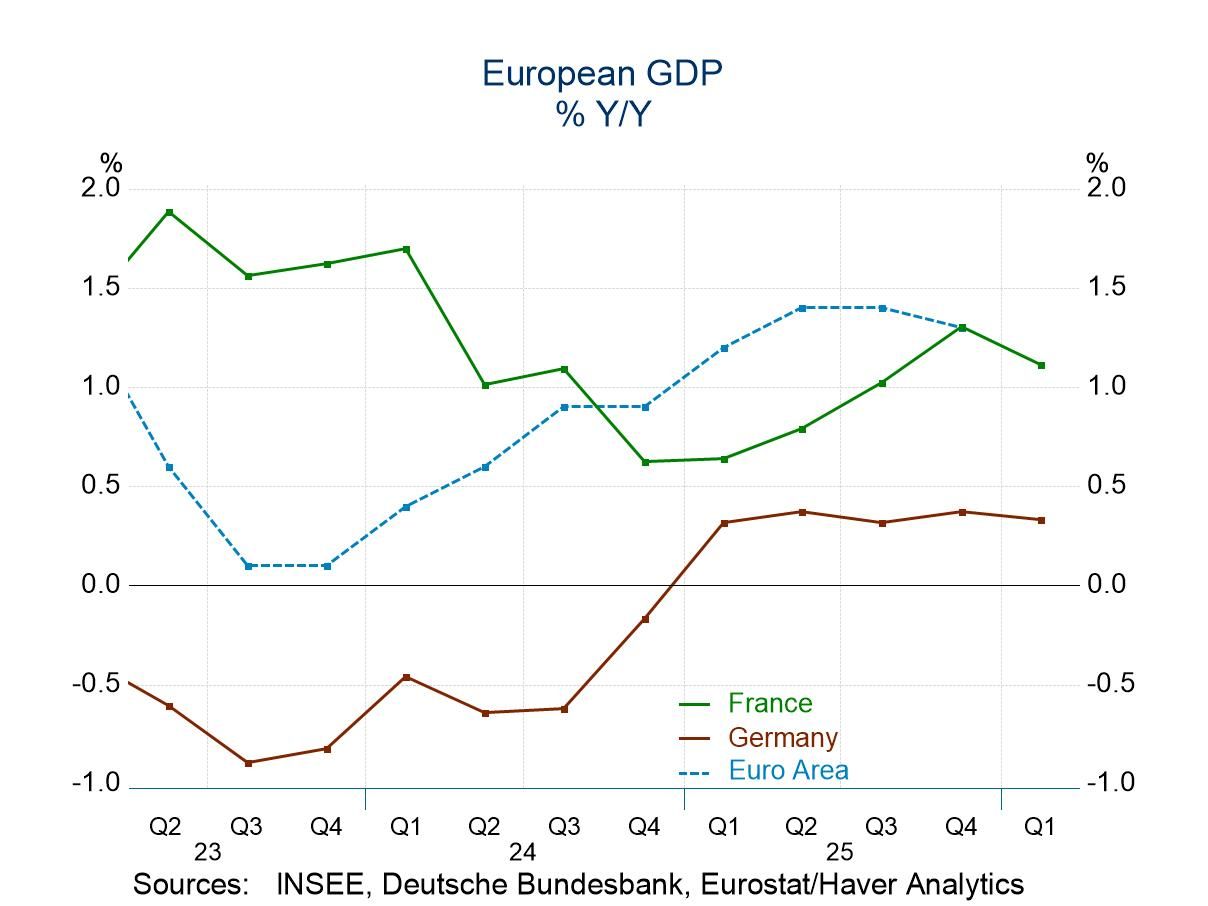
GDP growth in Europe in the first quarter of 2026 continued to be weak. First-quarter annualized growth at 0.6% followed a fourth-quarter annualized growth rate at 0.8%. Year-over-year growth in the monetary union logged a 0.8% annual rate; that represents a slowdown from earlier quarters where the growth rates were generally above 1% and more on the order of 1.5% at an annual rate.
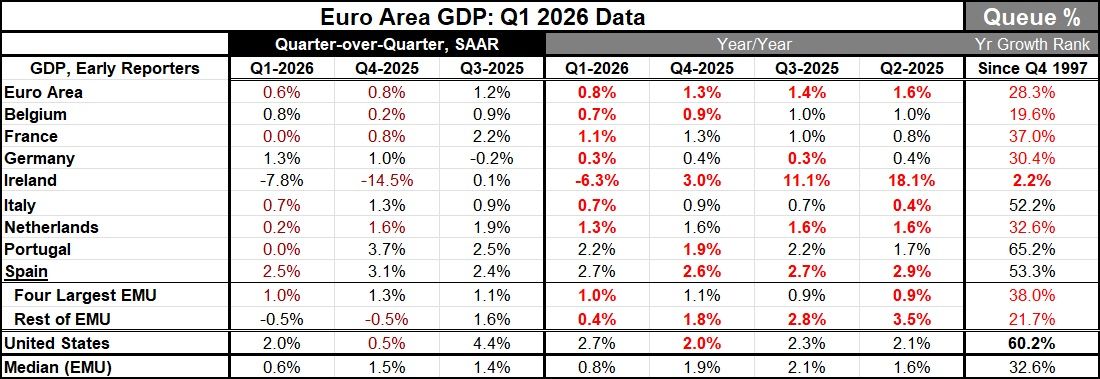
Early GDP reporters in EMU Among the 8 early reporters of GDP in the first quarter, in the table, only three posted growth pickups compared to the previous quarter. Those were Belgium, with a growth rate in the first quarter annualized at 0.8%, up from 0.2% in Q4 2025; Germany, where the growth rate picked up to 1.3% in the first quarter from 1.0% in Q4; and Ireland, with a dubious acceleration of growth to a -7.8% annualized rate, improving from -14.5% annualized in Q4.
Big country, small country The table also looks at growth divided into the four largest economies in the monetary union versus the rest of the monetary union. There we see a growth rate of 1% for the four largest economies, a slowdown from 1.3% in the fourth quarter. For the rest of the monetary union, the growth rate held at 0.5% in the first quarter, the same rate logged in the fourth quarter.
Median growth The median growth rate among these reporters was 0.6%, the same as for the weighted growth rate in the EMU, while the median in the fourth quarter was 1.5% compared to a weighted growth rate for the monetary union at 0.8%.
Ranking the growth rates vs. their own histories The ranking data on the far-right column rank growth in the first quarter on its year-over-year growth pace. On a historic profile, we see only three monetary union reporters with growth in the first quarter at a rate that exceeds median on data back to the 1990s. Those economies are Italy with a 52.2 percentile ranking, Spain with a 53.3 percentile ranking, and Portugal with a 65.2 percentile ranking. For the monetary union as a whole, the growth rate rank is 28.3%, placing it at a ranking between its lower 1/4 and lower 1/3. The median for the monetary union among these early reporting countries is a 32.6 percentile growth rate, and these compared to the United States where the growth rate has a 60.2 percentile standing.
Other data sources report that growth in the services sector has been extremely weak, while there actually has been some resilience in manufacturing. That is somewhat surprising given the Middle East War that affects the world trade and global supply chains. New disruptions because of war in the Middle East are a new fact of life. However, war itself sometimes is a stimulant to some forms of growth. These sector trends will be for us to watch, but for right now growth rates are not impressive and they're certainly not gaining momentum.

Robert Brusca
AuthorMore in Author Profile »Robert A. Brusca is Chief Economist of Fact and Opinion Economics, a consulting firm he founded in Manhattan. He has been an economist on Wall Street for over 25 years. He has visited central banking and large institutional clients in over 30 countries in his career as an economist. Mr. Brusca was a Divisional Research Chief at the Federal Reserve Bank of NY (Chief of the International Financial markets Division), a Fed Watcher at Irving Trust and Chief Economist at Nikko Securities International. He is widely quoted and appears in various media. Mr. Brusca holds an MA and Ph.D. in economics from Michigan State University and a BA in Economics from the University of Michigan. His research pursues his strong interests in non aligned policy economics as well as international economics. FAO Economics’ research targets investors to assist them in making better investment decisions in stocks, bonds and in a variety of international assets. The company does not manage money and has no conflicts in giving economic advice.
More Economy in Brief
 Global