French Manufacturing Survey Improves
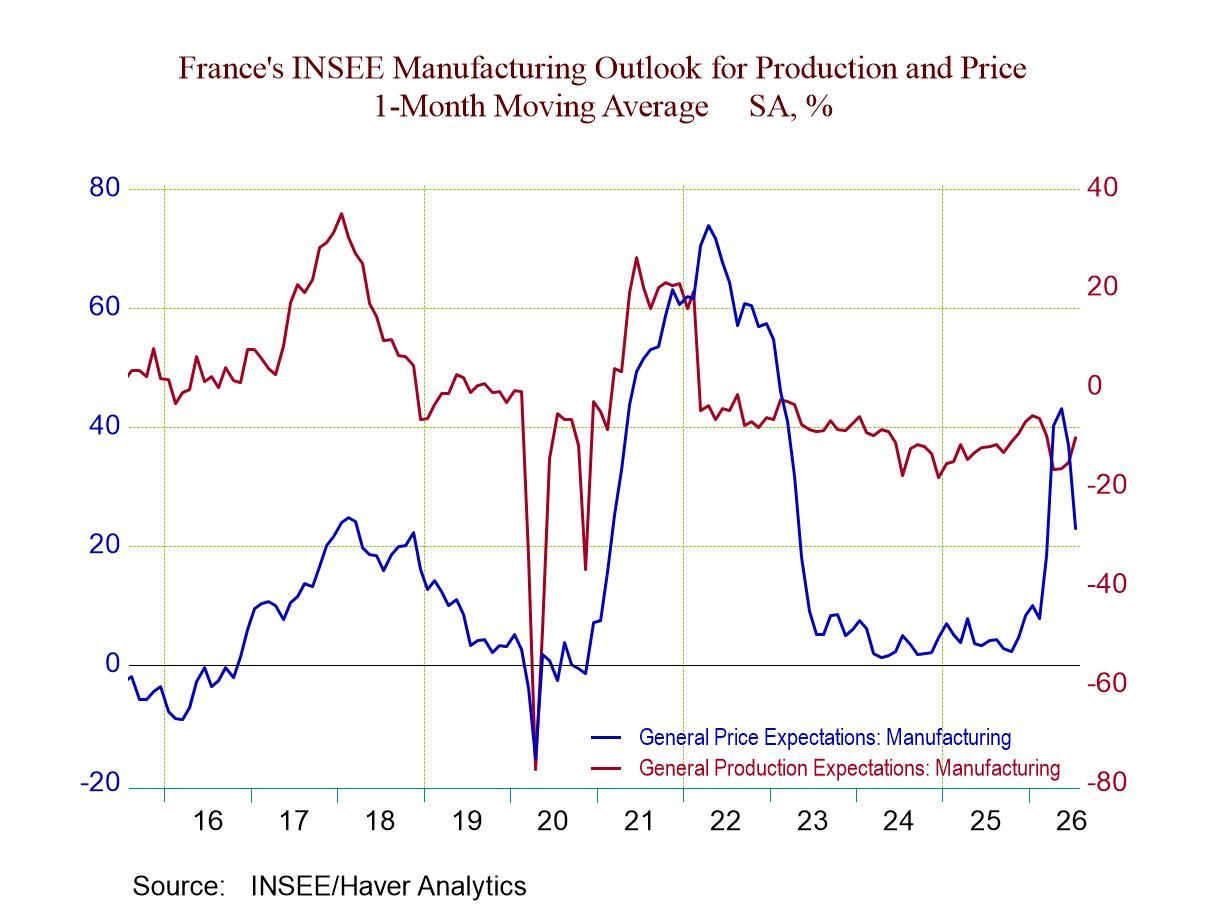
French manufacturing saw its climate index rise to 101.3 in July from 100.2 in June, still below its May level and exceeded by readings from December 2025 to February 2026. Apart from those four readings, the French index was last stronger in March 2024. On data back to April 2023, some 40 observations, the industry climate index has been higher only six times. Still, on data back to 2001 the current climate reading has a 53-percentile standing. While the current reading is slightly above par on a long historic timeline and just above its median reading, which occurs at a ranking of 50, its 53-percentile ranking marks it as slightly above its historic median; however, it is quite strong compared to the past 40 months (3 1/3 years).
Manufacturing production expectations have improved slightly over the past year from -11.9 to -10.1, with a 38.6 percentile standing, below its historic median.
The recent trend for production has improved even more sharply over the past year from -2.5 to +7.3, with a 59.8 percentile standing, well above its historic median. Interestingly, when asked about their own industry, survey respondents were less upbeat as the current reading at -0.6 was better than its year-ago -5.0, but only at a 16.3 percentile standing, a rather dismal showing.
Orders & demand and foreign orders & demand both moved up from their year-ago readings, improving by some six to eight points from their respective year-ago levels. Orders & demand overall have a 69.9 percentile standing, quite a solid reading, compared to foreign orders & demand, with only a slightly above-median 50.7 percentile standing.
Pricing finds both the own likely price level and the overall manufacturing level higher than they were a year ago. Own prices are higher by 3.1 points while manufacturing prices in general are deemed higher by 18.8 points, a massive difference. But the price levels by each response, placed in a percentile standing mode, produce standings at about the 75th percentile for each of them.
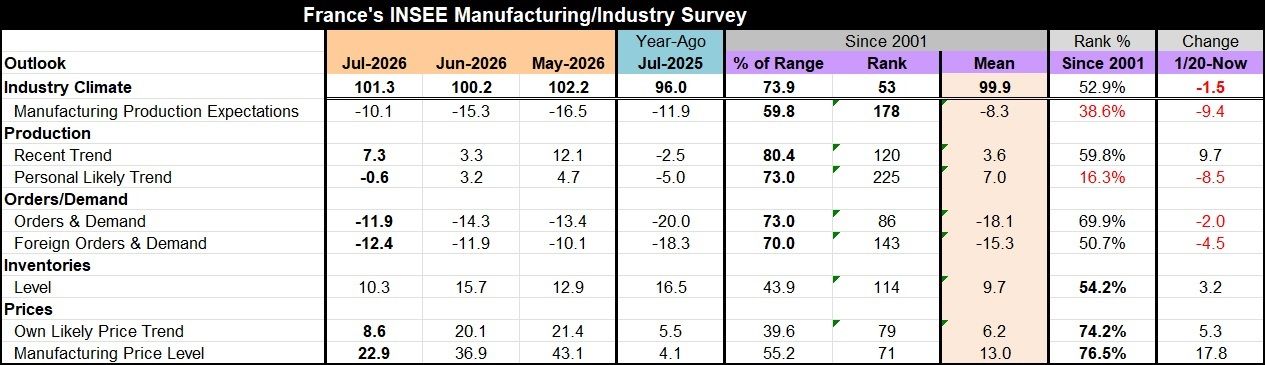
The graph shows French manufacturing prices on another up-down cycle. The down phases triggered rapidly this time; however, it is probably going to give way to another spurt with the Middle East progress unraveling that progress; it has already happened in the real world but is not yet reflected in published economic reports. That means we will have to monitor the industry recovery path closely again.
There has been too much war, and it remains too unpredictable to know its impact on the global economy. In the wake of what was a quite disruptive Covid that itself came as the world economy was still licking its wounds from the chaos and damage of the Great Recession, policymakers are still reeling and trying to decide where to draw lines and what standards to set. They all say the right things, but they have been unsure even what their own words should mean for action. All central bankers want to promote growth and give us stable prices; however, over the last 15 years, they have had a really hard time delivering the policy to achieve those simple goals. As of 2026, these decisions are not getting any easier.

Robert Brusca
AuthorMore in Author Profile »Robert A. Brusca is Chief Economist of Fact and Opinion Economics, a consulting firm he founded in Manhattan. He has been an economist on Wall Street for over 25 years. He has visited central banking and large institutional clients in over 30 countries in his career as an economist. Mr. Brusca was a Divisional Research Chief at the Federal Reserve Bank of NY (Chief of the International Financial markets Division), a Fed Watcher at Irving Trust and Chief Economist at Nikko Securities International. He is widely quoted and appears in various media. Mr. Brusca holds an MA and Ph.D. in economics from Michigan State University and a BA in Economics from the University of Michigan. His research pursues his strong interests in non aligned policy economics as well as international economics. FAO Economics’ research targets investors to assist them in making better investment decisions in stocks, bonds and in a variety of international assets. The company does not manage money and has no conflicts in giving economic advice.
More Economy in Brief
 Global