EU Commission Indexes Weaken in September
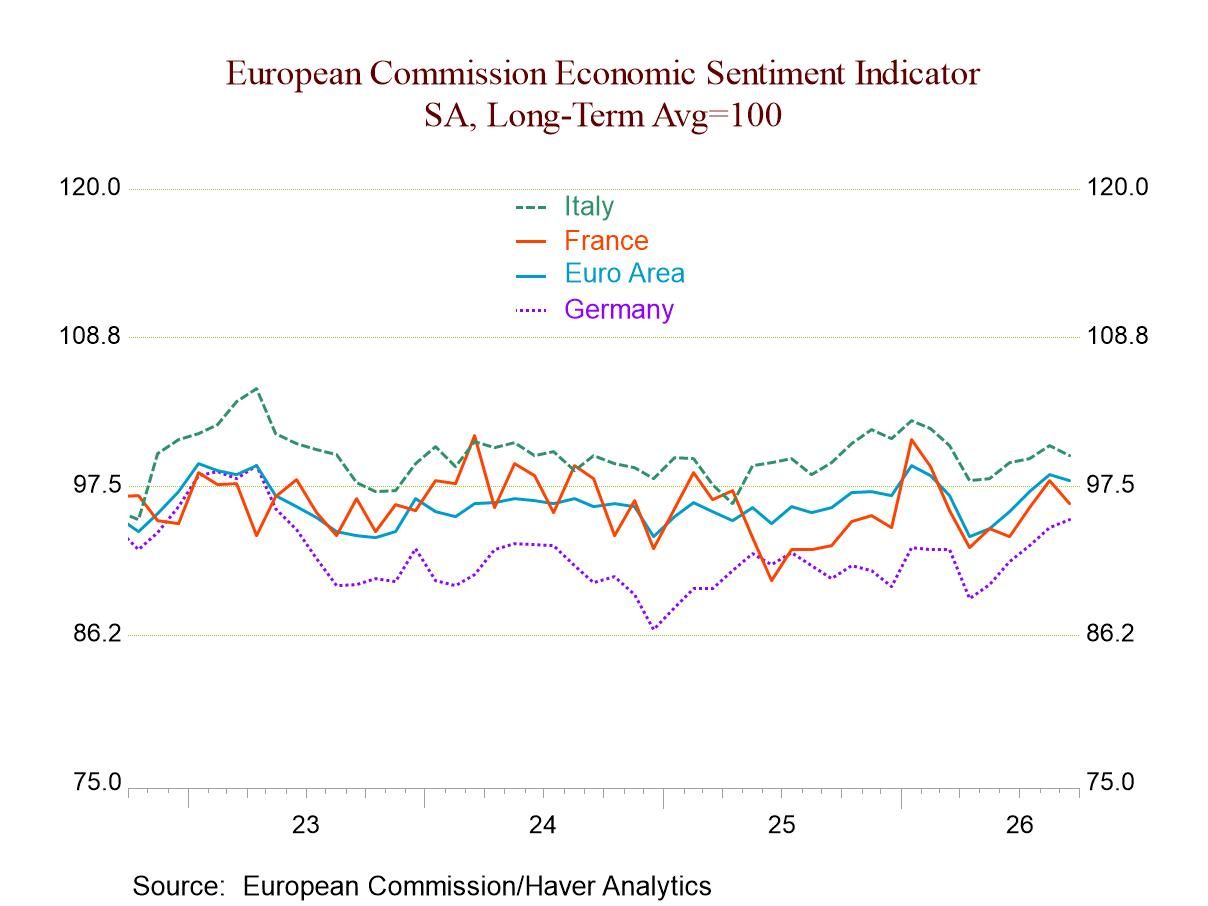
The EU Commission indexes weakened in September, with the overall index falling to 97.9 from 98.4 in August; however, the month's level is still stronger than recent readings prior to August (the strongest since February, excluding August). The index ranks at its 31.9 percentile on data since 1985, marking the month as below its median by a good margin. The median observation on data presented as a percentile ranking occurs at a ranking of 50%.
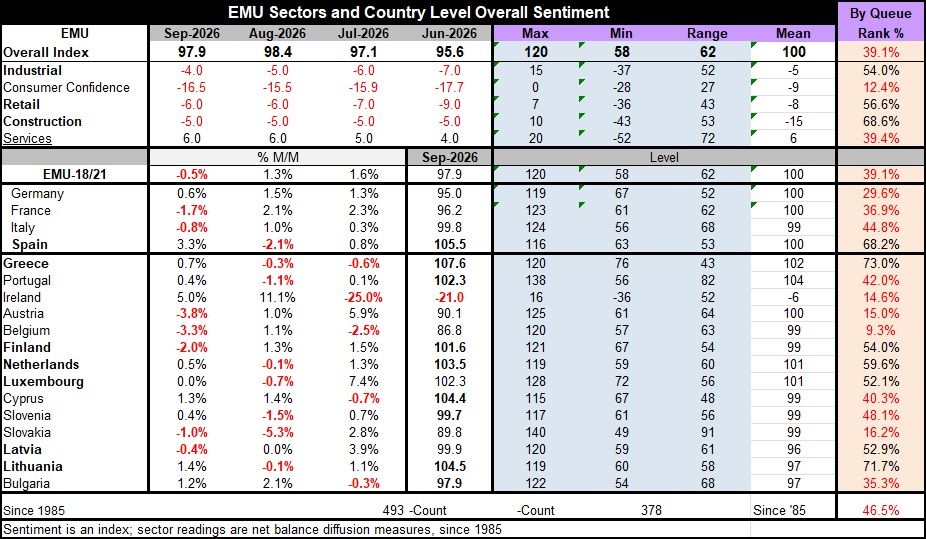
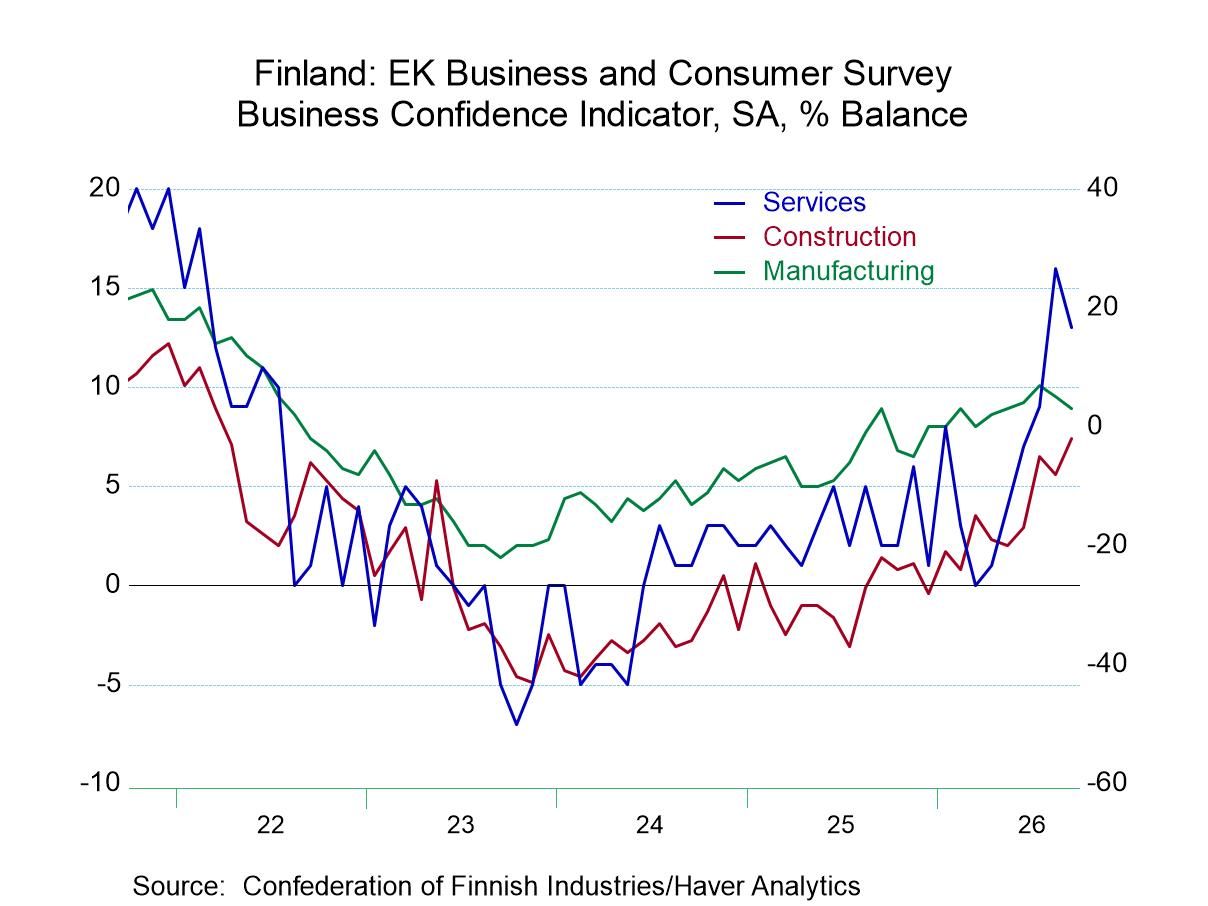
Monthly sector readings and perspectives The industrial reading improved month-to-month to -4 in September from -5 in August. The rise on the month lifts it just above its historic mean, and above its historic median, with a 54th percentile ranking. Consumer confidence slipped on the month to -16.5 from -15.5 in August. The consumer reading is substantially below its historic mean, which occurs at a reading of -9. The ranking for consumer confidence on the month is in its 12.4 percentile, an extremely weak reading. It has been this way for consumer confidence for some time. Even in the United States, where the economy is doing much better, readings on various consumer surveys have been exceptionally weak. The retailing assessment was unchanged at -6 in September; a reading of -6 is above its historic mean, which occurs at a value of -8. The month’s level also leaves retailing above its historic median at a standing of 56.6%. Construction was also unchanged at -5 in September; construction has been steady at -5 for a number of months in a row. Its historic mean is -15, and the -5 reading this month leaves construction at a 68.6 percentile, a quite firm level despite the negative diffusion reading. Services were also unchanged in the month at +6. Services have gotten slightly stronger in recent months. The historic mean for services is +6, so the sector is at its mean, but it is below its median, with a 39.4 percentile ranking.
Most country readings show gains on the month The reading for the overall EMU level declined in September, falling by 0.5%. In addition, seven reporting countries issued negative readings in September. Two of those countries, France and Italy, are among the four largest monetary union economies. However, the other two large EMU economies, Germany and Spain, marked improvements, with Germany rising 0.6% month-to-month in September and Spain rising 3.3% after a 2.1% decline in August.
Rankings remain overwhelmingly weak Looking at the rankings by country, among the 18 reporting countries only seven have country-specific ratings above their historic medians. Among the four largest EMU economies, only Spain is above its historic median with a 68.2 percentile ranking. Germany has a 29.6 percentile ranking, France is in its 36.9 percentile, and Italy is in its 44.8 percentile. The strongest reporting countries are small countries, with Greece posting a 73rd percentile ranking and Lithuania a 71.7 percentile ranking, followed by Spain’s 68.2 percentile ranking as the next highest reading.
Industry is back...for now It's good to see the industrial sector back up at a reading above its historic median and to be joined by retailing and construction. Retailing is a particularly rewarding sector to see performing well because consumer confidence is performing so poorly, with a 12.4 percentile standing. However, the services sector continues to lag with a 39.4 percentile standing, and that could be a problem because that's the job-creating sector for most economic units, and it's certainly true of the monetary union.
The job front On the job front, industrial employment and construction employment sectors report above 50th percentile standings in their monthly responses. With the employment in construction at a 71st percentile reading and for industry at a 68th percentile reading, we have some good news. However, for services, the employment reading is only at the 37th percentile, and that is the sector most responsible for delivering employment opportunities. Under consumer confidence, unemployment expectations have a 64.6 percentile standing, nearly a top one-third reading on that gauge. The U.S. economy is doing much better than the European economy; yet, there too, consumer confidence readings are weak, very weak. But the U.S. economy is growing strongly, and Europe continues to grow as well; a lack of confidence so far has not been an impediment to growth. As we can see so far this month, the manufacturing sector, the industrial sector, seems to be doing relatively better; however, everything is at risk due to events in the Middle East. Conditions in the Strait of Hormuz and what happens to oil prices are critical to what happens next. In addition, there's a great deal of concern about Europe and its low stocks of heating oil as winter approaches. The monthly readings from the EU indexes showed a step back on the month, but that was after the sharp improvement a month ago. In general, the European economy is doing a little bit better, with sectors in an upswing more so than they had previously, but conditions remain substantially touch-and-go, dependent on unforeseeable events.

Robert Brusca
AuthorMore in Author Profile »Robert A. Brusca is Chief Economist of Fact and Opinion Economics, a consulting firm he founded in Manhattan. He has been an economist on Wall Street for over 25 years. He has visited central banking and large institutional clients in over 30 countries in his career as an economist. Mr. Brusca was a Divisional Research Chief at the Federal Reserve Bank of NY (Chief of the International Financial markets Division), a Fed Watcher at Irving Trust and Chief Economist at Nikko Securities International. He is widely quoted and appears in various media. Mr. Brusca holds an MA and Ph.D. in economics from Michigan State University and a BA in Economics from the University of Michigan. His research pursues his strong interests in non aligned policy economics as well as international economics. FAO Economics’ research targets investors to assist them in making better investment decisions in stocks, bonds and in a variety of international assets. The company does not manage money and has no conflicts in giving economic advice.
More Economy in Brief
 Asia
Asia