EMU IP Advances in September but is Slowing Down
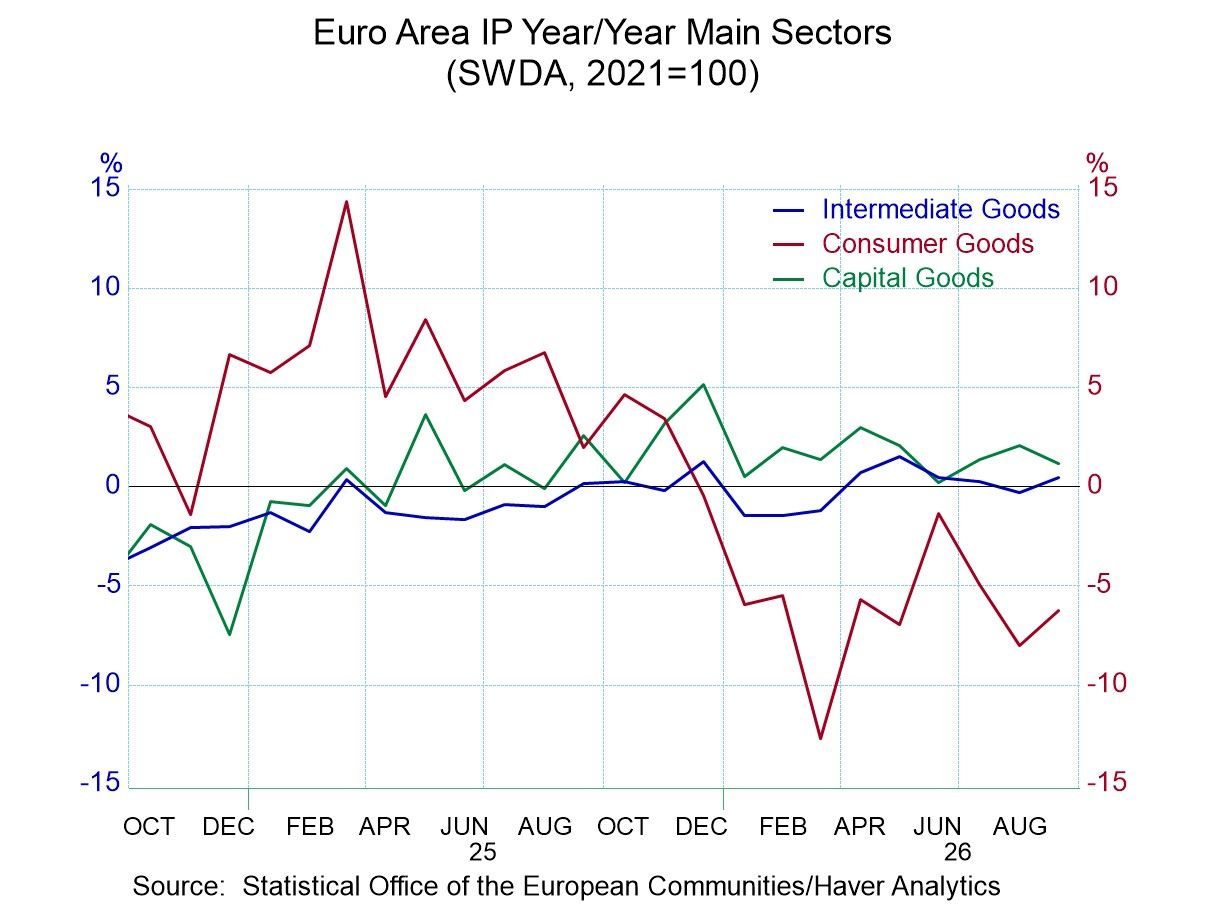
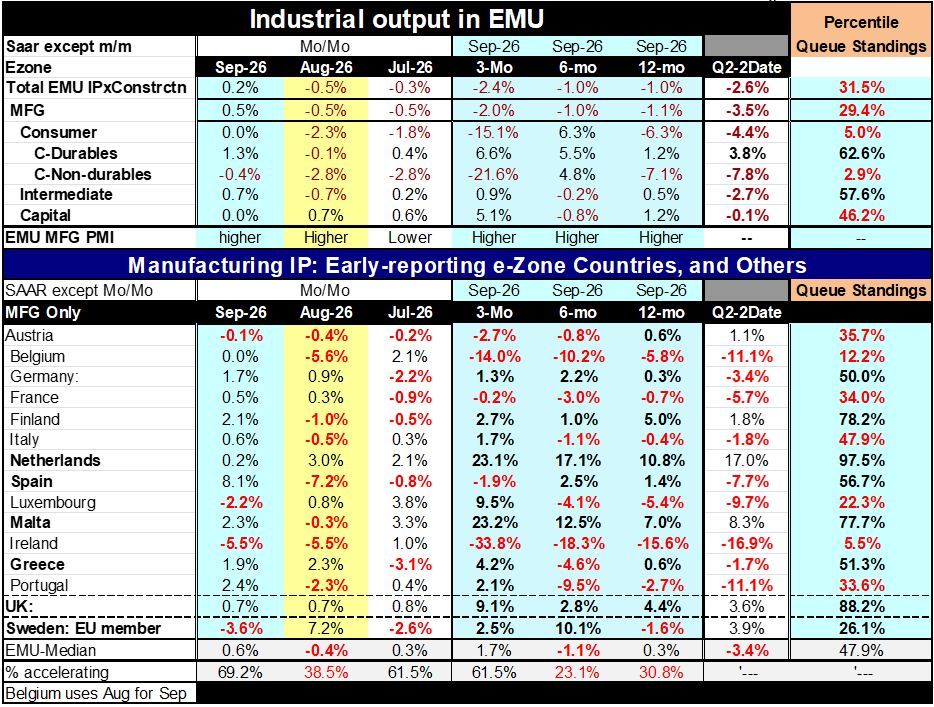
Industrial output in the European Monetary Union rose by 0.2% in September after falling an August and in July. Manufacturing output grew by 0.5% in September also after falling in August and in July. In September, in fact, only the output of consumer nondurable goods fell with the output of capital goods flat in the month.
On a monthly basis overall output generally was positive but growth rates were not impressive and certainly not impressive in the light of recent results. We get insight on this by looking at the sequential growth rates over 12-months, six-months, and three-months. In each case annualized headline production excluding construction output falls… by 1% over 12-months, by 1% at an annual rate over six-months, as well as an escalation to -2.4% at an annual rate over three-months; a clear deteriorating pattern.
For manufacturing output falls by 1.1% over 12-months, by 1% over 6-months, and by 2% over three-months - all at annualized rates. Looking at the individual manufacturing sectors and sub sectors the overall result for consumer goods is somewhat chaotic, however, for consumer durables there is an acceleration in output underway. Whereas for nondurables there is some degree of chaos but with a substantial negative result over three-months. For intermediate goods, the trends are chaotic and for capital goods the trends are chaotic as well. Sector trends taken separately don't support the overall trend that shows a clear decelerating tendency; however, there are a number of sectors and subsectors such as consumer goods overall, driven by consumer nondurables where the growth rate is negative and in double digits, which ends in a very weak three-month result. There are significant positive growth rates for consumer durables and for capital goods over three months to compensate for nondurables.
The bottom line for industrial production is that the trends are not clear, but the overriding trend is anything but strong. In the quarter to date, we see mostly declining results, and the quarter-to-date as of September is for the completed quarter. Overall manufacturing output is falling by 3.5% at an annual rate in the quarter, overall IP excluding construction it's down at a 2.6% annual rate, the only sector with output increasing on the quarter is consumer durable for the gain of 3.8% annualized.
The percentile standings are applied to year-over-year growth rates on data back to the end of 2006, a 20-year period. Ranked growth rates over that span show only two sectors that are above the 50% mark making only two of them above their median growth rate for the whole period: that's consumer durables with a ranking of 62.6% and immediate good with a ranking at the 57.6% level. Capital goods come close at 46.2%. But for total industrial production excluding construction, the rank is at the 31-percentile mark and for manufacturing it's at the 29-percentile mark. Annual growth rates are weak in historic context and one of the main reasons is the lagging behavior of output for consumer nondurable goods.
Country level data show us a good deal of lethargy but not a tremendous amount of weakness. For example, in September, among the 13 early reporting monetary union members only three show month-to month declines in output now that's a lot better than August when eight showed month-to-month declines and in July when six showed month-to-month declines. However, the September data show 69% of the countries have industrial output accelerating that compares to only 38% in August and 61% in July. Sequentially these same statistics show 61% of the monetary union countries with output accelerating over three-months compared to 23% over 6 months and 30% over 12 months. So, the experience with acceleration, is that it is a relatively new development and the year-over-year growth rates, that the rankings pertain to, are still weak. In fact, among monetary union countries only six of them have growth rates that rank above the 50th-percentile putting them above their median growth rate over the last 20 years. ...

Robert Brusca
AuthorMore in Author Profile »Robert A. Brusca is Chief Economist of Fact and Opinion Economics, a consulting firm he founded in Manhattan. He has been an economist on Wall Street for over 25 years. He has visited central banking and large institutional clients in over 30 countries in his career as an economist. Mr. Brusca was a Divisional Research Chief at the Federal Reserve Bank of NY (Chief of the International Financial markets Division), a Fed Watcher at Irving Trust and Chief Economist at Nikko Securities International. He is widely quoted and appears in various media. Mr. Brusca holds an MA and Ph.D. in economics from Michigan State University and a BA in Economics from the University of Michigan. His research pursues his strong interests in non aligned policy economics as well as international economics. FAO Economics’ research targets investors to assist them in making better investment decisions in stocks, bonds and in a variety of international assets. The company does not manage money and has no conflicts in giving economic advice.
More Economy in Brief
 Asia