EMU Inflation Pressure Remain over the Top but Not Intensifying
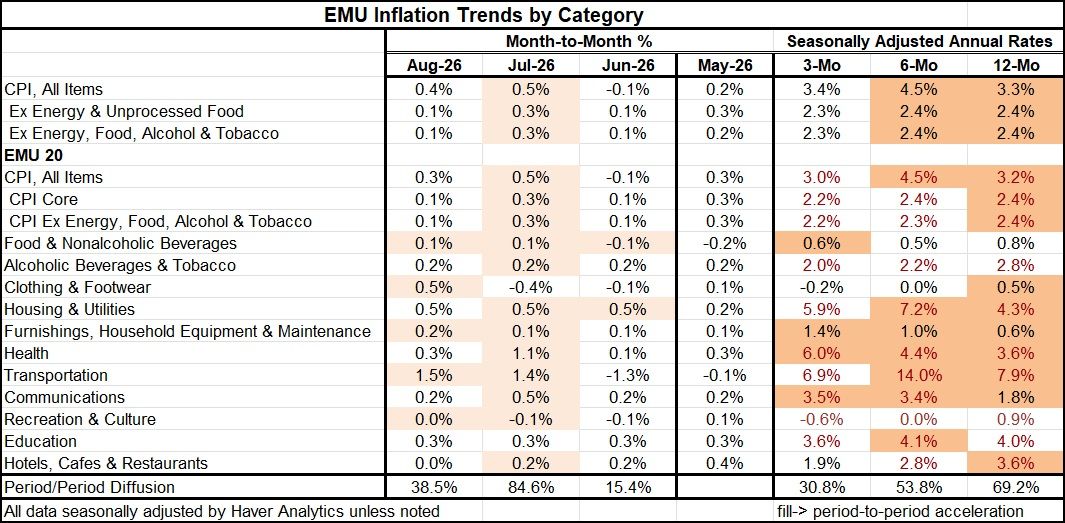
Inflation in the euro area rose by 0.4% in August after gaining 0.5% in July on the heels of a 0.1% decline in June. Sequentially, euro area inflation is up by 3.3% over 12 months, accelerates to a 4.5% annual rate over six months, and then settles back to a 3.4% pace over three months. Inflation is more excessive and stubborn than it is threatening.
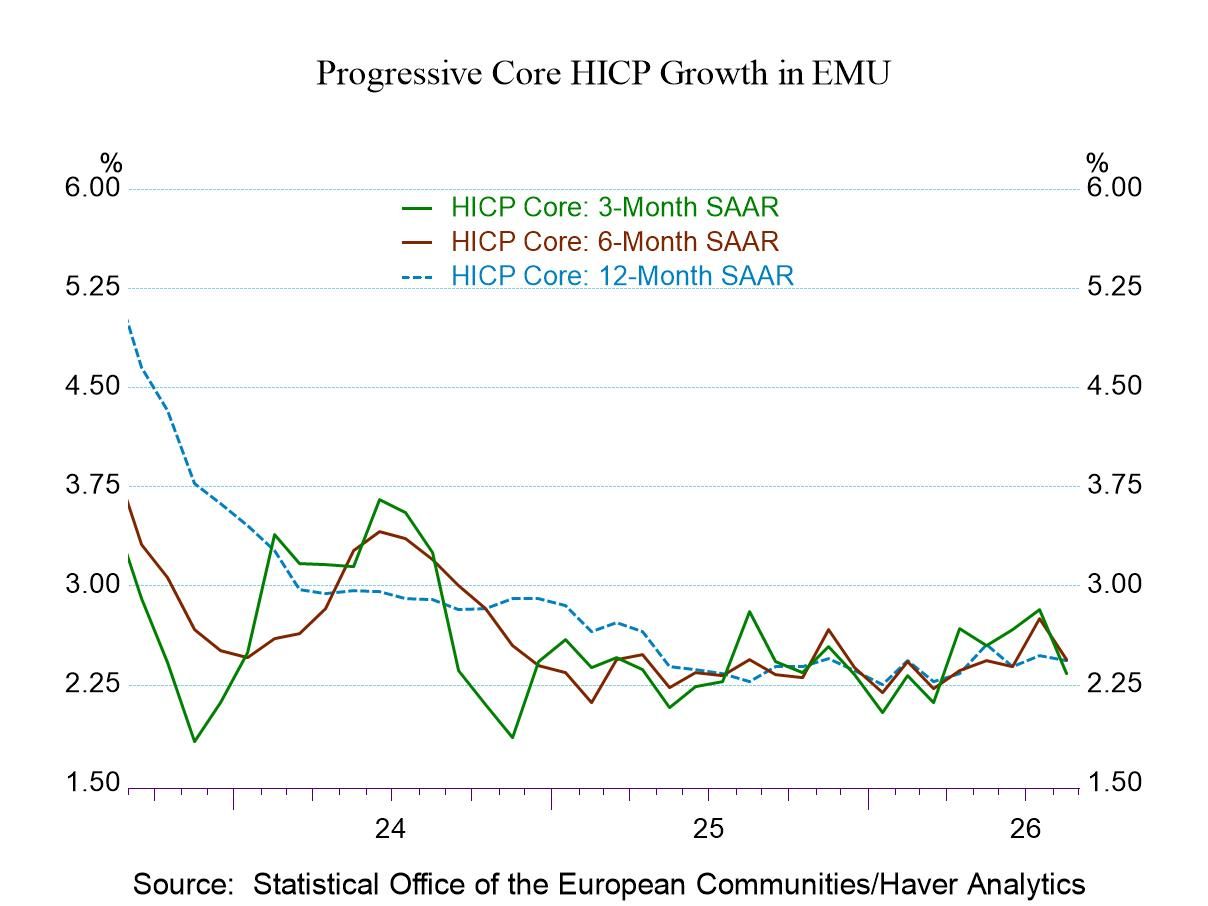
Inflation excluding energy and unprocessed food rose a skinny 0.1% in August after a 0.3% gain in July and a 0.1% increase in June. This version of core inflation is up by 2.4% over 12 months and six months and then settles down to a 2.3% annual rate over three months. The ex-food, alcohol & tobacco core measure, similarly posted restrained monthly gains, with a sequential profile matching the ex-energy & ex-unprocessed food progression.
A cautious ECB On balance, headline inflation is too high largely because of energy, and this is not a surprise. However, core inflation is much closer to being in target. Still, it is excessive over 12 months, six months, and three months, but it's not even 1/2 of one percentage point too high at an annualized rate. Still, it is consistently higher by 0.3% to 0.4% on an annual rate. With energy prices flaring, the ECB is being careful.
Inflation pressure is not growing in breadth The details of inflation for the ECB 20-member inflation measure are similar to those headlines in the core inflation progressions. The details on inflation show that inflation is not broadly accelerating. Diffusion measures, which chronicle the proportion of categories with inflation accelerating, showed very restrained sub-50% readings for August and June, even though July’s relatively hotter increase showed inflation accelerating in nearly 85% of the categories. However, that bad-news month was sandwiched in between two good-news months. Looking at inflation over 12 months, six months, and three months, the diffusion progressions step down from 69.2% over 12 months to 53.8% over six months and to 30.8% over three months. Inflation's breadth has been pulling back progressively.
Inflation is consistently accelerating for furnishings, household equipment & maintenance, healthcare, and communications. However, those are the only three categories that show inflation consistently higher over 12 months, six months, and three months. Inflation is consistently lower over those three periods for alcoholic beverages & tobacco and for recreation & culture.
Summing up On balance, the ECB seems to be in a pretty good place with inflation growth in the monetary union, while economic growth has been somewhat irregular, with the recent industrial production report slightly disappointing. Globally, oil prices are still high and possibly even firmer. There isn’t much evidence in the monetary union that inflation pressures have spread to other prices. But one reason that's true is that the central bank is being vigilant. Interest rate hikes will never roll back oil prices, but interest rate hikes are a way to remind businesses that the central bank is watching and trying to limit the impact of oil prices when they rise and stop them from mushrooming across industries. The ECB is doing a good job of that.

Robert Brusca
AuthorMore in Author Profile »Robert A. Brusca is Chief Economist of Fact and Opinion Economics, a consulting firm he founded in Manhattan. He has been an economist on Wall Street for over 25 years. He has visited central banking and large institutional clients in over 30 countries in his career as an economist. Mr. Brusca was a Divisional Research Chief at the Federal Reserve Bank of NY (Chief of the International Financial markets Division), a Fed Watcher at Irving Trust and Chief Economist at Nikko Securities International. He is widely quoted and appears in various media. Mr. Brusca holds an MA and Ph.D. in economics from Michigan State University and a BA in Economics from the University of Michigan. His research pursues his strong interests in non aligned policy economics as well as international economics. FAO Economics’ research targets investors to assist them in making better investment decisions in stocks, bonds and in a variety of international assets. The company does not manage money and has no conflicts in giving economic advice.
More Economy in Brief
 Global