

EMU Inflation Is Too High but Not Jet-setting
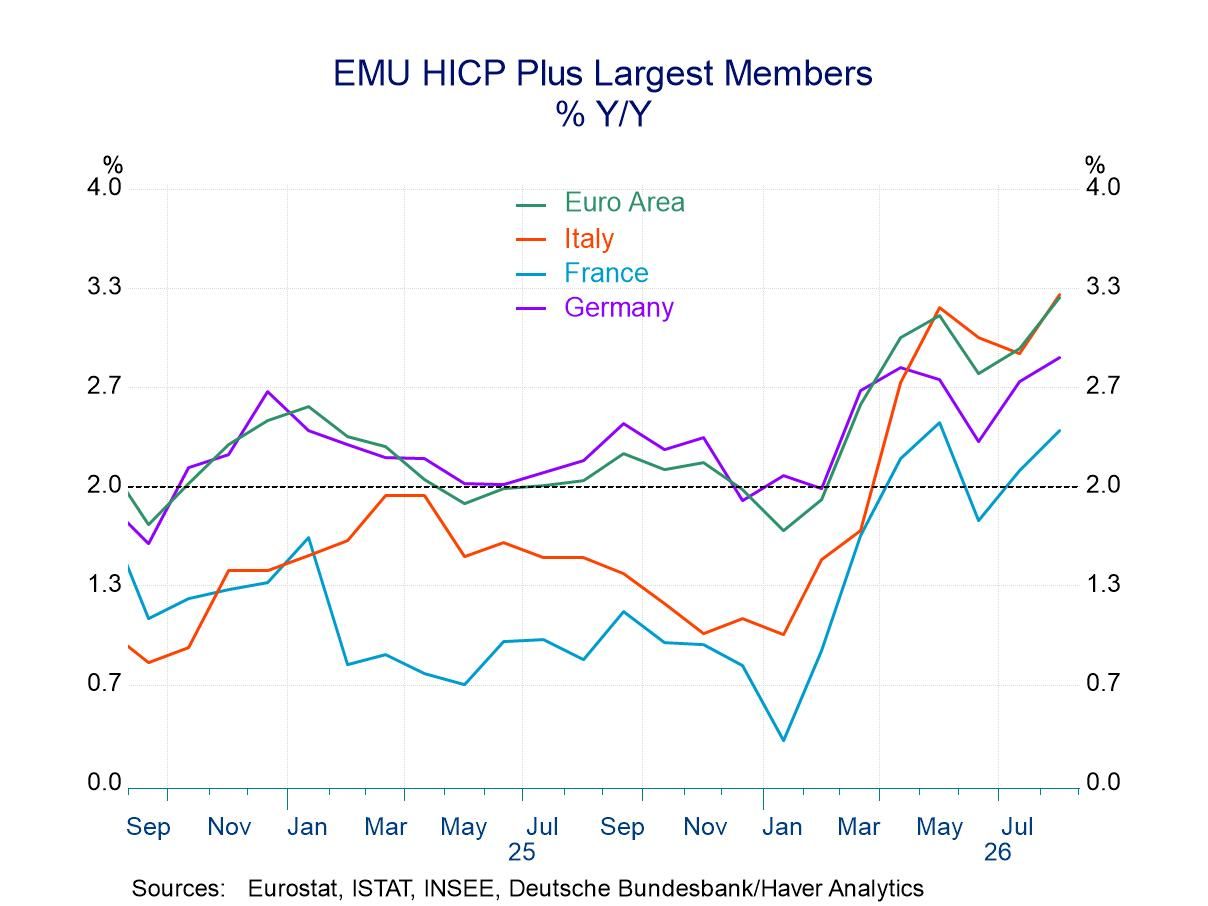
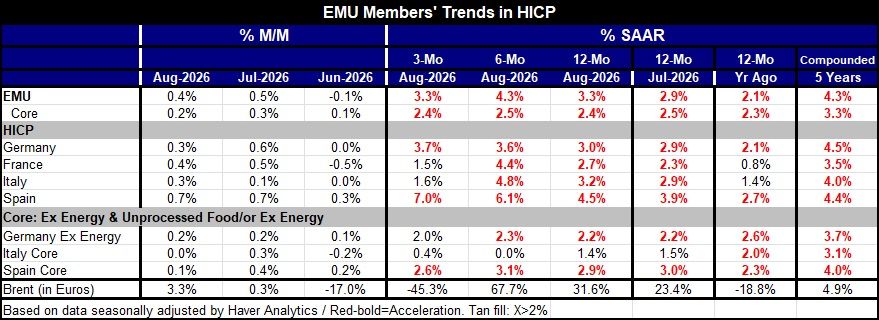
There's a good deal of concern about the development of inflation globally and across individual areas where central banks are making decisions on what to do with policy. In the euro area in August, the headline rate rose by 0.4%, with the core rising by just 0.2%. The three-month inflation rate for headline HICP inflation is 3.3% annualized while the pace for the core is only 2.4% annualized. That's excessive relative to the 2% target but not a particularly strong acceleration for inflation. It's not the kind of number that says to the ECB that it has to raise rates right now.
Sequentially, the headline rate goes from 3.3% to 4.3% to 3.3% over 12 months, six months, and three months on an annualized basis. These are all too high and too uncomfortable, topping 3% and in one case topping 4%. These are the kinds of numbers that require some kind of remedy. However, core inflation posts a very different set of numbers that go from 2.4% to 2.5% to 2.4% over 12 months, six months, and three months, again all annualized. These numbers show inflation skimming too high over the target but not even half a percentage point too high. It’s the kind of thing that a central bank might be willing to continue to tolerate for a while. There's nothing about a 2% target that says 2.4% is an outrageous miss and requires a monetary policy remedy. On the other hand, the fact that that's happening and the headline rate is cruising at a much higher pace over the top of the target may be something that will cause the central bank to say, well, core inflation is too high and I'm also concerned that headline inflation is going to pull it even higher, so maybe it is time to act. These sorts of considerations will keep the market a little bit off balance and wondering what the ECB is going to do.
The Big Four economies in the monetary union all have year-over-year inflation rates for the headline that are excessive compared to the target set for the entire community. France has the lowest 12-month headline pace at 2.7%. Spain has the highest at 4.5%. Over three months, both France and Italy run headline inflation near a pace of 1.5%, while German inflation runs hot at 3.7% and Spanish inflation sizzles at a 7.0% pace.
Once again, however, core is a better-behaved series, at a 12-month pace of 2.9% for Spain, 1.4% for Italy, and with German ex-energy inflation up at a 12-month pace of 2.2%. Over three months, the ex-energy or core paces run at 0.4% for Italy, 2.0% for Germany, and 2.6% for Spain.
Bottom line European inflation is too high. The inflation rate in the community appears to be irregular, just judging by the Big Four countries and all their variation. Core inflation is mostly contained, but the headline is not. Still, core inflation is running mildly hot. It is decision time for the ECB. The safe course would seem to hike rates again to be sure. But nothing here is clear. Stay tuned.

Robert Brusca
AuthorMore in Author Profile »Robert A. Brusca is Chief Economist of Fact and Opinion Economics, a consulting firm he founded in Manhattan. He has been an economist on Wall Street for over 25 years. He has visited central banking and large institutional clients in over 30 countries in his career as an economist. Mr. Brusca was a Divisional Research Chief at the Federal Reserve Bank of NY (Chief of the International Financial markets Division), a Fed Watcher at Irving Trust and Chief Economist at Nikko Securities International. He is widely quoted and appears in various media. Mr. Brusca holds an MA and Ph.D. in economics from Michigan State University and a BA in Economics from the University of Michigan. His research pursues his strong interests in non aligned policy economics as well as international economics. FAO Economics’ research targets investors to assist them in making better investment decisions in stocks, bonds and in a variety of international assets. The company does not manage money and has no conflicts in giving economic advice.
More Economy in Brief
 Global