EMU Growth Settles In as Advertised—Weak but Steady
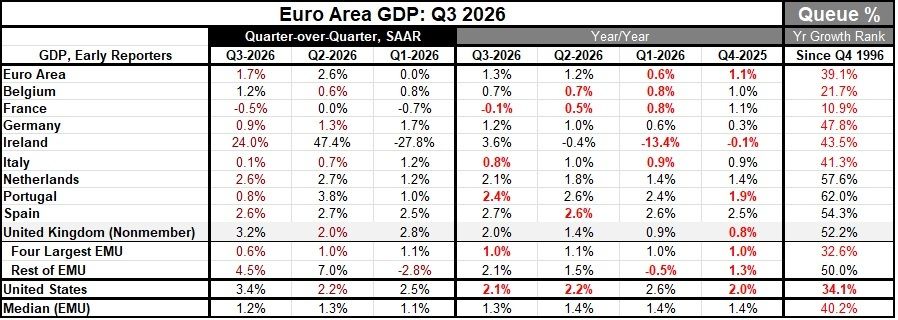
The monetary union in the third quarter registered an annual rate of increase of 1.7% after notching a 2.6% growth rate in the second quarter and being flat in the first quarter.
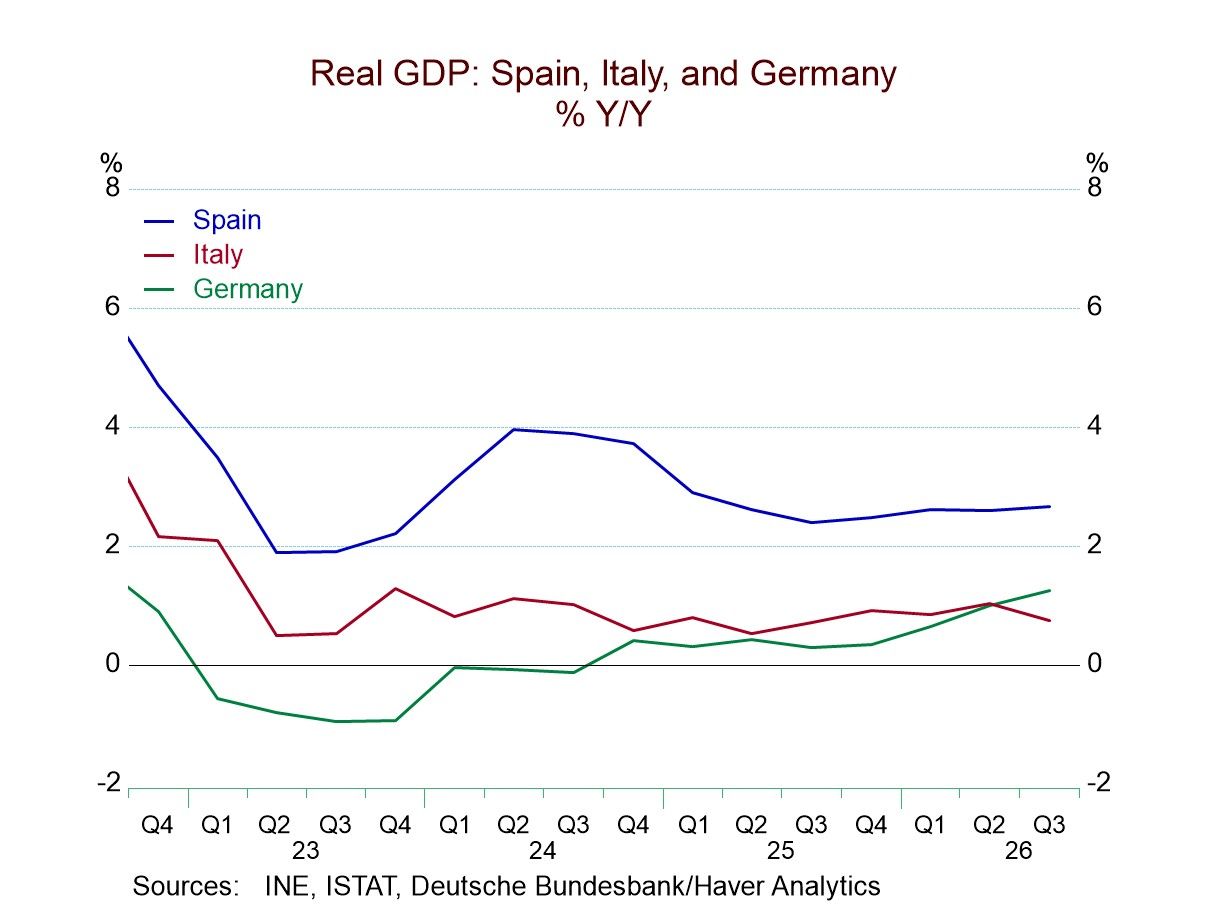
Year-over-year monetary union growth was 1.3% in the third quarter compared to 1.2% in Q2, 0.6% in Q1, and 1.1% in the fourth quarter of 2025. As 2025 ended, growth in 2026 slowed but now, in the second half, it is beginning to pick up. Will that continue?
Among the eight early reporters of GDP in the monetary union, only Belgium posted an increase in its growth rate in the third quarter compared to Q2, with the pace rising to 1.2% after gaining 0.6% in the second quarter. France, suffering political problems and outright protests, saw flat GDP in the second quarter and a 0.5% decline at an annual rate in the third quarter, compared to a 0.7% decline at an annual rate in the first quarter. France is clearly struggling and faces a difficult road ahead.
Ireland has extremely high or low and volatile growth rates because it's a small country, and it has a lot of multinationals reporting growth through its national accounts. In the third quarter, its growth rate was 24% at an annual rate and that slipped from a 47.4% annual rate in the second quarter, which was an acceleration from a -27.8% annual rate in the first quarter. None of these numbers are terribly reflective of what's really going on in the Irish economy.
The Netherlands saw its growth rate drop to 2.6% in the third quarter after a 2.7% pace in the second quarter. Spain saw a drop to 2.6% in the third quarter from 2.7% in the second quarter as well. Apart from those small declines, the quarter-to-quarter growth rate reductions are generally much larger.
However, pooling the GDP of the four largest economies and calculating growth rates, we see that the third quarter growth rate for the four largest monetary union economies dropped to 0.6% annualized from 1% in the second quarter, compared to a 1.1% pace in the first quarter. The four largest monetary union economies are growing at a year-over-year pace of 1% to 1.1% over each of the last four quarters.
In contrast, the rest of the monetary union posted growth of 4.5% annualized in the third quarter after logging 7% in the second quarter and a 2.8% decline in the first quarter. The rest of the monetary union posted year-over-year growth rates of 2.1% in the third quarter, 1.5% in the second quarter, and -0.5% in the first quarter, compared with a 1.3% growth rate in the fourth quarter of 2025. The median annualized quarterly growth rate for the monetary union has been 1.1% to 1.2% over the last three quarters, while the year-over-year growth rate in the monetary union has vacillated between 1.3% and 1.4% over the last four quarters. Growth has been low but relatively consistent both quarterly and year-on-year.
Rank standing of growth rates The queue standing of the growth rates for the monetary union and its eight early-reporting economies is largely down below the 50% mark, putting them below their median on all growth rates back to 1996. Only the Netherlands, Portugal, and Spain have rankings above their 50% mark, which puts the growth rates above their medians on this timeline. The four largest economies have growth rates with a 32.6 percentile standing, while the rest of the monetary union has a 50th percentile standing, which means that its growth has been exactly on its median. The U.S. GDP growth rate for this period has a 34.1 percentile standing, while the U.K., a former member of the EU and not a member of the single-currency bloc that adopted the euro, has a 52.2 percentile standing of its year-over-year GDP growth rate.
Summing up On balance, you see a picture of the monetary union with weak growth that is neither consistently accelerating nor decelerating. Rather, growth is meandering at a low pace. Some countries seem to be more at risk for growth slowing and others for speeding up. In the third quarter, slowing GDP obviously is the most consistent result, but even with that the median growth rate in the monetary union only slips to 1.2% from 1.3%. While the growth rate for the four largest economies slips from 1% to 0.6%, the growth for the rest of the EMU slips from 7% to a still-robust 4.5%. However, inflation is a problem that the central banks have decided they are going to pay more attention to. Interest rates are going up in the monetary union itself, in the U.K., and in the U.S., and then in Japan, too, for that matter. Wars coupled with high and rising oil prices are still a factor in the outlook for inflation. Inflation has been over target and continues to be over target, and it's not clear that firm expectations for inflation to fall can be depended upon based on a hope for a reduction in hostilities. Nor is it clear, after the war that Iran has been through, that if there is a reduction in hostilities, it is going to allow oil prices to go back down to where they were before there was military action in the Middle East. There is very little that we know about the future with a high probability, and a great deal of entropy and a lot to be concerned about in terms of creating an outlook.

Robert Brusca
AuthorMore in Author Profile »Robert A. Brusca is Chief Economist of Fact and Opinion Economics, a consulting firm he founded in Manhattan. He has been an economist on Wall Street for over 25 years. He has visited central banking and large institutional clients in over 30 countries in his career as an economist. Mr. Brusca was a Divisional Research Chief at the Federal Reserve Bank of NY (Chief of the International Financial markets Division), a Fed Watcher at Irving Trust and Chief Economist at Nikko Securities International. He is widely quoted and appears in various media. Mr. Brusca holds an MA and Ph.D. in economics from Michigan State University and a BA in Economics from the University of Michigan. His research pursues his strong interests in non aligned policy economics as well as international economics. FAO Economics’ research targets investors to assist them in making better investment decisions in stocks, bonds and in a variety of international assets. The company does not manage money and has no conflicts in giving economic advice.
More Economy in Brief
 Global