EMU GDP Contracts; Year-on-Year Growth Slows Sharply
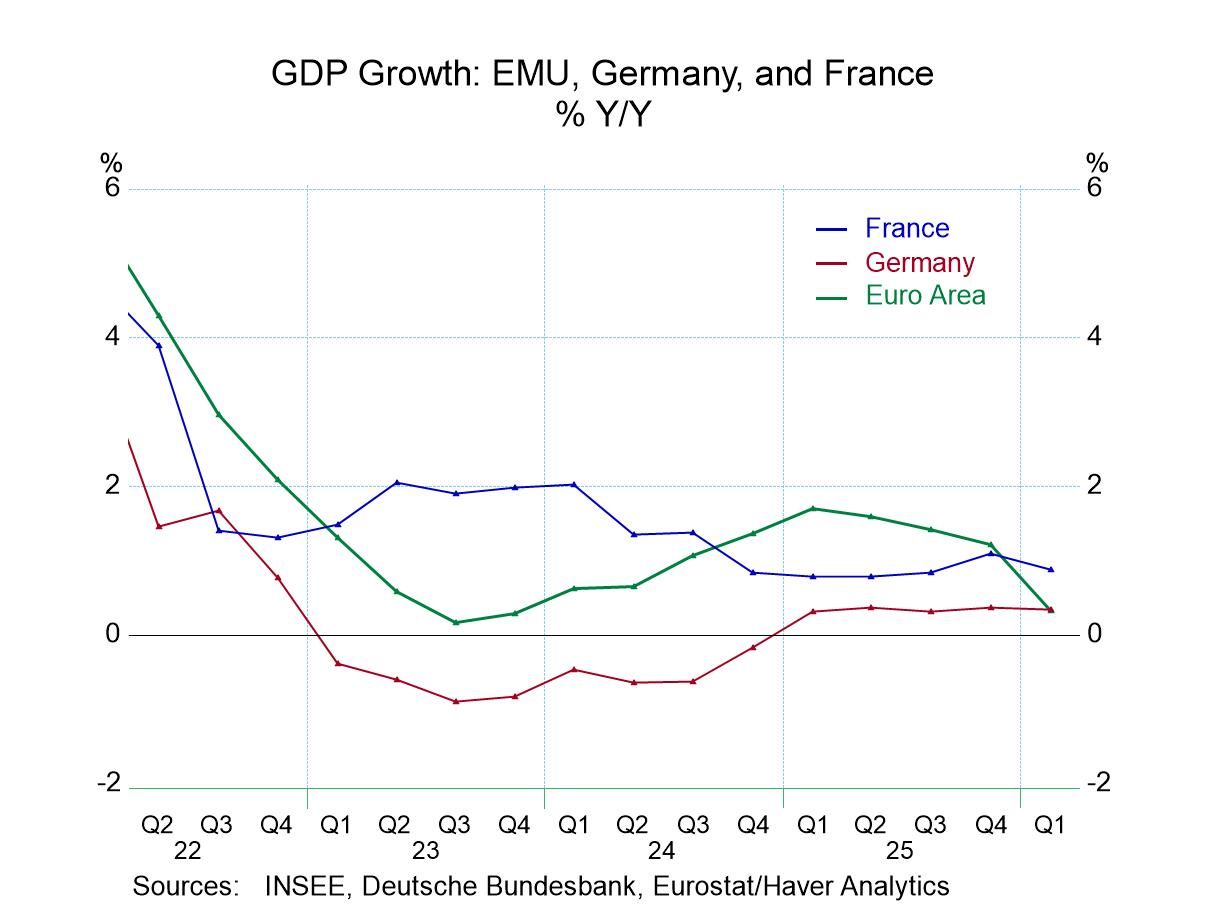
GDP growth in the European Monetary Union backtracked in the first quarter, falling by 0.9% at an annual rate after rising by 0.7% at an annual rate in the fourth quarter of 2025. The year-over-year growth rate from the monetary union also slowed sharply to 0.3%. The small positive gain in Q1 2026 comes after gains of over 1% in year-over-year calculations since the third quarter of 2024. The queue ranking of the year-on-year GDP growth rate, on data back to 1997, places the Q1 GDP result in its 21st percentile—roughly a lower one-fifth ranking.
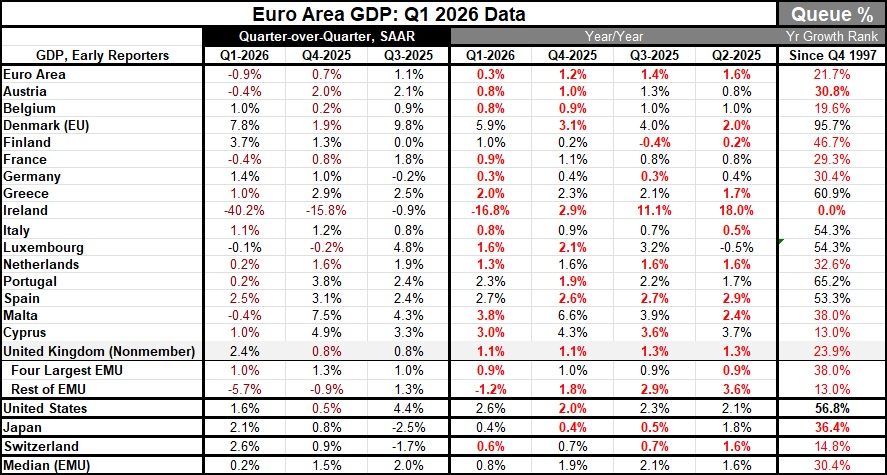
Among the 14 EMU member reporters of GDP data in the table, five countries experienced quarter-to-quarter declines in GDP in Q1 2026: France, Ireland, Luxembourg, Malta, and Austria. Ireland has some peculiar accounting issues because a number of multinational companies are headquartered there for tax reasons; this produced a decline in GDP at a 40% annual rate to dominate these results. And the sharp Irish decline in GDP has an outsized impact on the European Monetary Union GDP report itself. In contrast, among the individual reporting members, the median change in GDP in the first quarter was a 0.2% increase at an annual rate; both Portugal and the Netherlands experienced GDP increases of that magnitude.
In addition to that, the fourth quarter of 2025 showed decelerations in GDP for six of these reporting monetary union members; however, GDP declined in only two of these members in the fourth quarter.
Year-over-year data show GDP growth rates in the first quarter declining broadly in 11 of the 14 reporting members in this table. That compares to a slowdown reported by six member countries in the fourth quarter of 2025.
The four largest monetary union members experienced a slowdown in GDP, with growth at 1% in the first quarter compared to 1.3% in the fourth quarter; that 1% growth rate is the same as in the third quarter of 2025. The rest of the monetary union saw a sharp decline as GDP contracted at a 5.7% annual rate, with the Irish data playing a big role in that for the rest of the monetary union. For the four largest EMU economies, GDP advanced by 0.9% in Q1 2026 on a year-over-year basis. Year-over-year changes show relatively steady growth in the four largest monetary union economies, with growth rates of 1% or 0.9% in each of the last four quarters, while the rest of the monetary union shows much stronger growth rates over the last four quarters, but for that group, growth rates have been generally decelerating. That process culminates in a decline of 1.2% for year-over-year GDP growth in Q1 2026 for the rest of the EMU.
Over these last four quarters when the rest of the monetary union growth rates—apart from the four largest economies—showed steady slippage, Switzerland also showed a steady deceleration in GDP growth; so has the United Kingdom. Japan also has weakening growth over these last four quarters. However, the U.S. does not fall into that pattern, having maintained steady growth and then experienced a pickup in growth to 2.6% year-over-year in Q1 2026.
Few show above-median growth Among the countries in the table, very few have GDP growth rates year-over-year that are above their medians on performance back to 1997. However, countries with queue standing above their 50th percentile for growth rates reflect that phenomenon; those countries are the U.S., Spain, Portugal, Italy, Luxembourg, Greece, and Denmark. Belgium, Ireland, Cyprus, and Switzerland have growth rates ranked below the 20th percentile in the queue ranking system. The median and year-over-year growth rate in the monetary union has a 30.4 percentile ranking, similar to Japan with a 36.4 percentile ranking for its year-over-year GDP. Growth metrics are showing some struggle, and the combined weight of the ongoing Ukraine war and the new effect of the Middles East conflict take their tolls.

Robert Brusca
AuthorMore in Author Profile »Robert A. Brusca is Chief Economist of Fact and Opinion Economics, a consulting firm he founded in Manhattan. He has been an economist on Wall Street for over 25 years. He has visited central banking and large institutional clients in over 30 countries in his career as an economist. Mr. Brusca was a Divisional Research Chief at the Federal Reserve Bank of NY (Chief of the International Financial markets Division), a Fed Watcher at Irving Trust and Chief Economist at Nikko Securities International. He is widely quoted and appears in various media. Mr. Brusca holds an MA and Ph.D. in economics from Michigan State University and a BA in Economics from the University of Michigan. His research pursues his strong interests in non aligned policy economics as well as international economics. FAO Economics’ research targets investors to assist them in making better investment decisions in stocks, bonds and in a variety of international assets. The company does not manage money and has no conflicts in giving economic advice.
More Economy in Brief
 Global