Global| Oct 06 2026
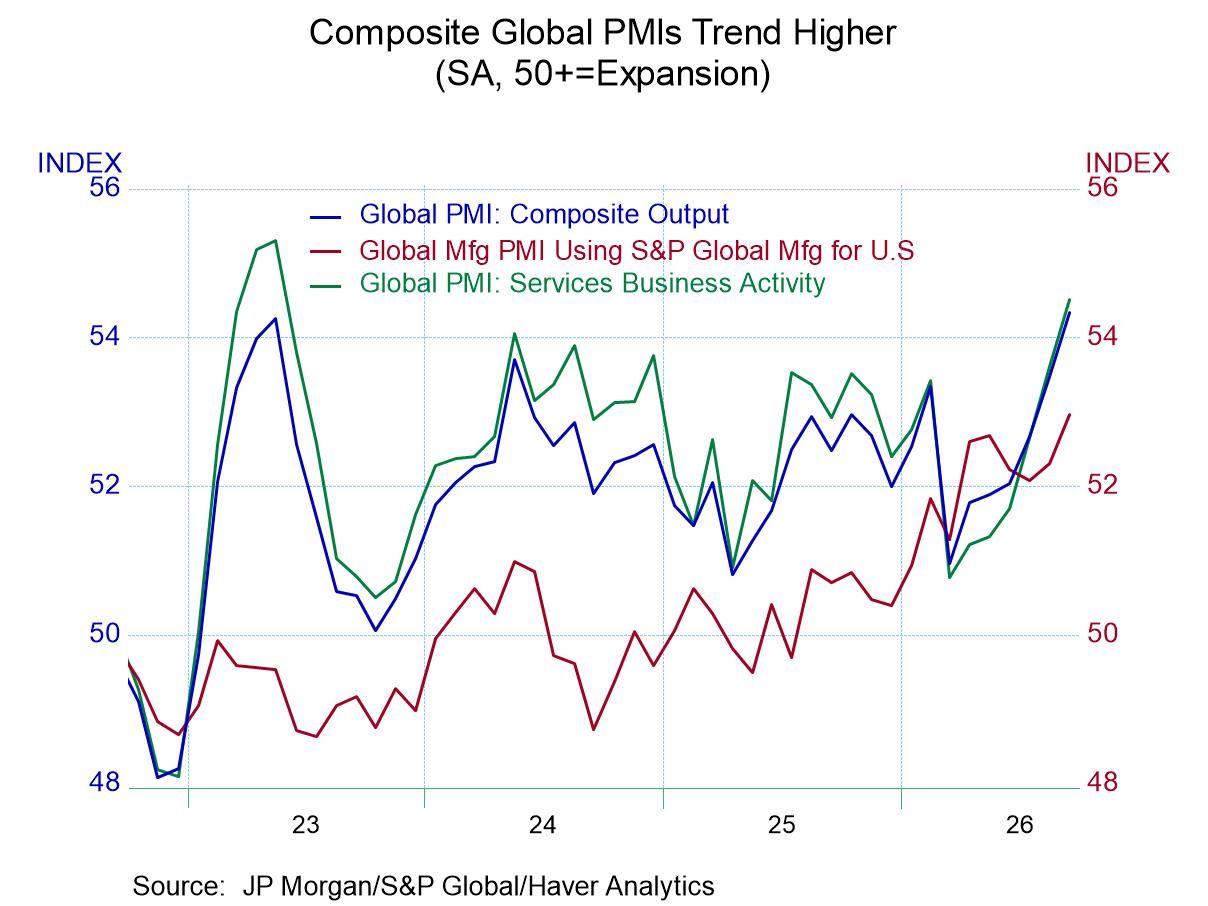
Composite Global PMIs trend higher
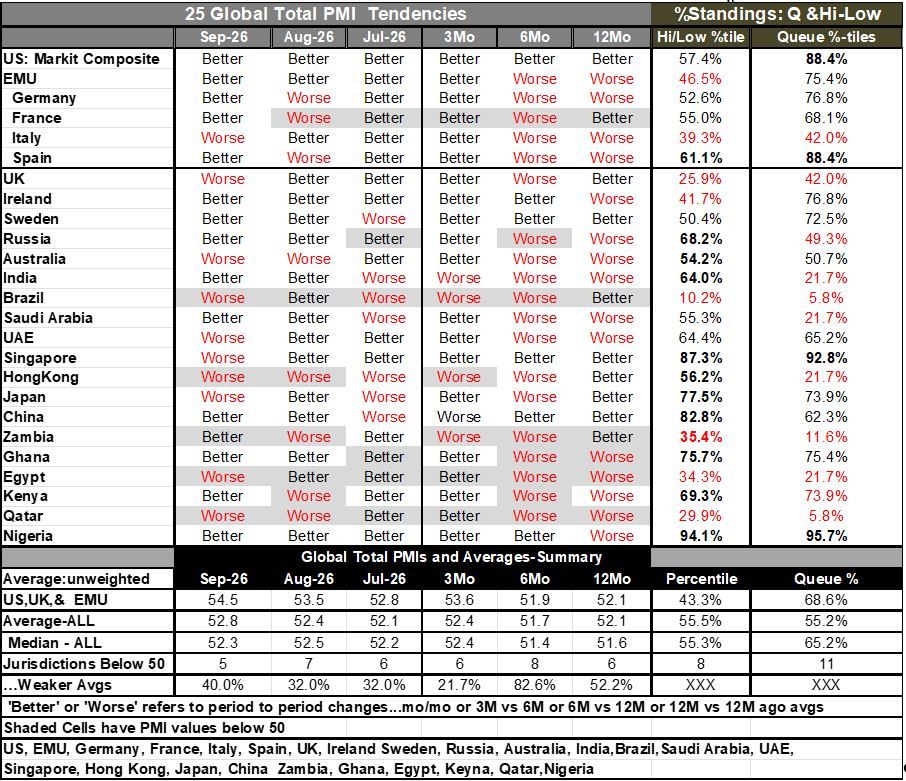
Expanding over all horizons based on median and average data Over the last 12-months and six months the composite PMI data show mostly setbacks – weaker performance- across the various 25 countries and regions that report in this table. However, over no horizon is there more than 8 of the 25 reporters showing an outright decline in terms of PMI values (readings below 50). Over the recent three-months more significant advances have been recorded. Only 21.7% of the reporters show weaking in their average performance over 3-months compared to 6-months. This is a sharp contrast with 82.6% weakening over six months compared to 12-months and even the 52.2% that shows weaking over 12-months compared to 12 months ago. The six-month comparison is a geopolitically difficult comparison.
Progress, yes – but will it endure? Progress is in gear. The last three months of month-to-month PMIs readings yield median PMI values of 52.2 to 52.5 to 52.3 moving from July to September. September shows a slight back tracking, but all readings are above a diffusion value of 52. Averages show better growth transition from 52.1 to 52.4 to 52.8 on the same time sequence. Using averages we see a strengthening trend.
The US, UK, and EMU as an unweighed group also show progressive improvement. This group shows irregular improvement from 12-months to six-months to three-months, but the three-month diffusion average is higher than the 12-month average.
Among the 25 reporters surveyed. Eleven have percentile standings over the last 4 ½ years of data that are below their respective medians – that’s a lot. So, there is still a considerable proportion of reporters with weak queue percentile standings on the standards of about the last five-years- years that have not been terribly strong.
Summing up The good news in this report is the breadth of improvement in September. With only five reporters below a diffusion reading of 50, indicating contraction and with 60% of the reporters showing month-to-month improvement.

Robert Brusca
AuthorMore in Author Profile »Robert A. Brusca is Chief Economist of Fact and Opinion Economics, a consulting firm he founded in Manhattan. He has been an economist on Wall Street for over 25 years. He has visited central banking and large institutional clients in over 30 countries in his career as an economist. Mr. Brusca was a Divisional Research Chief at the Federal Reserve Bank of NY (Chief of the International Financial markets Division), a Fed Watcher at Irving Trust and Chief Economist at Nikko Securities International. He is widely quoted and appears in various media. Mr. Brusca holds an MA and Ph.D. in economics from Michigan State University and a BA in Economics from the University of Michigan. His research pursues his strong interests in non aligned policy economics as well as international economics. FAO Economics’ research targets investors to assist them in making better investment decisions in stocks, bonds and in a variety of international assets. The company does not manage money and has no conflicts in giving economic advice.
More Economy in Brief