Global| Mar 03 2009
U.S. Construction Spending Fell Further
by:Tom Moeller
|in:Economy in Brief
Summary
The news on building activity continues grim. The value of construction put-in-place tumbled 3.3% during January for the third consecutive, sharp decline. The drop was was roughly double the Consensus expectation. Residential building [...]
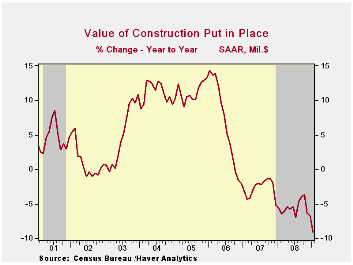
The news on building activity continues grim. The value of construction put-in-place tumbled 3.3% during January for the third consecutive, sharp decline. The drop was was roughly double the Consensus expectation.
Residential building activity continued its downward march with a 2.9% shortfall which started 2009 activity 18.6% below the 2008 average. Single-family construction activity fell 9.3% and remained off by nearly one half year-to-year. Building activity on multi-family units also was weak and it posted a 1.2% decline (-9.1% y/y). Spending on improvements did increase 3.8% from December but versus one year ago it fell 1.5%.
During the last twenty years there has been an 84% correlation between the q/q change in the value of residential building and its contribution to growth in real GDP.
The value of nonresidential building activity continued lower, down for the sixth month in the last seven. January activity fell 4.3% led by a 5.8% decline in the health care sector (+6.4% y/y). Spending on office construction fell another 1.5% and it was off 10.4% from one year earlier. Building in the multi-retail sector flopped 1.8% and that decline pulled activity down 20.2% from last January.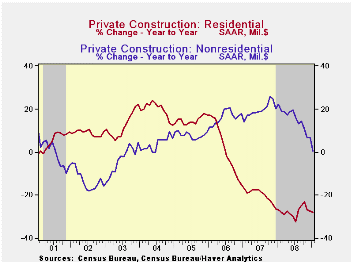
Public construction may have started to suffer the recession's effect of tax revenues. Activity fell 2.3% and that lowered year-to-year growth to 4.4%, the least since early 2005. To amplify the notion of weakness, the level of activity began this year 0.9% below 2008. The value of spending on transportation facilities fell 2.6% (-2.4% y/y), down hard for the third straight month. Spending on highways & streets also fell for the second month but the 1.0% decline still left activity up 6.1% y/y, in line with the firm gains since early 2007. The value of construction on highways & streets is roughly one-third of the value of total public construction spending.
The more detailed categories of construction represent the Census Bureau’s reclassification of construction activity into end-use groups. Finer detail is available for many of the categories; for instance, commercial construction is shown for automotive sales and parking facilities, drugstores, building supply stores, and both commercial warehouses and mini-storage facilities. Note that start dates vary for some seasonally adjusted line items in 2000 and 2002, and that constant-dollar data are no longer computed.
The construction put-in-place figures are available in Haver's USECON database.
| Construction (%) | January | December | Y/Y | 2008 | 2007 | 2006 |
|---|---|---|---|---|---|---|
| Total | -3.3 | -2.4 | -9.1 | -5.6 | -2.7 | 6.3 |
| Private | -3.7 | -2.6 | -14.1 | -9.8 | -6.9 | 5.5 |
| Residential | -2.9 | -4.4 | -28.0 | -27.6 | -19.8 | 1.0 |
| Nonresidential | -4.3 | -1.2 | 0.3 | 14.9 | 19.6 | 16.2 |
| Public | -2.3 | -1.8 | 4.4 | 6.8 | 12.3 | 9.3 |

Tom Moeller
AuthorMore in Author Profile »Prior to joining Haver Analytics in 2000, Mr. Moeller worked as the Economist at Chancellor Capital Management from 1985 to 1999. There, he developed comprehensive economic forecasts and interpreted economic data for equity and fixed income portfolio managers. Also at Chancellor, Mr. Moeller worked as an equity analyst and was responsible for researching and rating companies in the economically sensitive automobile and housing industries for investment in Chancellor’s equity portfolio. Prior to joining Chancellor, Mr. Moeller was an Economist at Citibank from 1979 to 1984. He also analyzed pricing behavior in the metals industry for the Council on Wage and Price Stability in Washington, D.C. In 1999, Mr. Moeller received the award for most accurate forecast from the Forecasters' Club of New York. From 1990 to 1992 he was President of the New York Association for Business Economists. Mr. Moeller earned an M.B.A. in Finance from Fordham University, where he graduated in 1987. He holds a Bachelor of Arts in Economics from George Washington University.
More Economy in Brief