Global| Apr 01 2009
Rise In ISM Index Suggests Factory Sector Stabilization
by:Tom Moeller
|in:Economy in Brief
Summary
The March composite index of activity in the manufacturing sector from the Institute for Supply Management improved slightly to 36.3 from 35.8 in February. Though the latest figure was still near the lowest level since the recession [...]
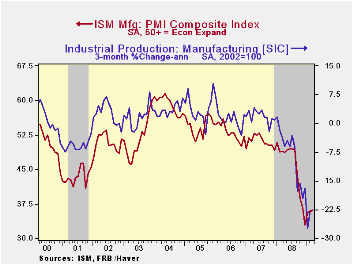
The March composite index of activity in the manufacturing sector from the Institute for Supply Management improved slightly to 36.3 from 35.8 in February. Though the latest figure was still near the lowest level since the recession year of 1980, the index has remained in a range of 33 to 37 during the last five months. The break-even level for this diffusion index of factory sector activity is a level of 50.
During the last twenty years there has been a 72% correlation between the level of the composite index and the three-month growth in factory sector industrial production. The latest reading of the composite index suggests that the recent 10% rate of decline in industrial output will continue.
It is appropriate to correlate the ISM index level with factory sector growth because the ISM index is a diffusion index. It measures growth by using all of the positive changes in activity added to one half of the zero change in activity measures.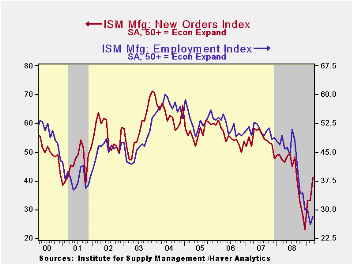
Improvement in the new orders index has been sharp since its December low as 28% of survey participants reported higher orders versus a low of 5%. Even the export order index improved modestly to a still low 39.0 versus the December reading of 35.5. Nevertheless, it remained near the lowest level in this index's short twenty year history. During the last ten years there has been a 53% correlation between the index and the q/q change in real exports of goods in the GDP accounts.
The production component was about unchanged after sharp improvement in January and February. Offsetting these gains were sharp declines in the vendor deliveries index to the lowest level since 1989. The inventory index was weak and fell to the lowest level since 1982.
The separate index of prices paid improved slightly but it remained near the record low. During the last twenty years there has been a 79% correlation between the price index and the three-month change in the PPI for intermediate goods.
The ISM data is available in Haver's USECON database.
How Will a Credit Crunch Affect Small Business Finance? from the Federal Reserve Bank of San Francisco is available here
| ISM Mfg | March | February | March '08 | 2008 | 2007 | 2006 |
|---|---|---|---|---|---|---|
| Composite Index | 36.3 | 35.8 | 49.0 | 45.5 | 51.1 | 53.1 |
| New Orders Index | 41.2 | 33.1 | 47.1 | 42.1 | 54.3 | 55.4 |
| Employment Index | 28.1 | 26.1 | 49.3 | 43.2 | 50.5 | 51.7 |
| Prices Paid Index (NSA) | 31.0 | 29.0 | 83.5 | 66.5 | 64.6 | 65.0 |

Tom Moeller
AuthorMore in Author Profile »Prior to joining Haver Analytics in 2000, Mr. Moeller worked as the Economist at Chancellor Capital Management from 1985 to 1999. There, he developed comprehensive economic forecasts and interpreted economic data for equity and fixed income portfolio managers. Also at Chancellor, Mr. Moeller worked as an equity analyst and was responsible for researching and rating companies in the economically sensitive automobile and housing industries for investment in Chancellor’s equity portfolio. Prior to joining Chancellor, Mr. Moeller was an Economist at Citibank from 1979 to 1984. He also analyzed pricing behavior in the metals industry for the Council on Wage and Price Stability in Washington, D.C. In 1999, Mr. Moeller received the award for most accurate forecast from the Forecasters' Club of New York. From 1990 to 1992 he was President of the New York Association for Business Economists. Mr. Moeller earned an M.B.A. in Finance from Fordham University, where he graduated in 1987. He holds a Bachelor of Arts in Economics from George Washington University.
More Economy in Brief
 Global| Aug 21 2026
Flash S&P PMIs Show Ongoing Improvement Amid Unsettled Geopolitics