U.S. Productivity Jumped in Q3; Unit Labor Costs Fell
by:Sandy Batten
|in:Economy in Brief
Summary
- Nonfarm business output per hour rose 4.9% q/q SAAR in Q3 on top of an upward revision to Q2.
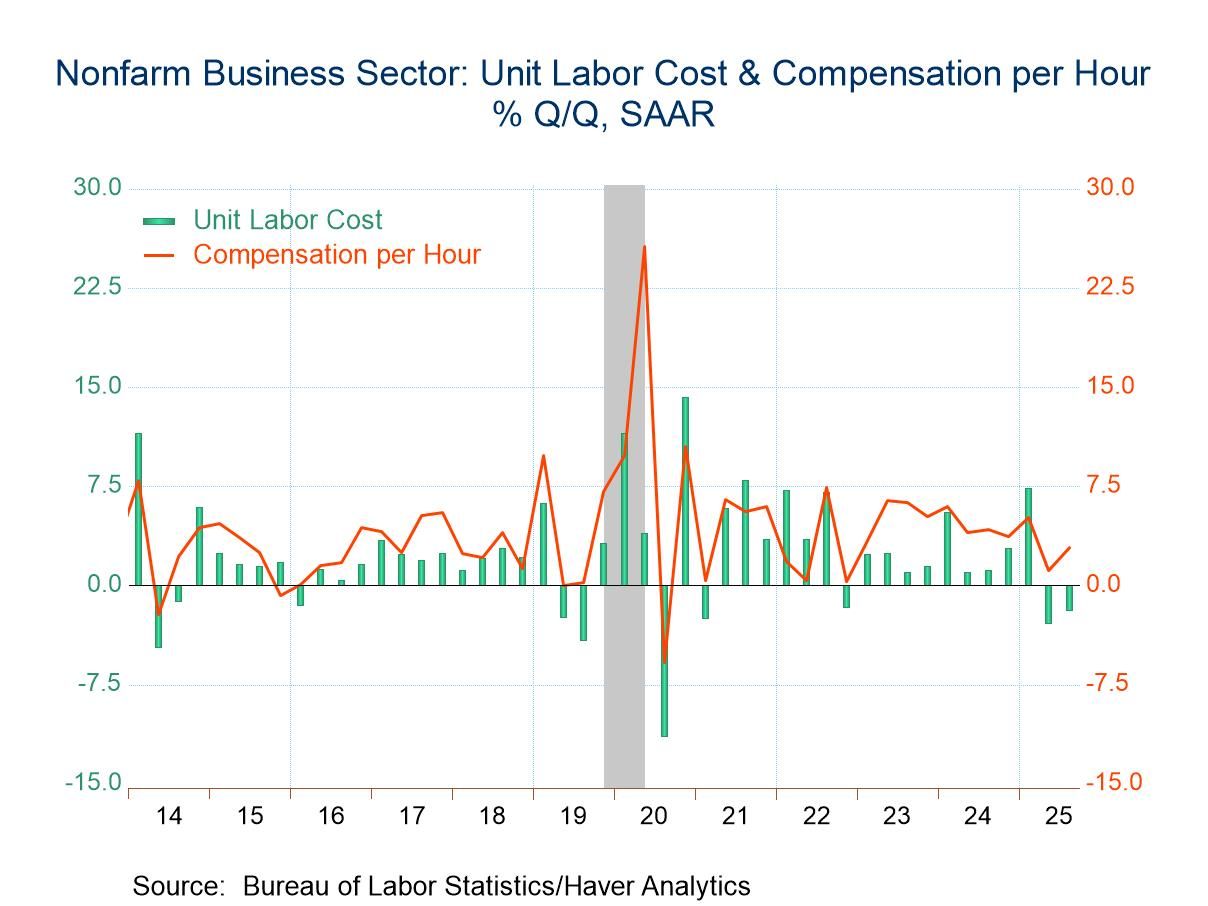
- Compensation increased 2.9% in Q3 resulting in a 1.9% quarterly decline in unit labor costs.
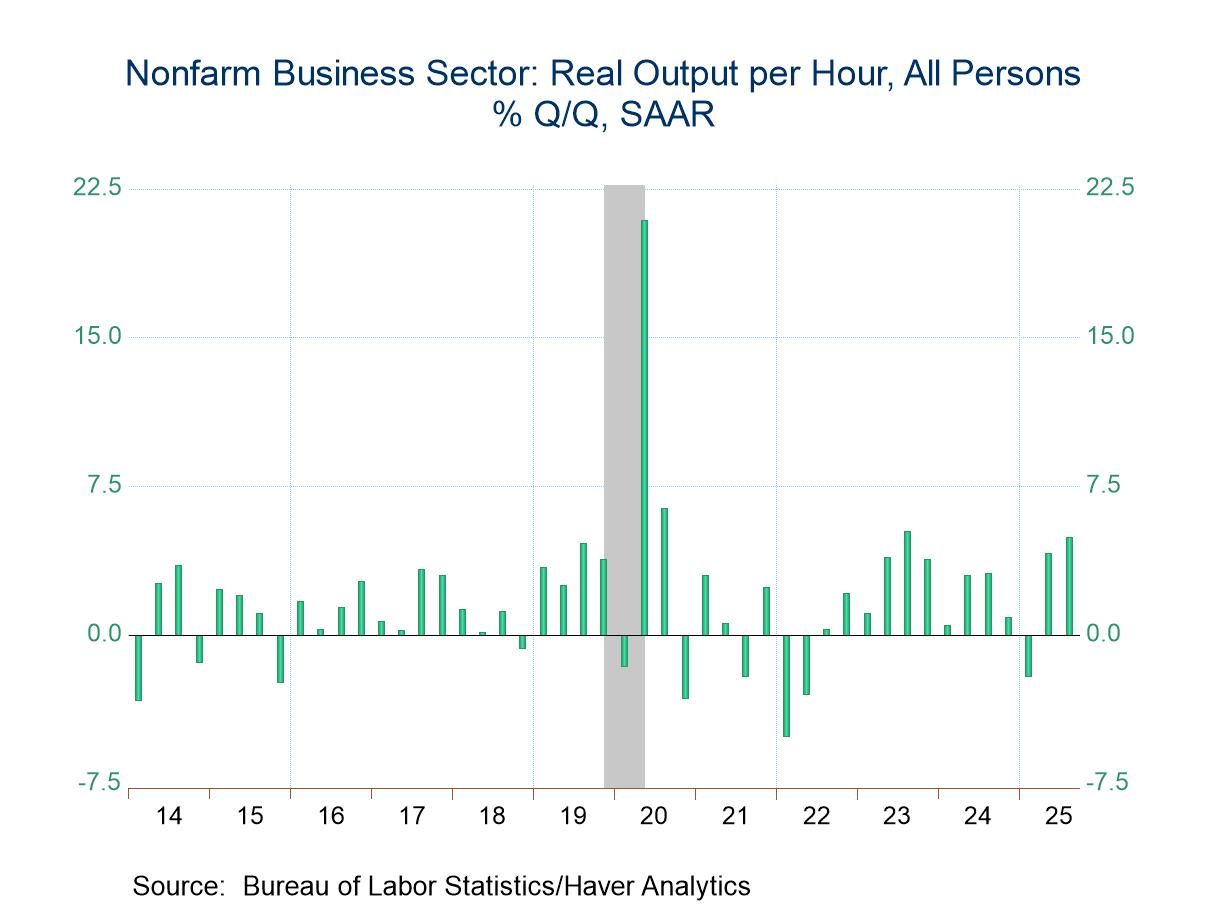
Nonfarm business labor productivity (output per hour) exhibited further robust growth in Q3, increasing 4.9% q/q SAAR following an upwardly revised 4.1% quarterly increase in Q2 (previously +3.3%). A quarterly gain of 4.1% was expected by the Action Economics Forecast Survey. Compared to a year ago, productivity rose 1.9% in Q3 versus 1.5% in Q2. Since productivity growth began to accelerate at the beginning of 2023, it has grown at a well above trend 2.7% annual rate. Strong productivity is a key factor for boosting real incomes and restraining inflation pressures going forward.
Nonfarm business output increased 5.4% q/q in Q3 on top of a 5.2% quarterly rise in Q2 while hours worked edged up just 0.5% q/q, down from 1.0% in Q2. Compensation growth picked up to 2.9% q/q in Q3 from a downwardly revised 1.1% q/q in Q2 (previously +4.3%) although compensation growth from a year ago slowed to 3.2% in Q3 from 3.5%. As a result, unit labor costs declined 1.9% q/q in Q3 following a downwardly revised 2.9% quarterly decline in Q2 (previously +1.0%). On a y/y basis, unit labor costs advanced only 1.2% y/y in Q2, the smallest annual gain since Q3 2023.
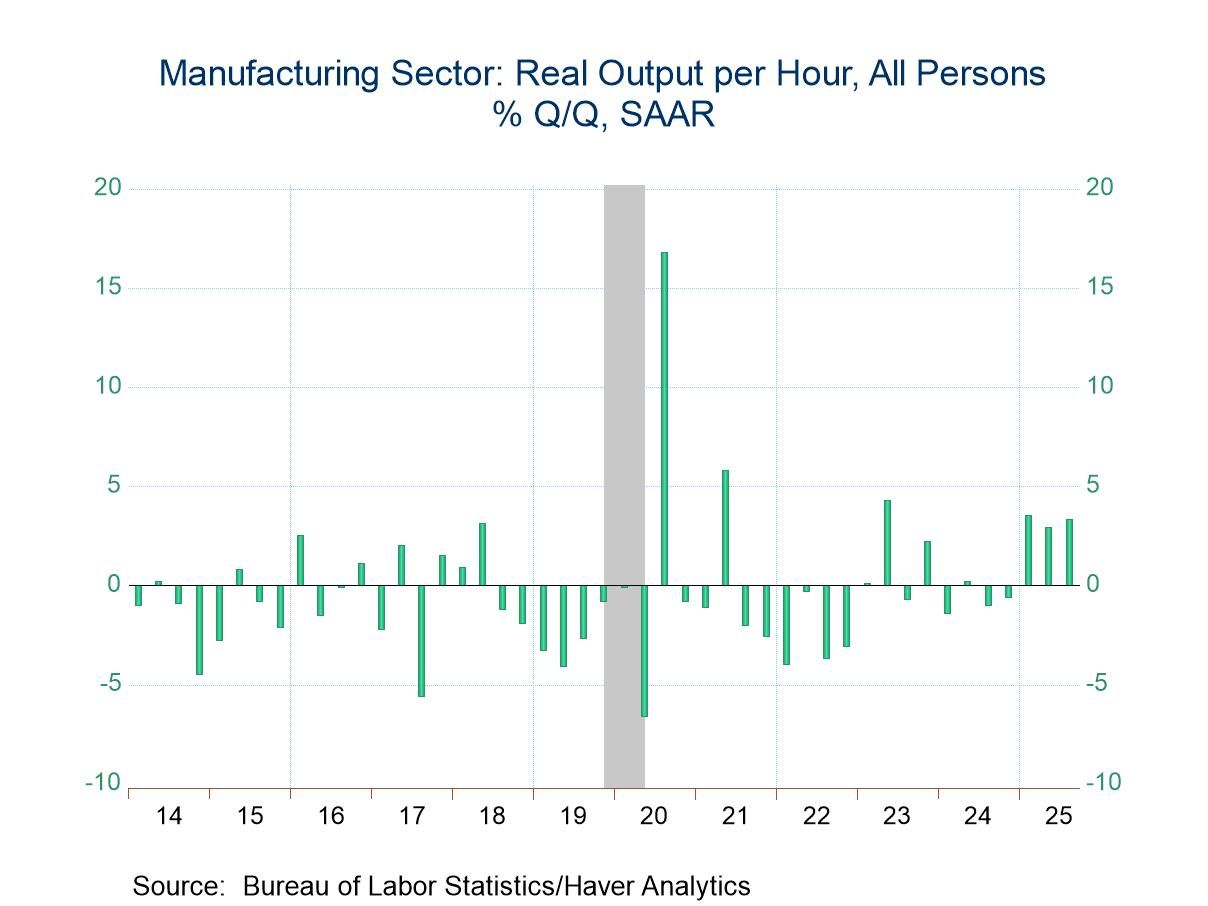
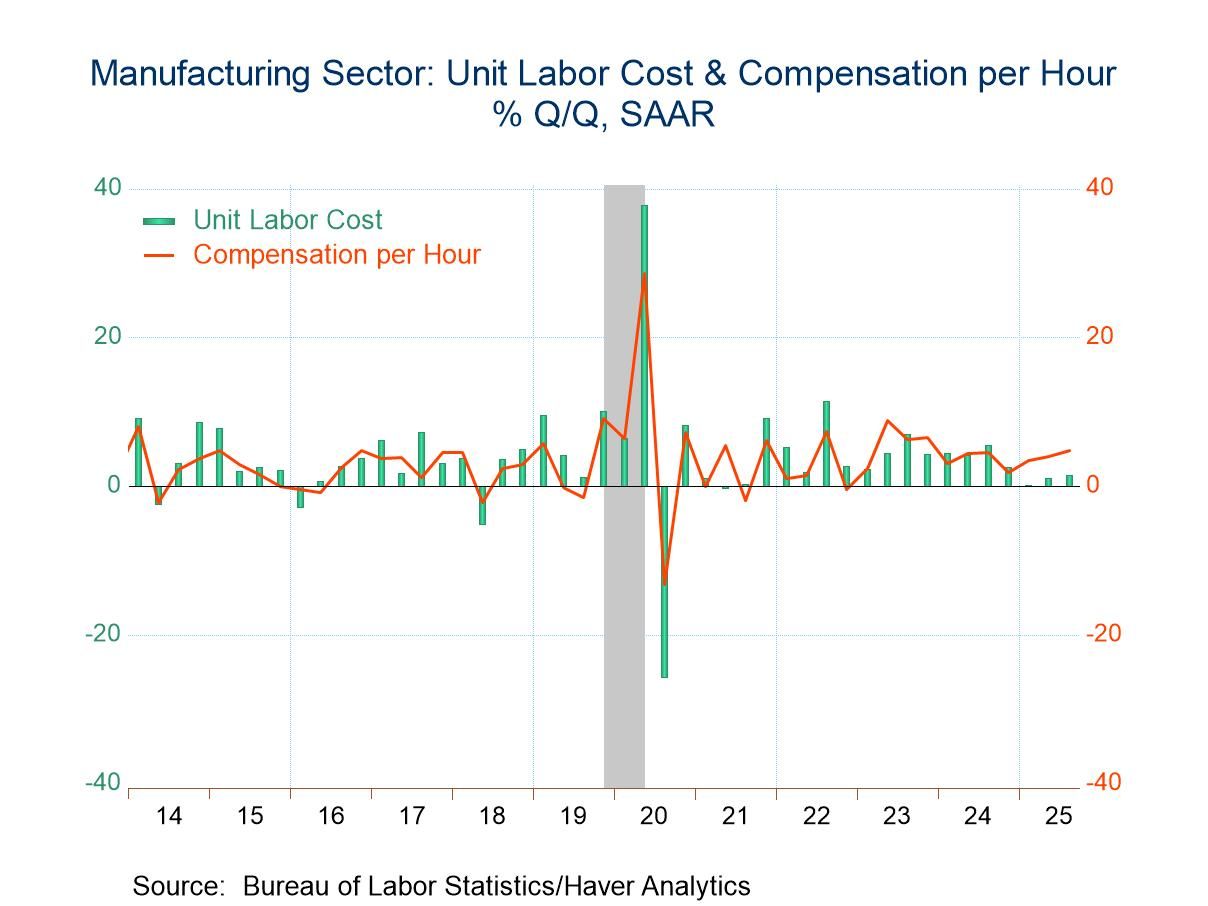
Growth of factory output slowed to 2.6% q/q in Q3 from 2.9% in Q2. However, hours worked fell 0.7% in Q3 after having been unchanged in Q2. Consequently, factory productivity growth accelerated to 3.3% from 2.9% in Q2. Factory compensation growth picked up to 4.8% q/q in Q3 from 4.0% in Q2, resulting in a pickup in unit labor cost growth to 1.5% from 1.1% in Q2.
The productivity and labor cost data are available in Haver’s USECON database. The Action Economics expectations figures are in the AS1REPNA database.

Sandy Batten
AuthorMore in Author Profile »Sandy Batten has more than 30 years of experience analyzing industrial economies and financial markets and a wide range of experience across the financial services sector, government, and academia. Before joining Haver Analytics, Sandy was a Vice President and Senior Economist at Citibank; Senior Credit Market Analyst at CDC Investment Management, Managing Director at Bear Stearns, and Executive Director at JPMorgan. In 2008, Sandy was named the most accurate US forecaster by the National Association for Business Economics. He is a member of the New York Forecasters Club, NABE, and the American Economic Association. Prior to his time in the financial services sector, Sandy was a Research Officer at the Federal Reserve Bank of St. Louis, Senior Staff Economist on the President’s Council of Economic Advisors, Deputy Assistant Secretary for Economic Policy at the US Treasury, and Economist at the International Monetary Fund. Sandy has taught economics at St. Louis University, Denison University, and Muskingun College. He has published numerous peer-reviewed articles in a wide range of academic publications. He has a B.A. in economics from the University of Richmond and a M.A. and Ph.D. in economics from The Ohio State University.
More Economy in Brief
 Global