U.S. Payroll Employment Unexpectedly Declined in July
by:Sandy Batten
|in:Economy in Brief
Summary
- U.S. nonfarm payrolls unexpectedly fell 23,000 in July with meaningful downward revisions to both May and June.
- The market consensus looked for an 85,000 increase.
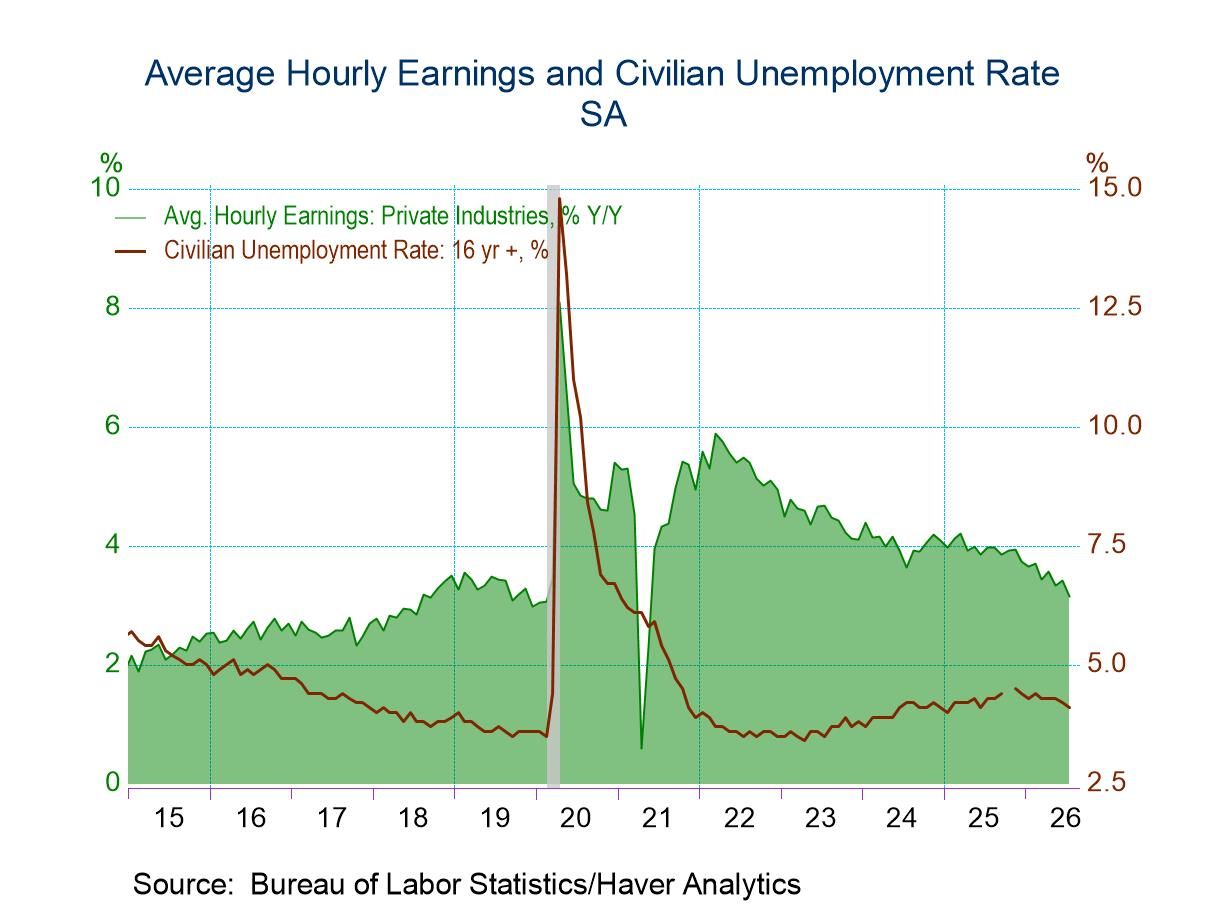
- The unemployment rate edged down to 4.1%, its lowest since June 2025, from 4.2%, due mostly to another significant decline in the labor force.
- Average hourly earnings edged up 0.1% m/m (3.2% y/y), meaningfully lower than expectations.
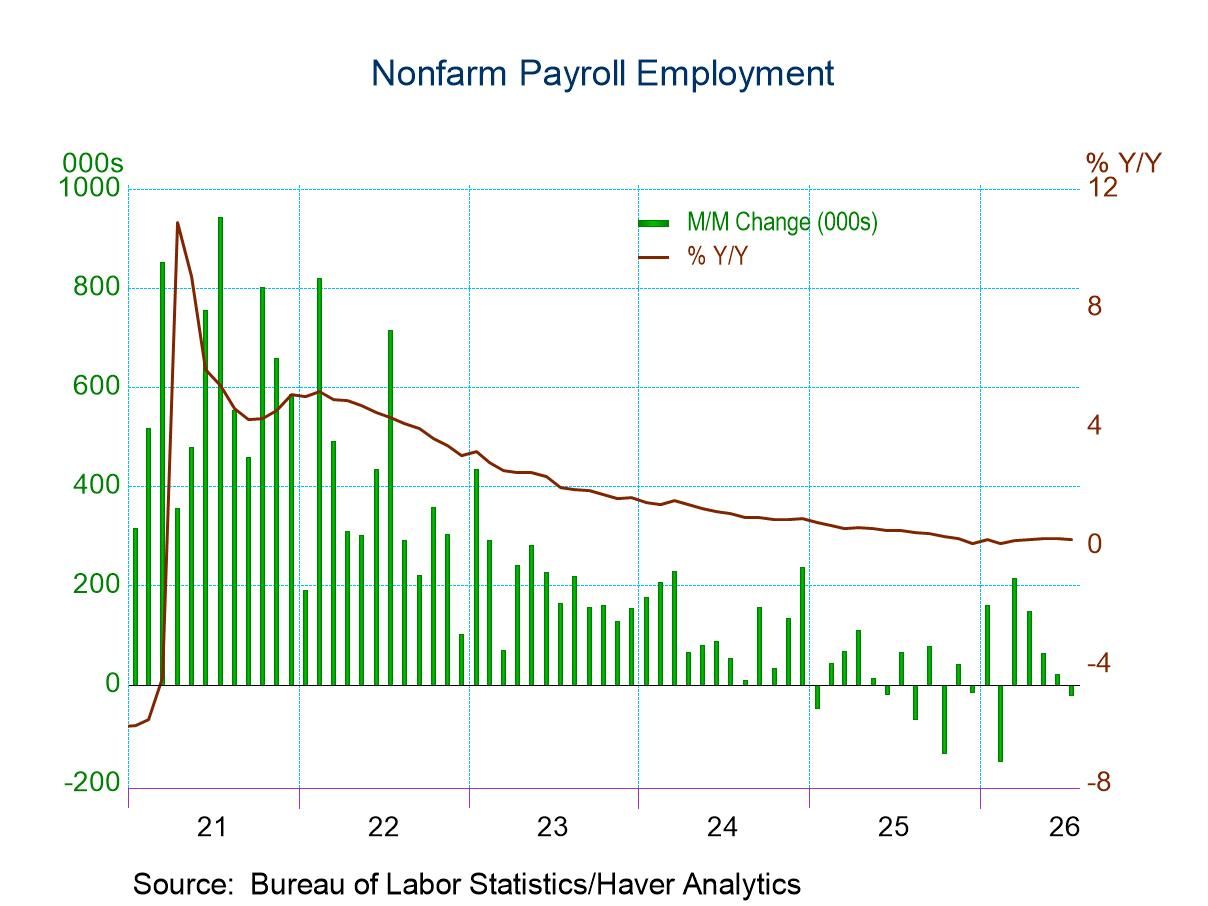
For the second consecutive month, the employment report disappointed. Nonfarm payrolls fell 23,000 in July with significant downward revisions to both May and June, according to today’s report from the Bureau of Labor Statistics. The Action Economics Forecast Survey expected an increase of 85,000. The 129,000 increase previously reported for May was revised down to 63,000 while the much lower-than-expected 57,000 increase previously reported for June was revised down to 20,000. The average gain over the past three months fell to 20,000 from 77,000 in June while the average increase over the past six months declined to 44,330 from 74,830 in June. Both remain stronger than in the second half of last year but in the past two months have slowed from the pace exhibited in the spring.
In contrast to the headline figure, private-sector payrolls posted a 30,000 increase in July. However, this was still much lower than the expected 79,000 increase, and there were also significant, though smaller than for the headline figure, downward revisions to both May and June (totaling 55,000). Government employment fell 53,000 in July, almost completely accounted for by a surprising 49,600 decline in local government education jobs.
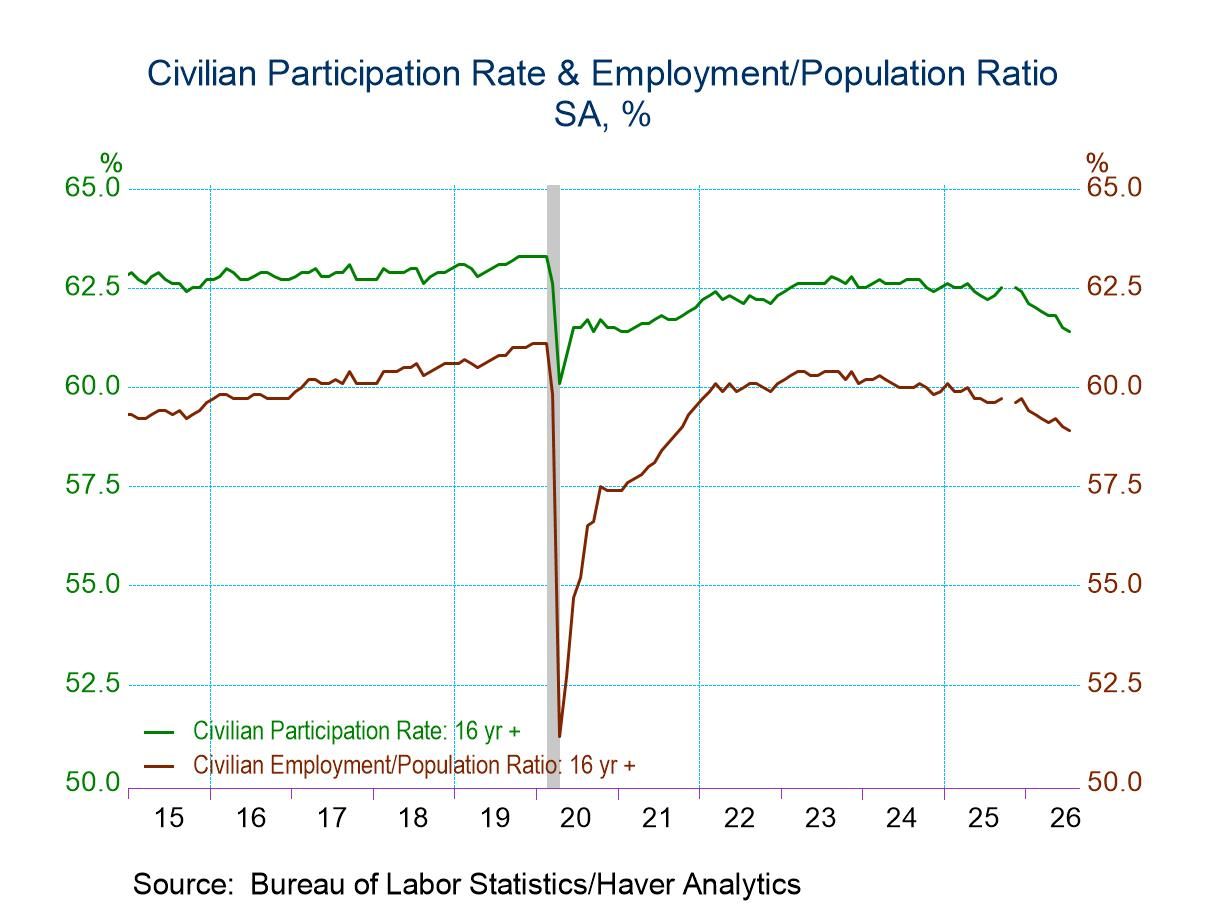
The weaker-than-expected payroll report was once again reinforced by a weak report from the household survey for July. While the number of unemployed fell 178,000, the third consecutive monthly decline, and the unemployment rate unexpectedly edged down to 4.1% from 4.2% in June, the number of employed fell 87,000, the fifth monthly decline in the past six months, on top of a 507,000 plunge in June. The labor force continued its sharp fall, declining 264,000 in July following a 720,000 drop in June. The labor force participation rate decreased to 61.4%, its lowest reading since February 2021.
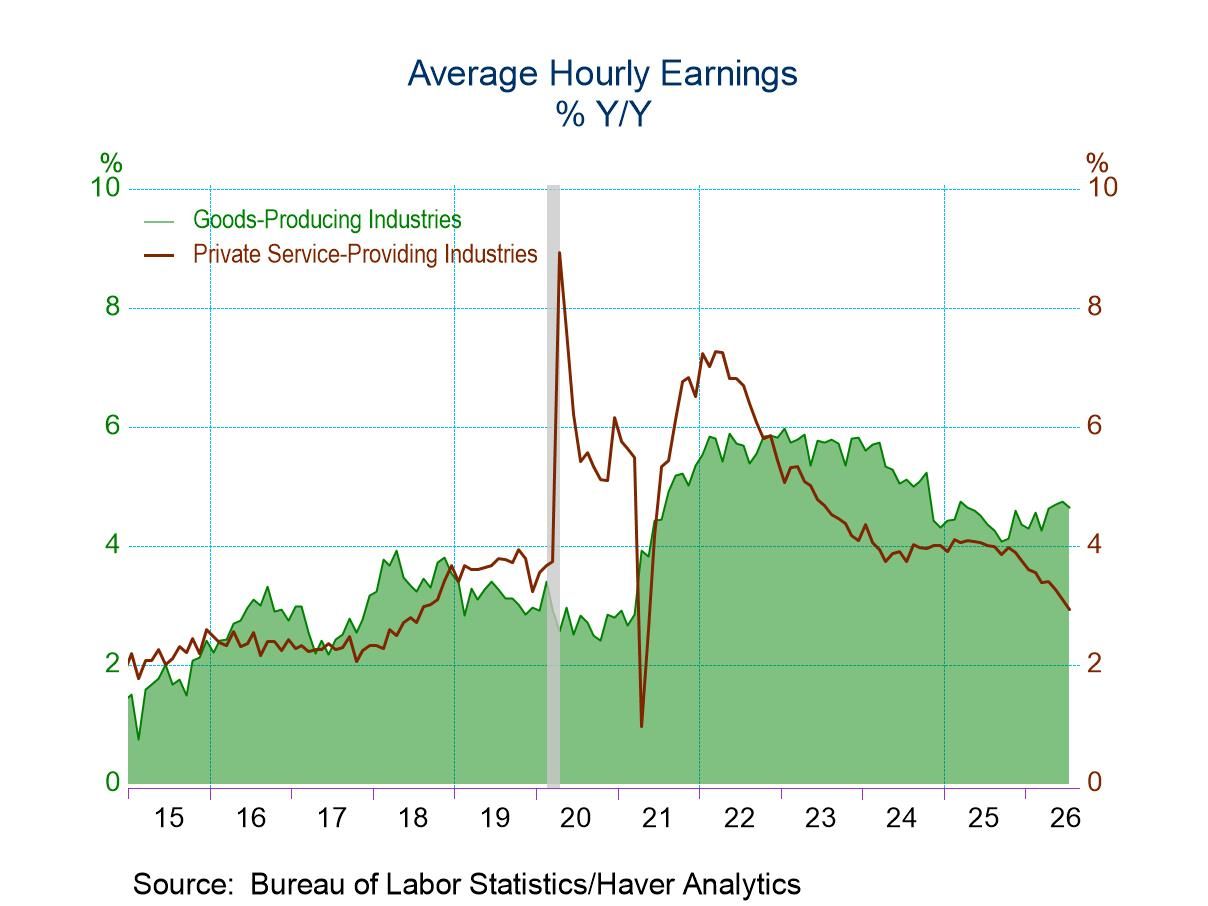
On a slightly brighter note, wage growth was well behaved. Private sector average hourly earnings, a key variable for the Federal Reserve, edged up a less-than-expected 0.1% m/m in July, the smallest monthly gain since last December. The 3.2% increase from a year ago was the lowest May 2021. Action Economics Forecast Survey looked for a 0.3% m/m rise. Wages in private service-producing firms were unchanged and advanced just 2.9% from a year ago, the slowest pace of advance since May 2021. Goods-producing wages rose 0.3% m/m (4.1% y/y) in July, up slightly from a 0.2% monthly increase in June.
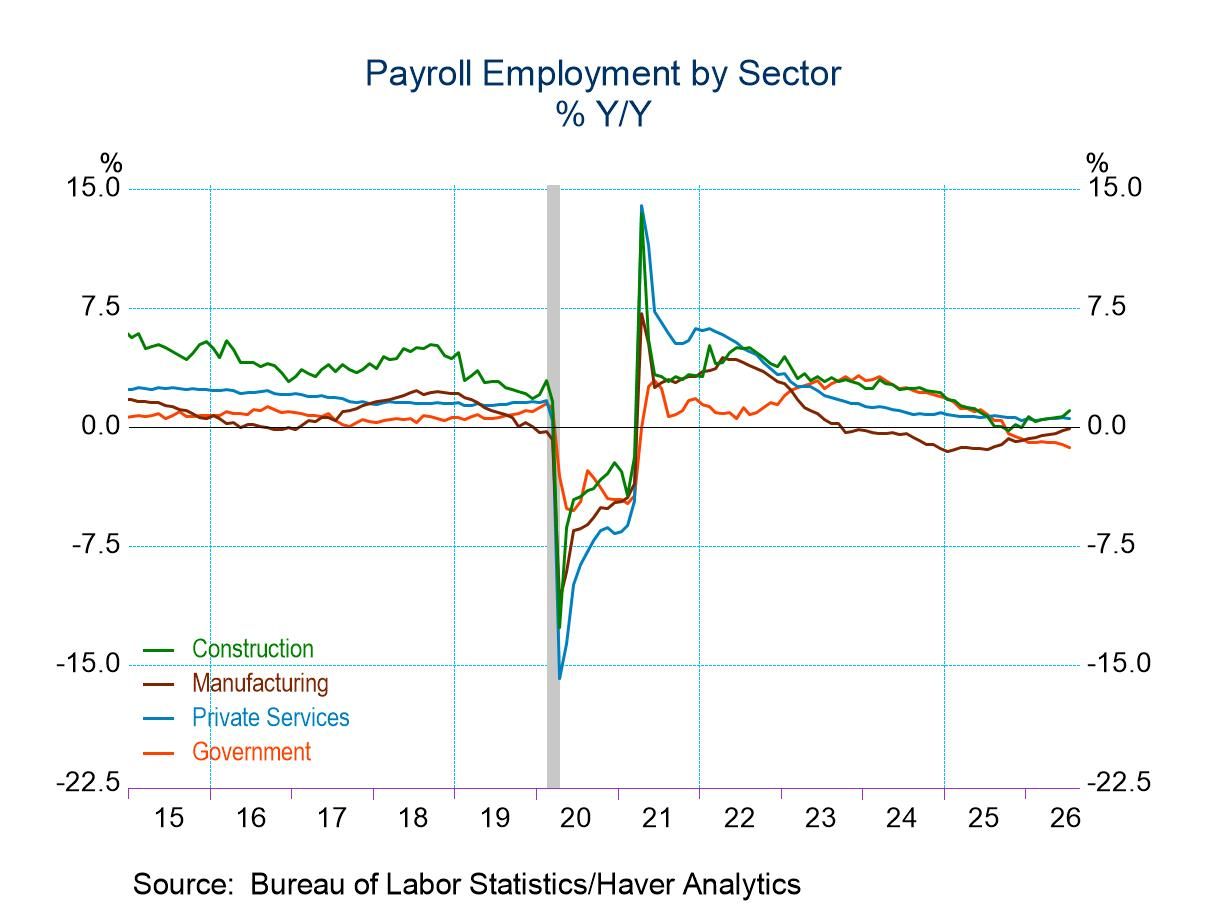
In the establishment survey, goods-producing jobs increased a solid 25,000 in July, the largest monthly advance since March, led by a 22,000 rise in construction jobs. Manufacturing jobs rose 5,000 in July, the second consecutive monthly gain. Private-sector service-producing jobs rose only 5,000 in July, the weakest performance since a 127,000 decline in February. Job performance varied significantly across sectors. Surprisingly, leisure and hospitality was the weakest sector with jobs declining 40,000 in July on top of a 43,000 decline in June. There were expectations that the World Cup would generate additional leisure and hospitality jobs, but this obviously has failed to pan out. Retail trade jobs fell 19,400 following a 3,700 decline in June. Financial activities jobs declined 14,000, the fifth consecutive monthly decline. By contrast, private education and healthcare jobs increased 25,000 in Jul, though this was well below the 60,000 monthly increase averaged over the previous four months. Professional and business services jobs rose 18,000, and information jobs gained 11,000, the first monthly increase in four months.
The breadth of private job growth narrowed in July from June with the one-month diffusion index falling to 51.8 from 53.2, though still above the key 50 level that indicates that more industries were adding jobs than losing them. Moreover, the six-month diffusion index rose to 55.0 in July, its highest reading since January 2024.
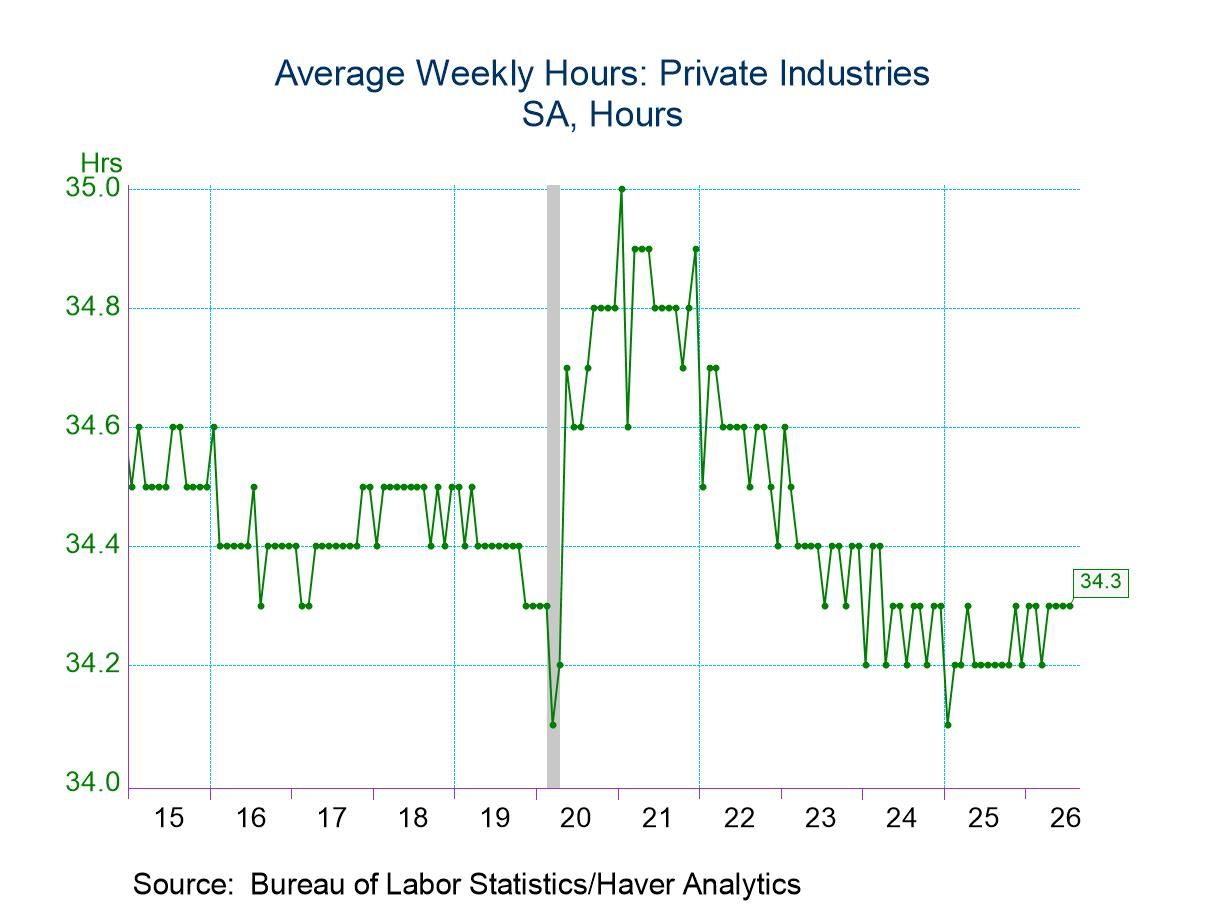
The length of the workweek was unchanged at 34.3 hours in July, where it has been for the past four months. The aggregate weekly hours index was also unchanged in July as it had been in June. The goods-producing workweek edged up to 40.2 hours in July, the highest since January 2023, from 40.1 in June. The private service-producing workweek was unchanged at 33.2 hours in July.
The employment and earnings data are collected from surveys taken each month during the week containing the 12th day of the month. The labor market data are contained in Haver's USECON database. Detailed figures are in the EMPL and LABOR databases. The expectations figures are in the AS1REPNA database.

Sandy Batten
AuthorMore in Author Profile »Sandy Batten has more than 30 years of experience analyzing industrial economies and financial markets and a wide range of experience across the financial services sector, government, and academia. Before joining Haver Analytics, Sandy was a Vice President and Senior Economist at Citibank; Senior Credit Market Analyst at CDC Investment Management, Managing Director at Bear Stearns, and Executive Director at JPMorgan. In 2008, Sandy was named the most accurate US forecaster by the National Association for Business Economics. He is a member of the New York Forecasters Club, NABE, and the American Economic Association. Prior to his time in the financial services sector, Sandy was a Research Officer at the Federal Reserve Bank of St. Louis, Senior Staff Economist on the President’s Council of Economic Advisors, Deputy Assistant Secretary for Economic Policy at the US Treasury, and Economist at the International Monetary Fund. Sandy has taught economics at St. Louis University, Denison University, and Muskingun College. He has published numerous peer-reviewed articles in a wide range of academic publications. He has a B.A. in economics from the University of Richmond and a M.A. and Ph.D. in economics from The Ohio State University.
More Economy in Brief
U.K. Housing Surveys and Consumer Sentiment Support the View of Weak Growth
 Asia
Asia