U.S. New Home Sales Ease in October After Two Straight M/M Increases
Summary
- October sales -0.1% (+18.7% y/y) to 737,000; still 42.0% above the July ’22 low.
- Sales fall m/m in all major regions except the South (+16.9%).
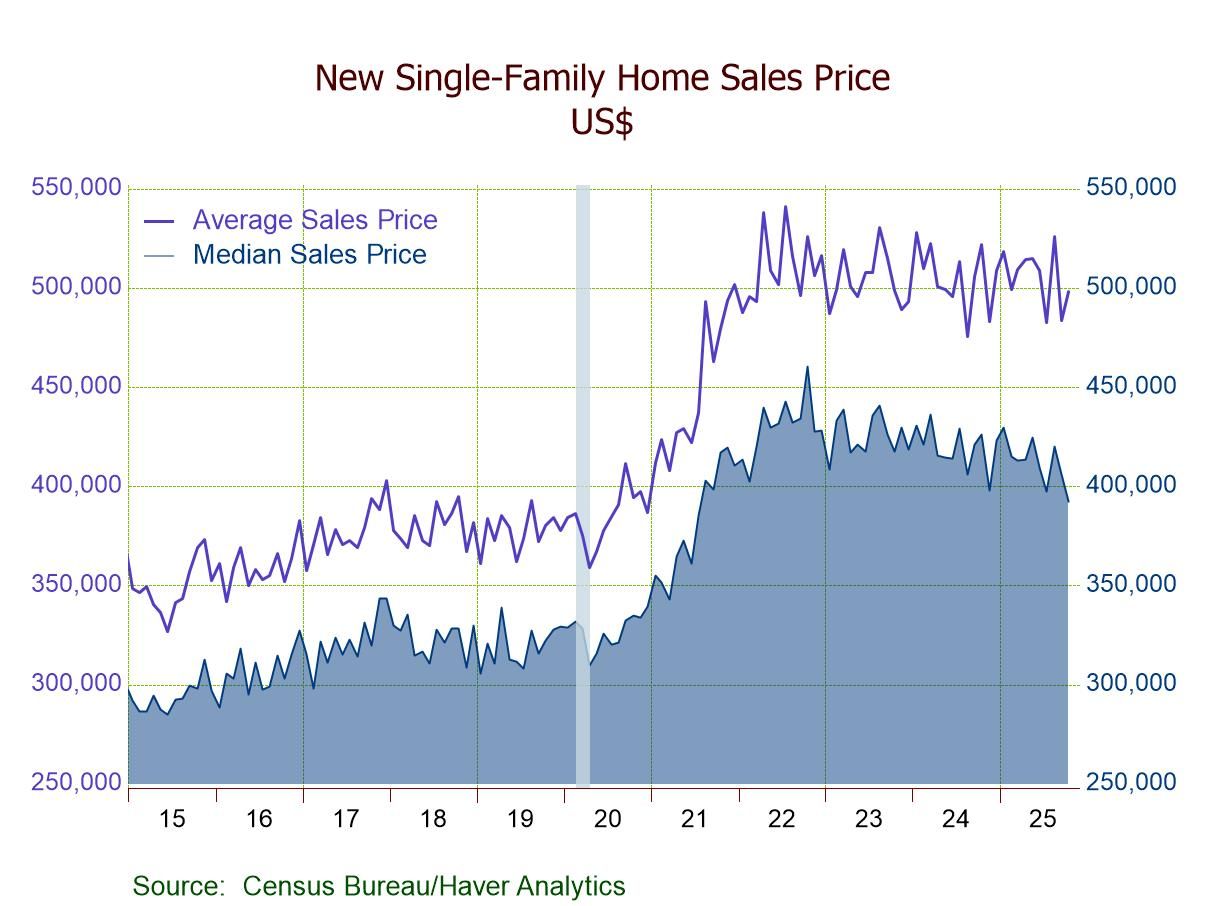
- Median sales price down to $392,300, lowest since July ’21; avg. price up to $498,000.
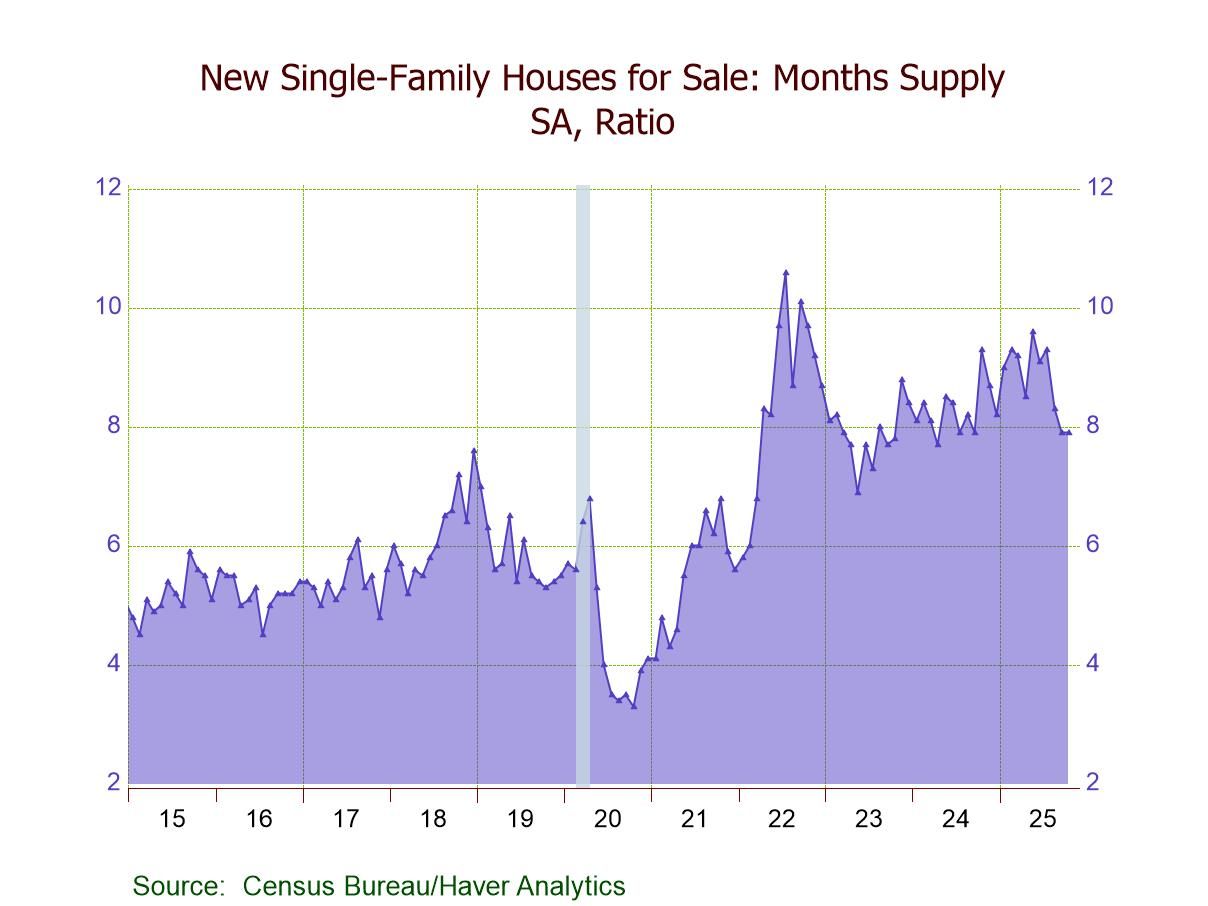
- Months' supply of new homes for sale holds steady at 7.9 mths., lowest since Sept. '24.
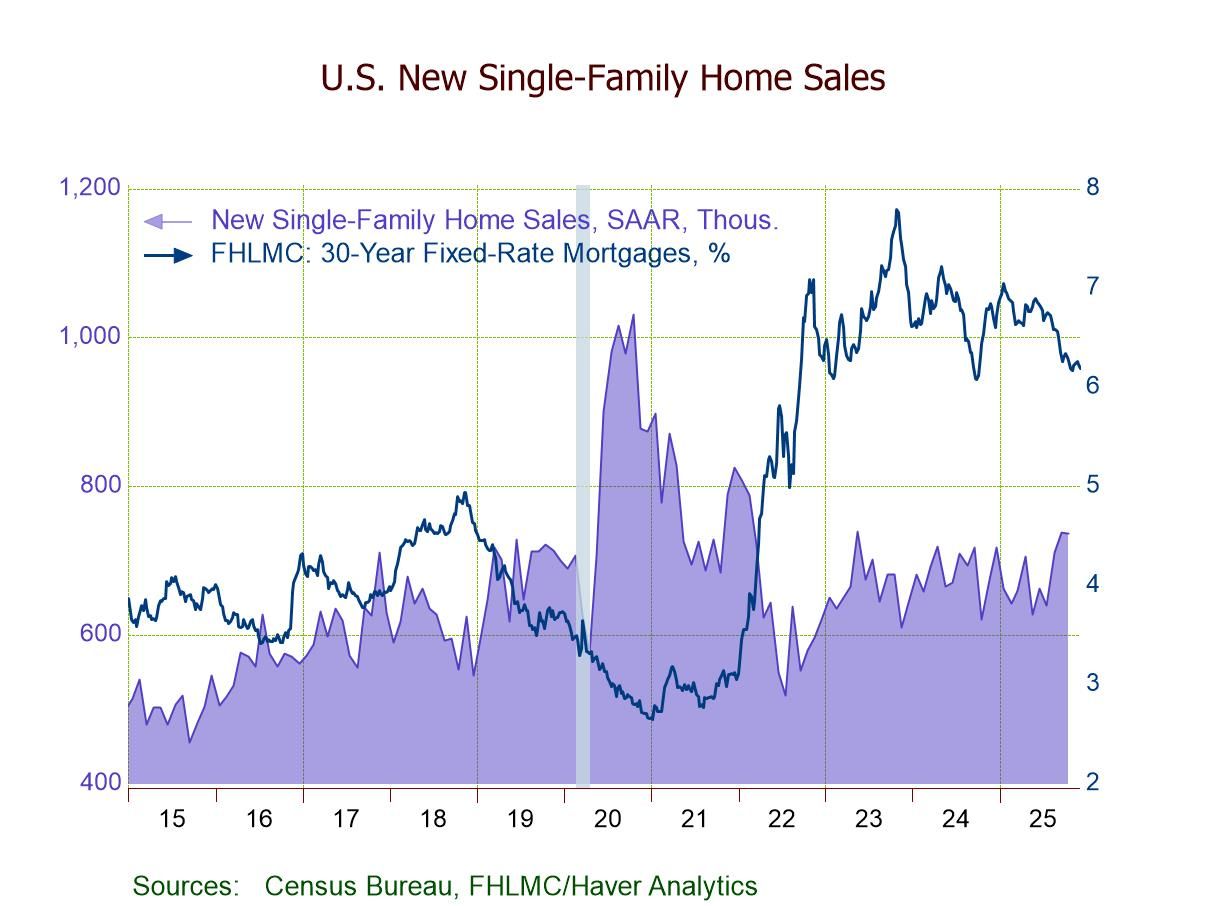
New single-family home sales dipped 0.1% m/m (+18.7% y/y) to a seasonally adjusted annual rate of 737,000 units in October following rises of 3.8% to 738,000 in September and 11.3% to 711,000 in August (+20.5%, 800,000 previously), data from the U.S. Census Bureau showed. The Action Economics Forecast Survey had expected sales of 710,000 for October. The October figure was the first m/m decline since July, though sales remained 42.0% up from the July 2022 low of 519,000. The sales dip occurred alongside a drop in the average 30-year fixed mortgage rate to 6.25% in October, the lowest since September 2024, after declining to 6.35% in September; it had subsequently continued trending downward, according to Freddie Mac.
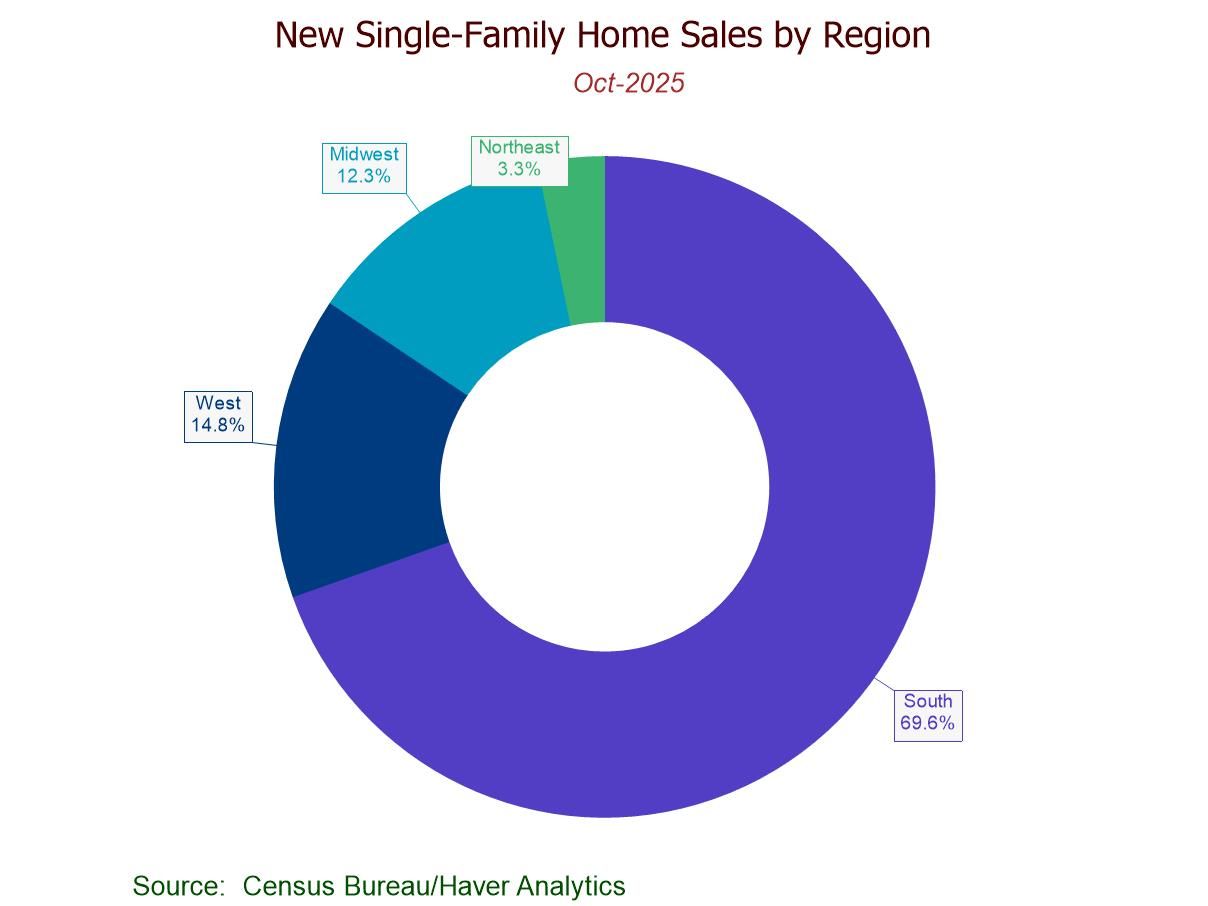
By region, October new home sales fell m/m in all major regions except the South. Sales in the West plunged 36.3% (-24.8% y/y) to 109,000 in October, the lowest level since July 2022, after a 9.6% increase in September. Sales in the Northeast dropped 14.3% (-40.0% y/y) to 24,000 after registering at 28,000 in September and August. Sales in the Midwest fell 9.0% (+21.3% y/y) to 91,000 following a strong 25.0% September gain. For these three regions, October marked the first m/m decline since July. In contrast, sales in the South surged 16.9% (42.1% y/y) to 513,000, the highest level since March 2021, after a 1.8% September decline. The South remained the dominant region, accounting for 69.6% of total U.S. new home sales.
The median sales price of a new home fell 3.3% (-8.0% y/y) to $392,300 in October on top of a 3.4% decline to $405,800 in September, marking the fourth m/m fall in five months and the lowest level since July 2021. The median sales price had fallen 14.8% since its record high of $460,300 in October 2022. Meanwhile, the average sales price of a new home rose 3.0% (-4.6% y/y) to $498,000 in October after an 8.1% drop to $483,500 in September. The average price was 8.0% below a high of $541,200 in July 2022. These sales price data are not seasonally adjusted.
The number of unsold new homes on the market held steady at 488,000 (+1.7% y/y) in October after four straight m/m declines. The latest figure was 14.6% above a low of 426,000 in July 2023. The seasonally adjusted months' supply of new homes for sale remained at 7.9 months in October and September—the lowest reading since September 2024—after falling to 8.3 months in August. The latest reading, while above a low of 6.9 months in May 2023, remained below a high of 10.6 months in July 2022.
The median number of months a new home stayed on the market rose to 2.7 months in October, the highest since March 2025, after registering at 2.4 months in September and August. The latest number was above its record low of 1.5 months in both September and October of 2022 but well below a peak of 5.1 months in March 2021. These figures date back to January 1975.
New home sales are recorded when the sales contract is signed. New home sales activity and prices are available in Haver's USECON database. The consensus expectation figure from Action Economics is available in the AS1REPNA database.

Winnie Tapasanun
AuthorMore in Author Profile »Winnie Tapasanun has been working for Haver Analytics since 2013. She has 20+ years of working in the financial services industry. As Vice President and Economic Analyst at Globicus International, Inc., a New York-based company specializing in macroeconomics and financial markets, Winnie oversaw the company’s business operations, managed financial and economic data, and wrote daily reports on macroeconomics and financial markets. Prior to working at Globicus, she was Investment Promotion Officer at the New York Office of the Thailand Board of Investment (BOI) where she wrote monthly reports on the U.S. economic outlook, wrote reports on the outlook of key U.S. industries, and assisted investors on doing business and investment in Thailand. Prior to joining the BOI, she was Adjunct Professor teaching International Political Economy/International Relations at the City College of New York. Prior to her teaching experience at the CCNY, Winnie successfully completed internships at the United Nations. Winnie holds an MA Degree from Long Island University, New York. She also did graduate studies at Columbia University in the City of New York and doctoral requirements at the Graduate Center of the City University of New York. Her areas of specialization are international political economy, macroeconomics, financial markets, political economy, international relations, and business development/business strategy. Her regional specialization includes, but not limited to, Southeast Asia and East Asia. Winnie is bilingual in English and Thai with competency in French. She loves to travel (~30 countries) to better understand each country’s unique economy, fascinating culture and people as well as the global economy as a whole.
More Economy in Brief
 Global