Global| Apr 08 2026
U.S. Mortgage Applications Edged Down in the April 3 Week
Summary
- Signs of stabilization in mortgage applications emerged in the latest week.
- Applications for loans to purchase posted a small increase, while applications for loan refinancing posted a small decline in the latest week.
- Interest rate on 30-year fixed-rate loans eased 8bps to 6.68%.
- Average loan size edged up.
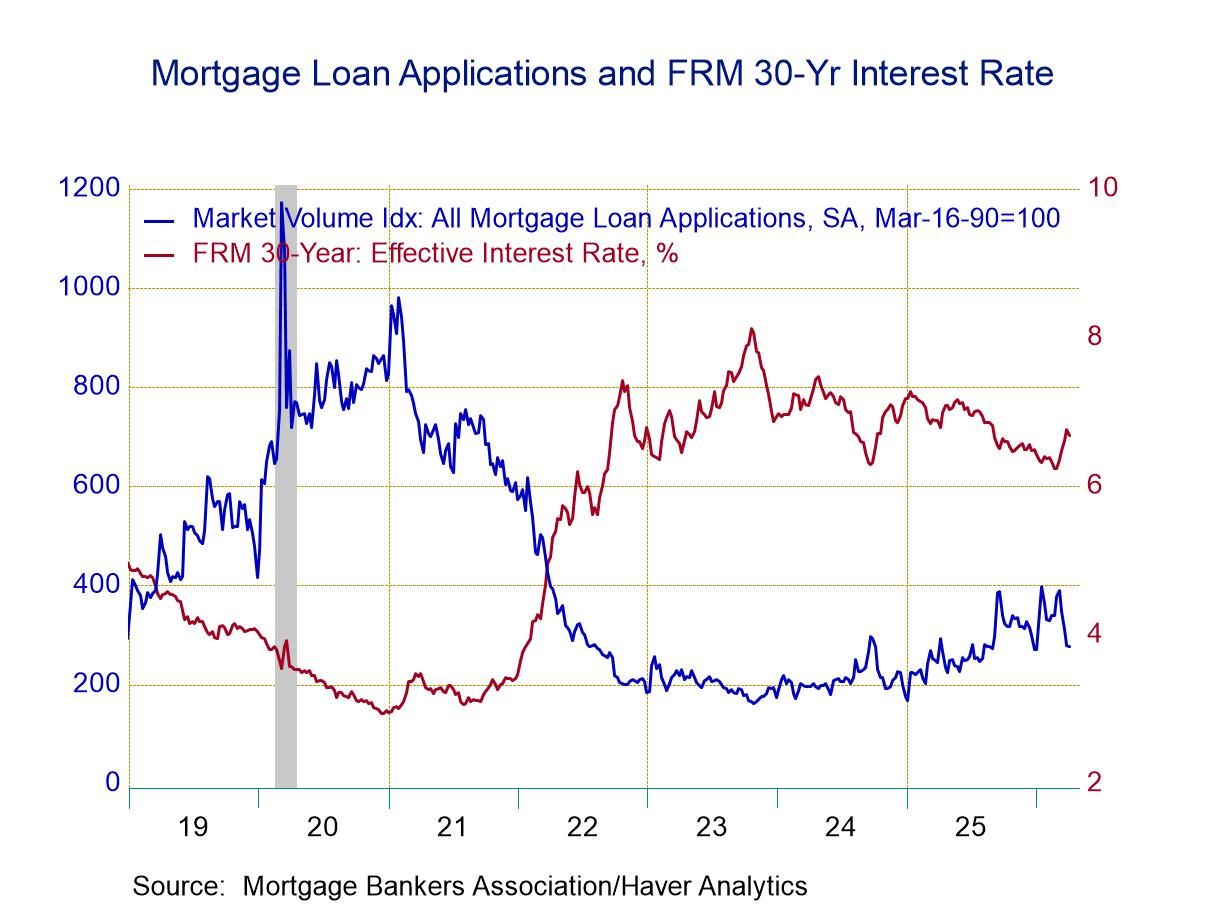
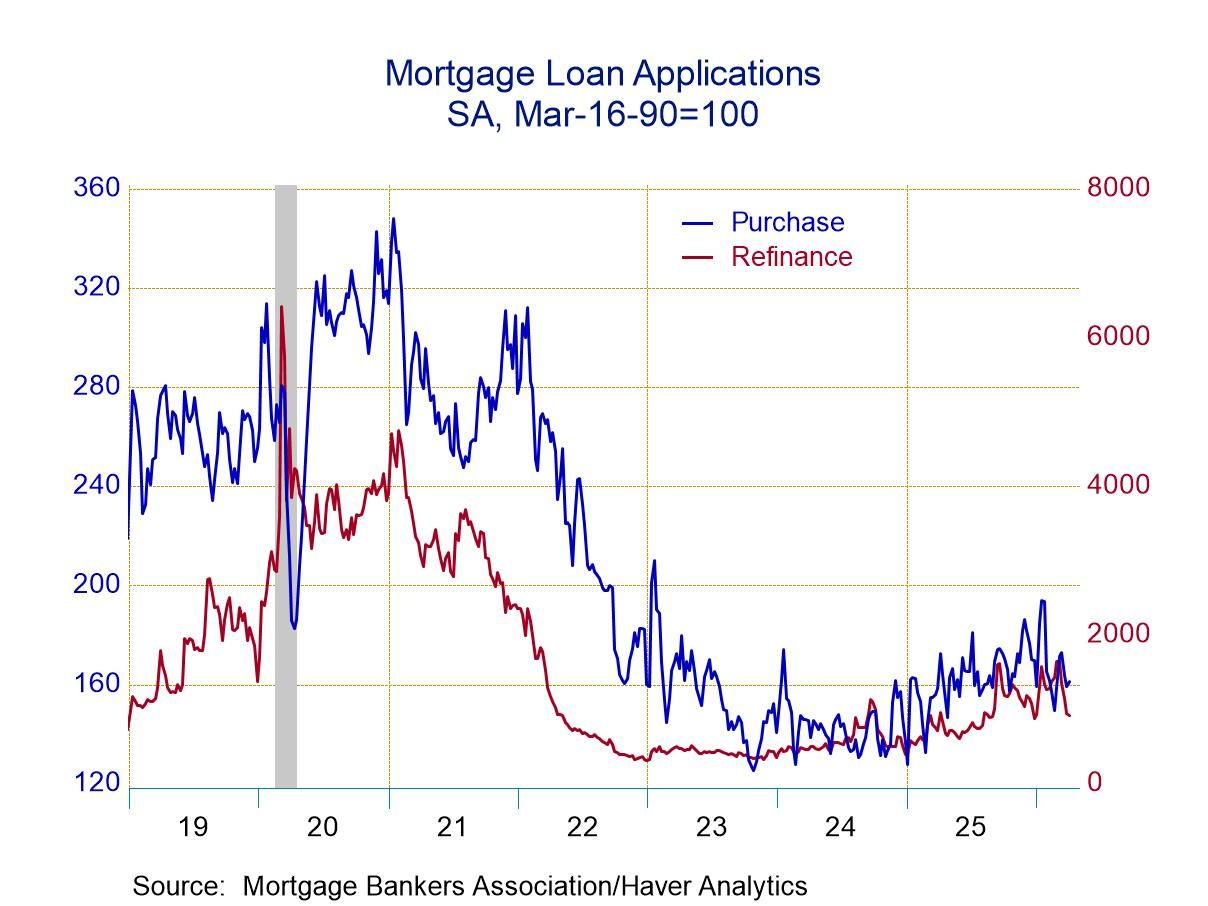
Mortgage applications declined 0.8% w/w (-5.6% y/y) in the week ending April 3. The weekly decline eased relative to the prior three weeks, when mortgage applications dropped by 10.4% w/w (+14.2% y/y) in the week ending March 27, and by 10.5% and 10.9% in the March 20 and 13 weeks, respectively, according to the Mortgage Bankers Association’s (MBA) Weekly Mortgage Applications Survey. Applications for loans to purchase a house rose 1.1% w/w (-6.7% y/y) in the April 3 week, after declining 2.6% w/w (+0.8% y/y) in the week ending March 27. Applications for loan refinancing dropped by a smaller 2.8% w/w (-4.3% y/y) in the latest week, following weekly declines of 17.3% (+33.2% y/y) in the March 27 week, 14.6% in the March 20 week, and of 18.5% in the week ending March 13.
The effective interest rate on a 30-year fixed-rate loan declined 8bps to 6.68% in the week ending April 3 from 6.76% in the week ending March 27 and after having risen by 52bps since the February 27 week. The rate on 15-year fixed-rate mortgages rose 1bp to 6.09% in the latest week from 6.08% in the prior week. The 30-year Jumbo rate declined 6bps to 6.65% in the week ending April 3 from 6.71% in the March 27 week. The rate on a 5-year ARM eased 3bps to 5.85% in the latest week from 5.88% in the week ending March 27.
The share of applications for refinancing an existing loan declined to 44.3% of total applications in the week of April 3, from 45.3% in the March 27 week. The adjustable-rate mortgage (ARM) share of activity rose to 8.6% in the week ending April 3 from 8.0% in the week ending March 27.
The average size of a mortgage loan edged up 0.2% w/w (-9.1% y/y) to $390,100 in the week ending April 3, after declining 1.3% w/w (-1.9% y/y) to $389,200 in the week ending March 27. The average size of a purchase loan edged down 0.3% w/w (-0.9% y/y) to $448,100 in the latest week, following a decline of 0.8% w/w (+0.4% y/y) to $449,400 in the March 27 week. The average size of a loan to refinance a mortgage edged up 0.1% w/w (-20.7% y/y) to $317,000 in the week ending April 3 after declining 5.5% w/w (+0.3% y/y) to $316,600 in the March 27 week. From the week ending February 27 to the week ending March 27, the average size of a loan to refinance a mortgage had declined 21.8%.
The Mortgage Bankers Association Survey covers 75% of all U.S. retail residential mortgage applications and has been conducted weekly since 1990. Respondents include mortgage bankers, commercial banks and thrifts. The base period and value for all indexes is March 16, 1990=100. The figures for weekly mortgage applications and interest rates are available in Haver’s SURVEYS database.

Kathleen Stephansen, CBE
AuthorMore in Author Profile »Kathleen Stephansen is a Senior Economist for Haver Analytics and an Independent Trustee for the EQAT/VIP/1290 Trust Funds, encompassing the US mutual funds sponsored by the Equitable Life Insurance Company. She is a former Chief Economist of Huawei Technologies USA, Senior Economic Advisor to the Boston Consulting Group, Chief Economist of the American International Group (AIG) and AIG Asset Management’s Senior Strategist and Global Head of Sovereign Research. Prior to joining AIG in 2010, Kathleen held various positions as Chief Economist or Head of Global Research at Aladdin Capital Holdings, Credit Suisse and Donaldson, Lufkin and Jenrette Securities Corporation.
Kathleen serves on the boards of the Global Interdependence Center (GIC), as Vice-Chair of the GIC College of Central Bankers, is the Treasurer for Economists for Peace and Security (EPS) and is a former board member of the National Association of Business Economics (NABE). She is a member of Chatham House and the Economic Club of New York. She holds an undergraduate degree in economics from the Universite Catholique de Louvain and graduate degrees in economics from the University of New Hampshire (MA) and the London School of Economics (PhD abd).
More Economy in Brief