U.S. Industrial Production Increases in December on Utilities Rebound
Summary
- December IP +0.4% (+2.0% y/y), third m/m rise in four months, led by a 2.6% gain in utilities.
- Manufacturing +0.2% (+2.0% y/y), w/ durables +0.1% and nondurables +0.3%.
- Selected high-tech +0.7%, third consecutive m/m rise; motor vehicles -1.1%, fourth straight m/m fall.
- Mining -0.7%, third m/m decline in four months.
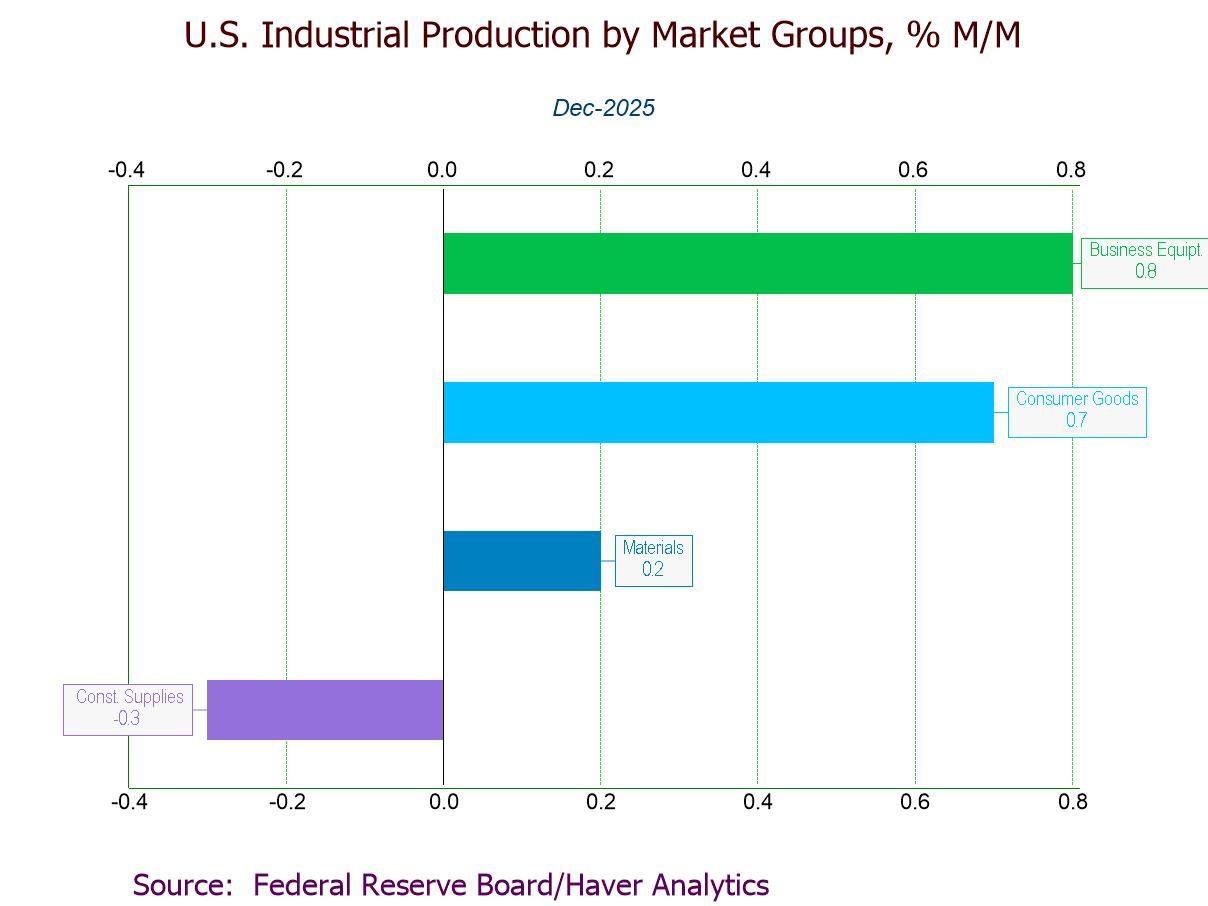
- Key categories in market groups mostly increase.
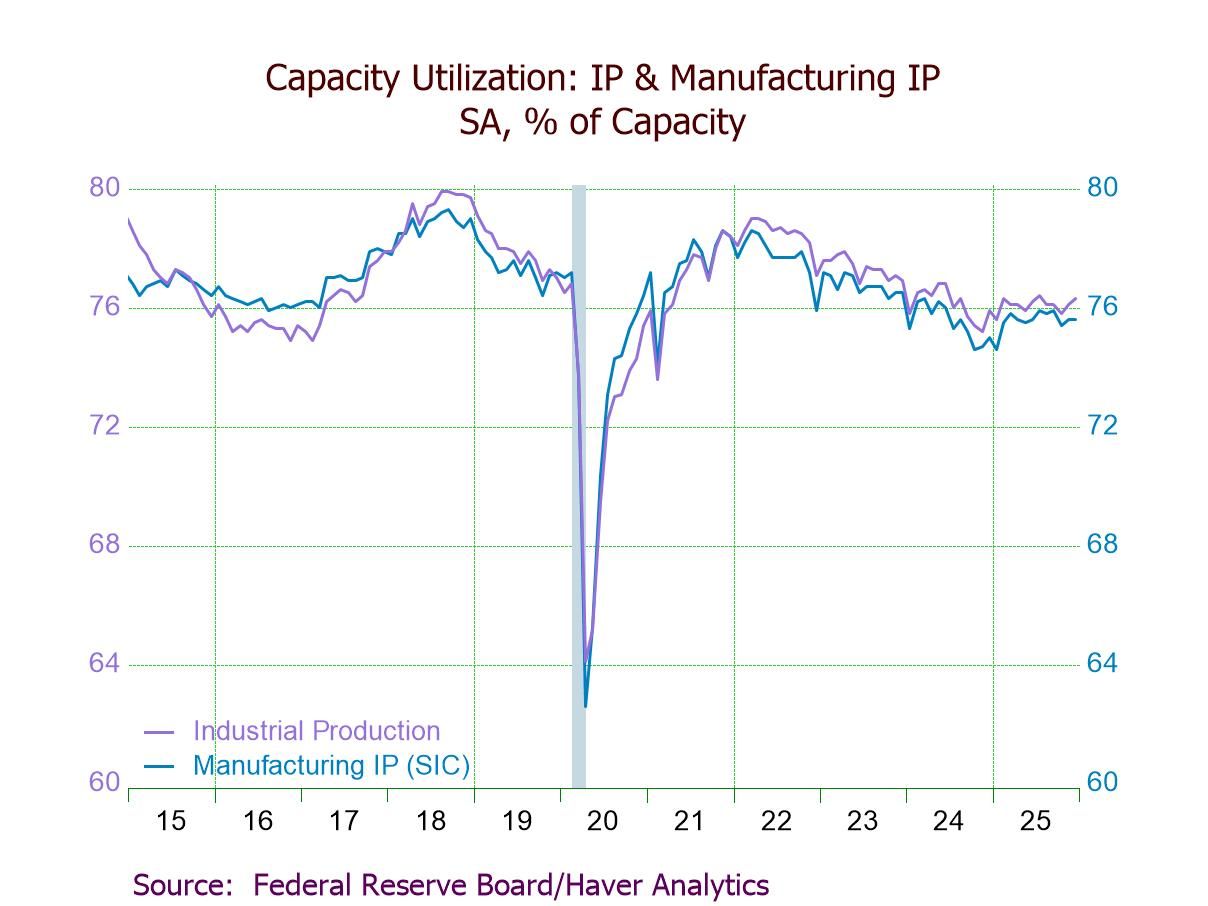
- Capacity utilization at a five-month-high 76.3%; mfg. capacity utilization steady at 75.6%.
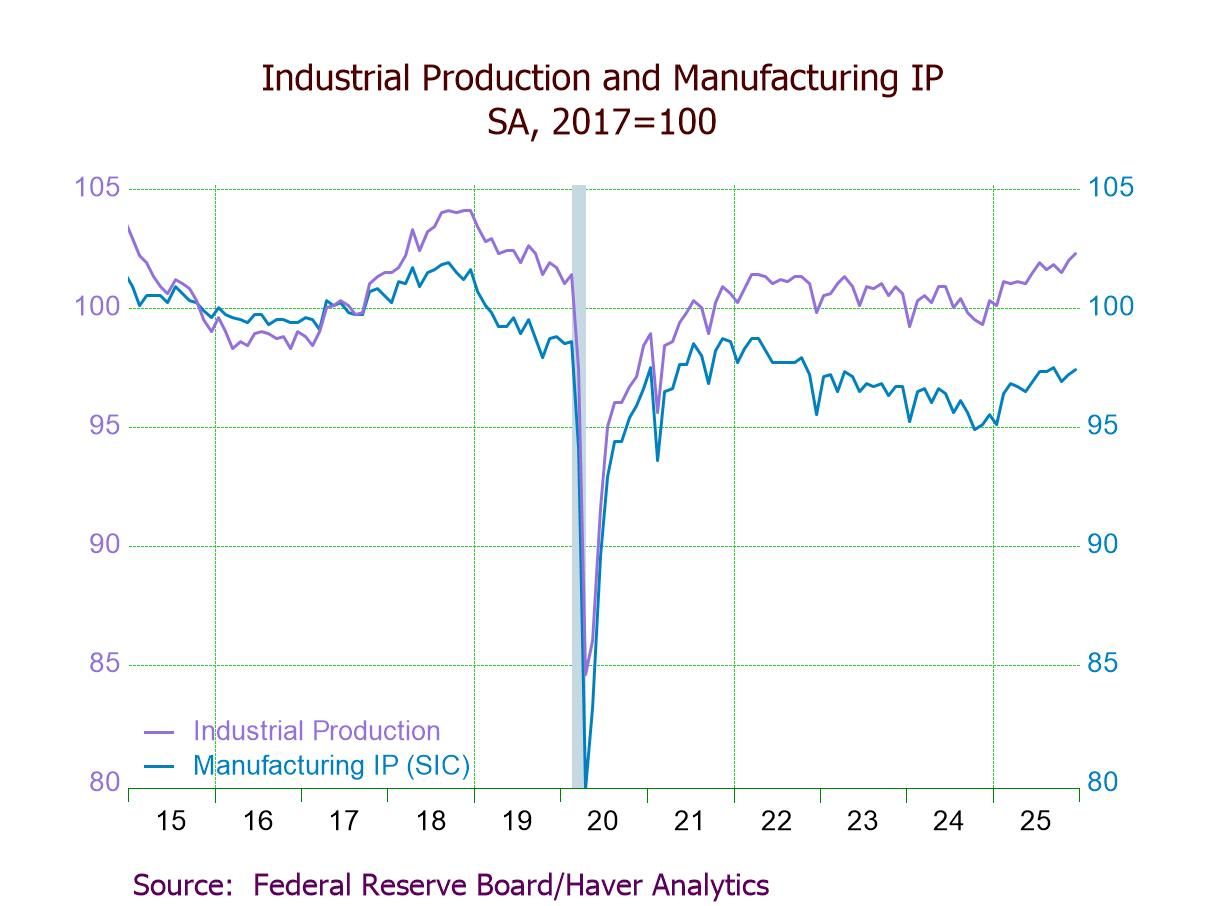
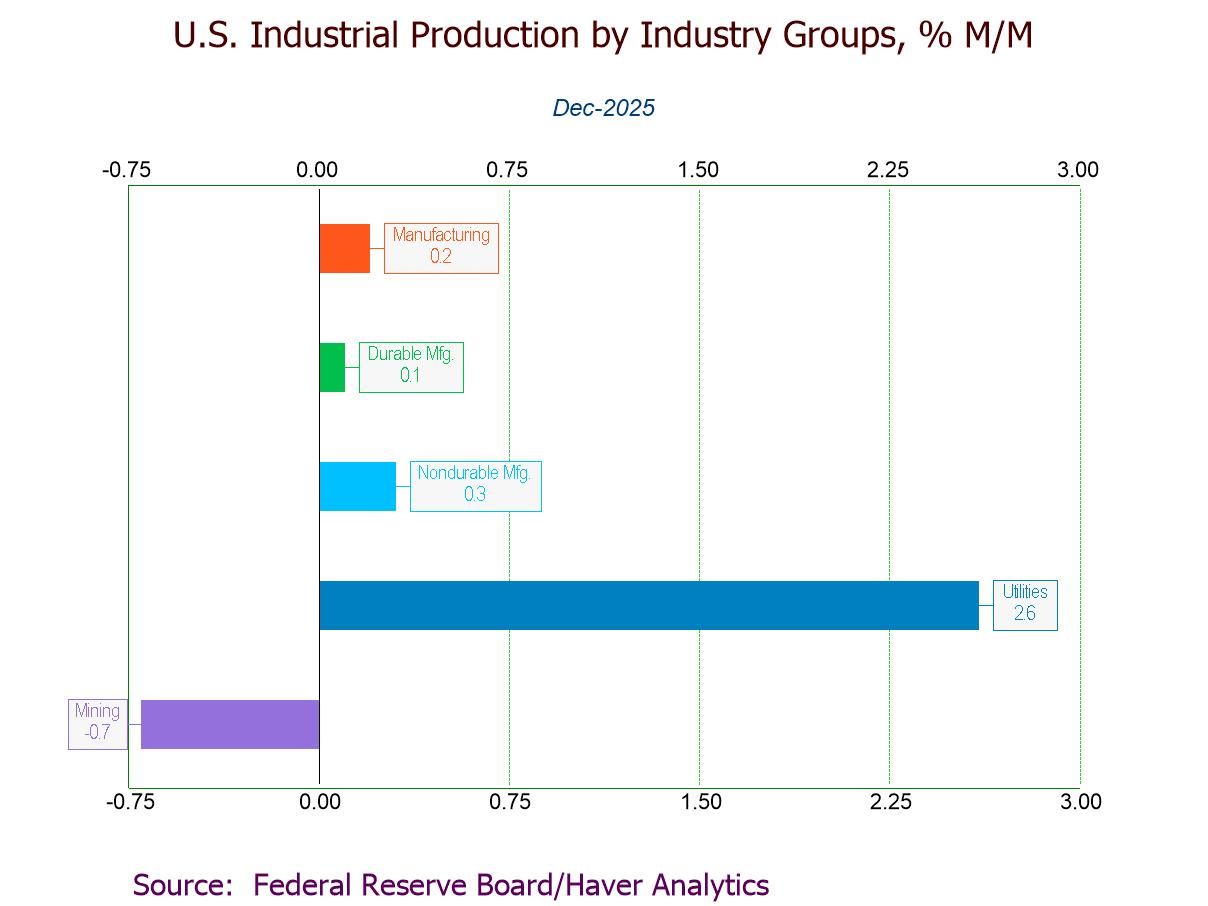
Industrial production (IP) rose a more-than-expected 0.4% m/m in December following a 0.4% rise in November (+0.2% initially) and a 0.3% decline in October (-0.1% previously), data from the Federal Reserve Board showed. December marked the third m/m gain in four months. A 0.1% m/m December increase had been expected in the Action Economics Forecast Survey. The year-on-year growth rate slowed to 2.0% in December, the lowest since September, from 2.5% in November; this compared with a 0.3% y/y decline in December 2024. The December IP index at 102.3 was 3.1% above a low of 99.2 in January 2024. IP rose 0.2% q/q in Q4 2025 after a 0.6% q/q gain in Q3 2025, increasing at a 0.7% annualized rate following a 2.3% Q3 annualized pace. In 2025, IP rose 1.3% after declines of 0.7% in 2024 and 0.2% in 2023.
By industry groups, manufacturing production grew 0.2% (2.0% y/y) in December, up for the third time in four months, following a 0.3% increase in November (0.0% initially) and a 0.6% drop in October (-0.4% previously). Durable goods production edged up 0.1% (3.1% y/y) in December, the first m/m increase since September, after a 0.1% downtick in November. Within durables, the following categories rose m/m in December, including output rises of 2.4% (3.5% y/y) in primary metals, 1.7% (1.3% y/y) in electrical equipment, appliances & components, 1.5% (17.2% y/y) in aerospace & miscellaneous transportation equipment, 0.8% (-2.2% y/y) in furniture & related products, 0.2% (4.8% y/y) in machinery, and 0.1% (7.4% y/y) in computer & electronic products. Notably, aircraft & parts production climbed 2.1% (30.0% y/y), the third m/m increase in four months, reversing a 2.1% November drop. To the downside, the following durable goods categories fell m/m in December, including drops of 2.3% (-5.5% y/y) in wood products, 1.1% (-2.8% y/y) in motor vehicles & parts, 1.1% (-1.0% y/y) in nonmetallic mineral products, 0.1% (+2.6% y/y) in fabricated metal products, and 0.1% (-3.7% y/y) in miscellaneous durables goods.
Nondurable goods production increased 0.3% (1.0% y/y) in December, the third m/m gain in four months, after a 0.8% rebound in November. The December increase reflected m/m output rises of 1.8% (2.1% y/y) in petroleum & coal products, 0.5% (1.9% y/y) in food, beverages & tobacco, and 0.3% (-0.2% y/y) in plastics & rubber products. In contrast, the following nondurable goods categories declined m/m in December, including output drops of 1.3% (-0.8% y/y) in textiles & product mills, 1.1% (-0.5% y/y) in apparel & leather goods, 0.3% (-3.1% y/y) in paper, 0.3% (-3.4% y/y) in printing & related support activities, and 0.1% (+1.6% y/y) in chemicals.
Utilities output recovered 2.6% (2.3% y/y) in December, the third m/m rise in four months, following a 0.3% decline in November (-0.4% initially), reflecting a 1.2% rebound (1.3% y/y) in electric utilities output and a 12.0% jump (8.7% y/y) in natural gas utilities output. Mining activity, however, fell 0.7% (+1.7% y/y), the third m/m slide in four months, after an unrevised 1.7% November gain.
By market groups, business equipment output advanced 0.8% (10.1% y/y) in December, up for the third time in four months, after a 0.3% increase in November. Consumer goods output rose 0.7% (0.7% y/y) after a 0.7% November rebound, reflecting a 0.7% decline (-3.5% y/y) in durable consumer goods and a 1.1% gain (1.8% y/y) in nondurable consumer goods. Materials production grew 0.2% (1.7% y/y), the third m/m increase in four months, after a 0.5% November rise. In contrast, construction supplies production fell 0.3% (+1.3% y/y) in December, the second m/m fall in three months, reversing a 0.3% increase in November.
In special classifications, factory output of selected high-tech industries increased 0.7% (10.9% y/y) in December, the third successive m/m gain, following a downwardly revised 0.5% rise in November (+1.1% initially). Manufacturing production excluding selected high-tech industries rose 0.2% (1.7% y/y) in December after a 0.3% gain in November, and manufacturing production excluding selected high-tech and motor vehicles & parts rose 0.3% (2.1% y/y) after a 0.4% increase; both measures posted their third m/m gain in four months.
Capacity utilization rose to 76.3% in December, the highest since July, from 76.1% in November (76.0% initially). The Action Economics Forecast Survey forecasted 76.0%. The December reading was 3.2 percentage points below its long-run (1972–2024) average. Manufacturing capacity utilization held at 75.6% in December and November (75.4% previously); the December rate was 2.6 percentage points below its long-run average.
Industrial production and capacity data are in Haver’s USECON database. Additional detail on production and capacity utilization can be found in the IP database. The expectations figures come from the AS1REPNA database.

Winnie Tapasanun
AuthorMore in Author Profile »Winnie Tapasanun has been working for Haver Analytics since 2013. She has 20+ years of working in the financial services industry. As Vice President and Economic Analyst at Globicus International, Inc., a New York-based company specializing in macroeconomics and financial markets, Winnie oversaw the company’s business operations, managed financial and economic data, and wrote daily reports on macroeconomics and financial markets. Prior to working at Globicus, she was Investment Promotion Officer at the New York Office of the Thailand Board of Investment (BOI) where she wrote monthly reports on the U.S. economic outlook, wrote reports on the outlook of key U.S. industries, and assisted investors on doing business and investment in Thailand. Prior to joining the BOI, she was Adjunct Professor teaching International Political Economy/International Relations at the City College of New York. Prior to her teaching experience at the CCNY, Winnie successfully completed internships at the United Nations. Winnie holds an MA Degree from Long Island University, New York. She also did graduate studies at Columbia University in the City of New York and doctoral requirements at the Graduate Center of the City University of New York. Her areas of specialization are international political economy, macroeconomics, financial markets, political economy, international relations, and business development/business strategy. Her regional specialization includes, but not limited to, Southeast Asia and East Asia. Winnie is bilingual in English and Thai with competency in French. She loves to travel (~30 countries) to better understand each country’s unique economy, fascinating culture and people as well as the global economy as a whole.
More Economy in Brief
 Global