U.S. Industrial Production Edged Up in September
by:Sandy Batten
|in:Economy in Brief
Summary
- IP edged up 0.1% m/m in September with a downward revision to August.
- Manufacturing and mining production were unchanged.
- Utilities output rebounded 1.1% m/m.
- Capacity utilization unchanged.
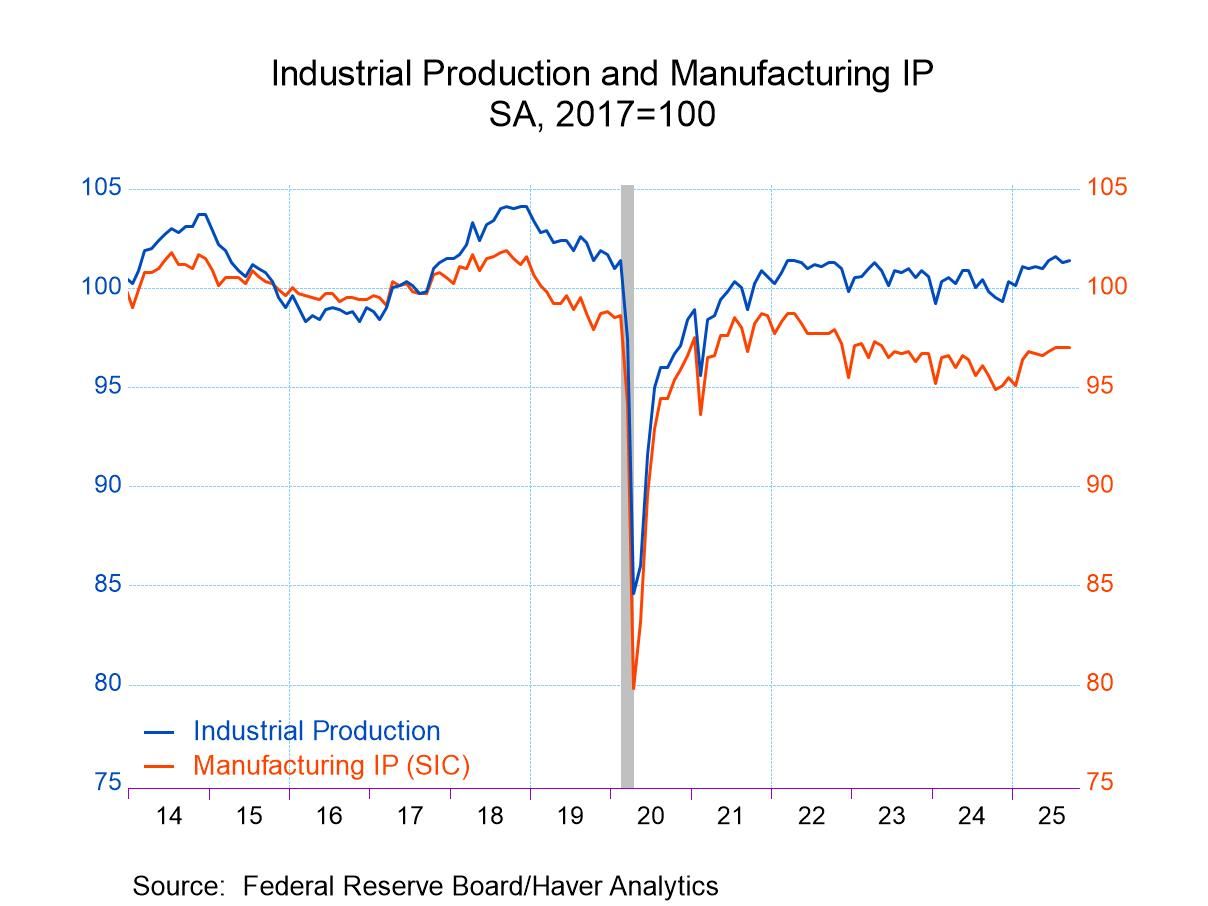

Industrial production edged up 0.1% m/m (1.6% y/y) in September following a downwardly revised 0.3% m/m decline in August (previously -0.1%). The Action Economics Forecast Survey expected a 0.1% monthly gain in September. Both manufacturing and mining output were unchanged m/m in September while utilities output rose 1.1% m/m. Compared with a year ago, manufacturing was up 1.5%, mining rose 2.8%, and utilities output increased 1.4% in September. This release had been delayed by the federal government shutdown as it uses some data compiled by government statistical agencies.
By market group, output of durable consumer goods fell 1.7% m/m in September (-3.6% y/y) after rising 1.0% m/m in August. Nondurable consumer goods output declined 0.3% m/m (-0.3% y/y) in September for the second consecutive monthly decline (-0.7% m/m in August). Business equipment production rebounded 0.7% m/m (9.1% y/y) following a 0.3% monthly decline in August. Production of nonindustrial supplies was unchanged in September from August (+0.8% y/y).
By industry group, output of durable goods edged up 0.1% m/m (+3.0% y/y) in September, the same monthly gain as in August. Motor vehicle and parts production fell 2.2%, the third monthly decline in the past four months, following a 3.0% m/m increase in August. Output of wood products slumped 3.5% m/m, the first decline in three months. By contrast, production of electrical equipment and appliances increased 1.8% m/m; aerospace output rose 1.4% m/m; primary metal output gained 1.4% m/m; and output of fabricated metal products increased 1.2% m/m.
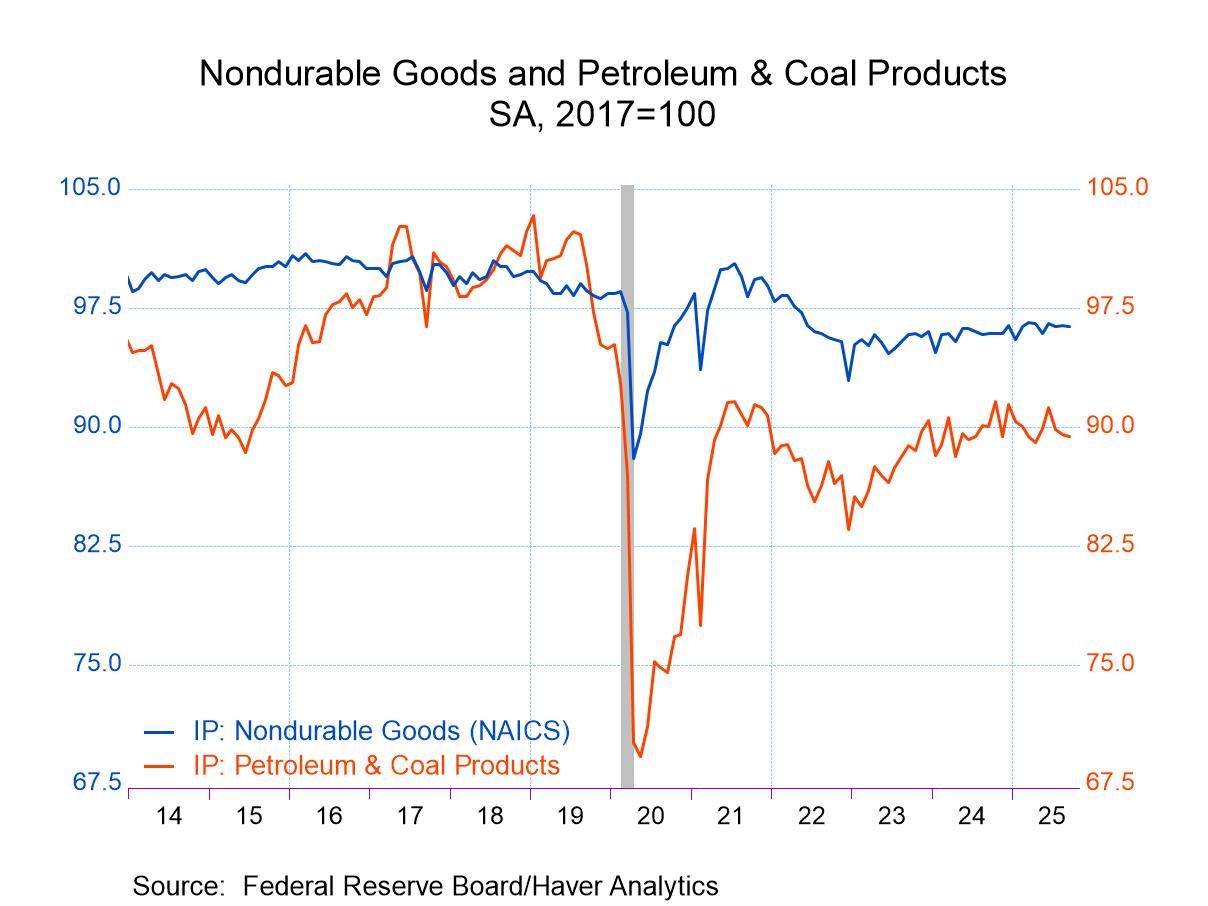
Output of nondurable goods slipped 0.1% m/m (+0.3% y/y) in September, reversing a 0.1% monthly gain in August. Declines were widespread across industry groups, led by a 1.3% m/m drop in printing and related activities. Output of petroleum and coal products fell 0.1% m/m, the third consecutive monthly decline. Chemical output fell 0.2% m/m. By contrast, production of plastics and rubber products increased 0.3% m/m in September on top of a 1.3% m/m gain in August.
Output of selected high-technology industries increased 0.6% m/m (10.8% y/y) in September following a 1.4% monthly decline in August. Manufacturing output excluding selected high-tech industries fell 0.1% m/m (+1.2% y/y) in September, the first decline in the past four months. Manufacturing output excluding motor vehicle production rose 0.2% m/m (+1.7% y/y) in September, offsetting a 0.2% monthly decline in August. Manufacturing output excluding production of motor vehicles and selected high-tech industries edged up 0.1% m/m (+1.3% y/y), the third monthly increase in the past four months and reversed a 0.1% m/m decline in August.
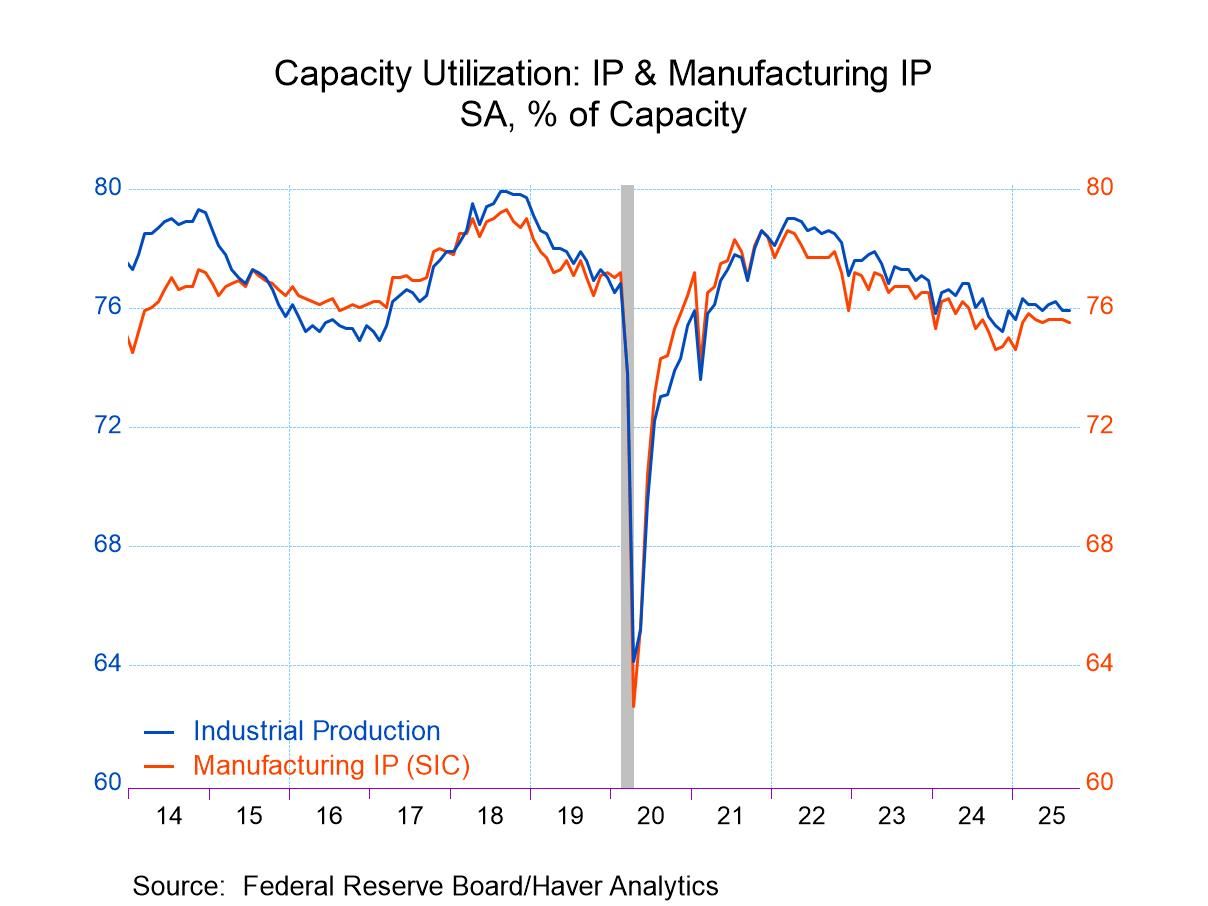
Total industry capacity utilization was unchanged at 75.9% in September. In the manufacturing sector, the utilization rate edged down to 75.5% from 75.6% in August.
Industrial production and capacity data are in Haver’s USECON database. Additional detail on production and capacity utilization can be found in the IP database. The expectations figures come from the AS1REPNA database.

Sandy Batten
AuthorMore in Author Profile »Sandy Batten has more than 30 years of experience analyzing industrial economies and financial markets and a wide range of experience across the financial services sector, government, and academia. Before joining Haver Analytics, Sandy was a Vice President and Senior Economist at Citibank; Senior Credit Market Analyst at CDC Investment Management, Managing Director at Bear Stearns, and Executive Director at JPMorgan. In 2008, Sandy was named the most accurate US forecaster by the National Association for Business Economics. He is a member of the New York Forecasters Club, NABE, and the American Economic Association. Prior to his time in the financial services sector, Sandy was a Research Officer at the Federal Reserve Bank of St. Louis, Senior Staff Economist on the President’s Council of Economic Advisors, Deputy Assistant Secretary for Economic Policy at the US Treasury, and Economist at the International Monetary Fund. Sandy has taught economics at St. Louis University, Denison University, and Muskingun College. He has published numerous peer-reviewed articles in a wide range of academic publications. He has a B.A. in economics from the University of Richmond and a M.A. and Ph.D. in economics from The Ohio State University.
More Economy in Brief
 Global