U.S. Construction Spending Slipped in September but Rebounded in October
by:Sandy Batten
|in:Economy in Brief
Summary
- Total construction spending fell 0.6% m/m in September but rebounded 0.5% m/m in October.
- Private construction spending slumped 0.9% m/m in September but rose 0.6% m/m in October.
- Private nonresidential construction fell for the fourth consecutive month while private residential construction posted a 1.3% m/m gain.
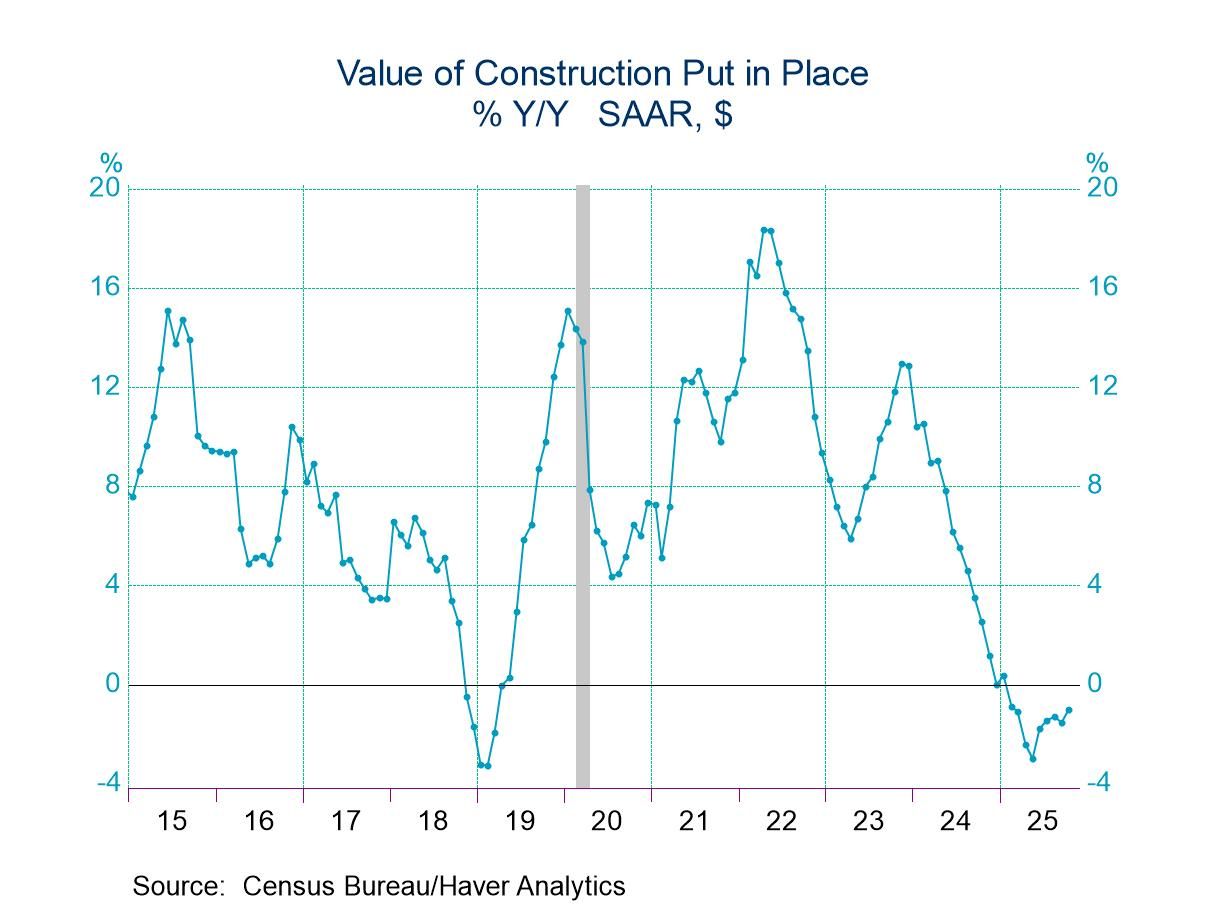
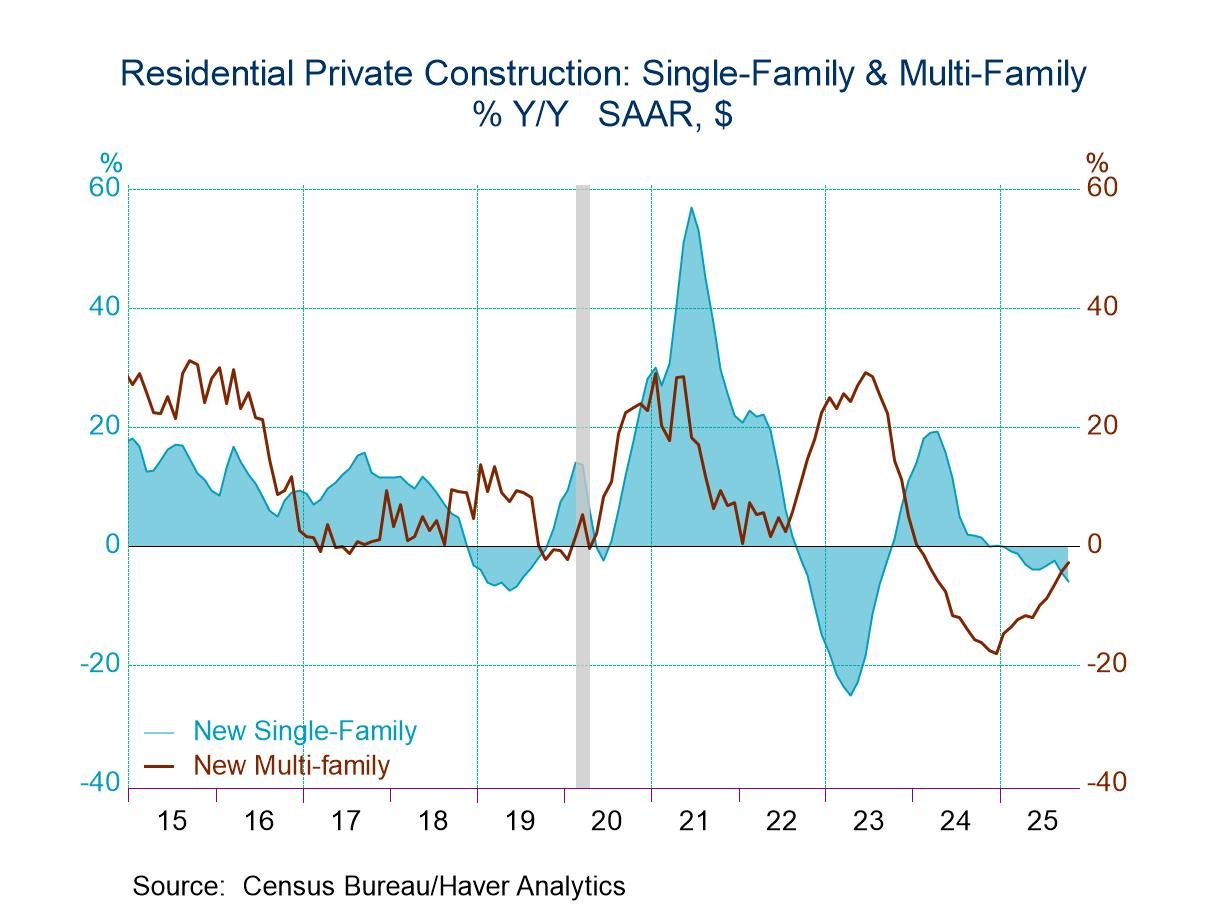
Total construction spending fell 0.6% m/m (-1.5% y/y) in September to $2,164.3 billion following a 0.4% monthly gain in August. However, it rebounded in October, rising 0.5% m/m (-1.0% y/y) to $2,175.2 billion (saar). This is the ninth consecutive month that construction spending has been lower than a year ago. A 0.1% m/m decline in September and an unchanged reading in October had been expected in the Action Economics Forecast Survey. Over the first ten months of this year, construction spending amounted to $1,825.3 billion, 1.4% below the $1,851.4 billion for the same period in 2024.
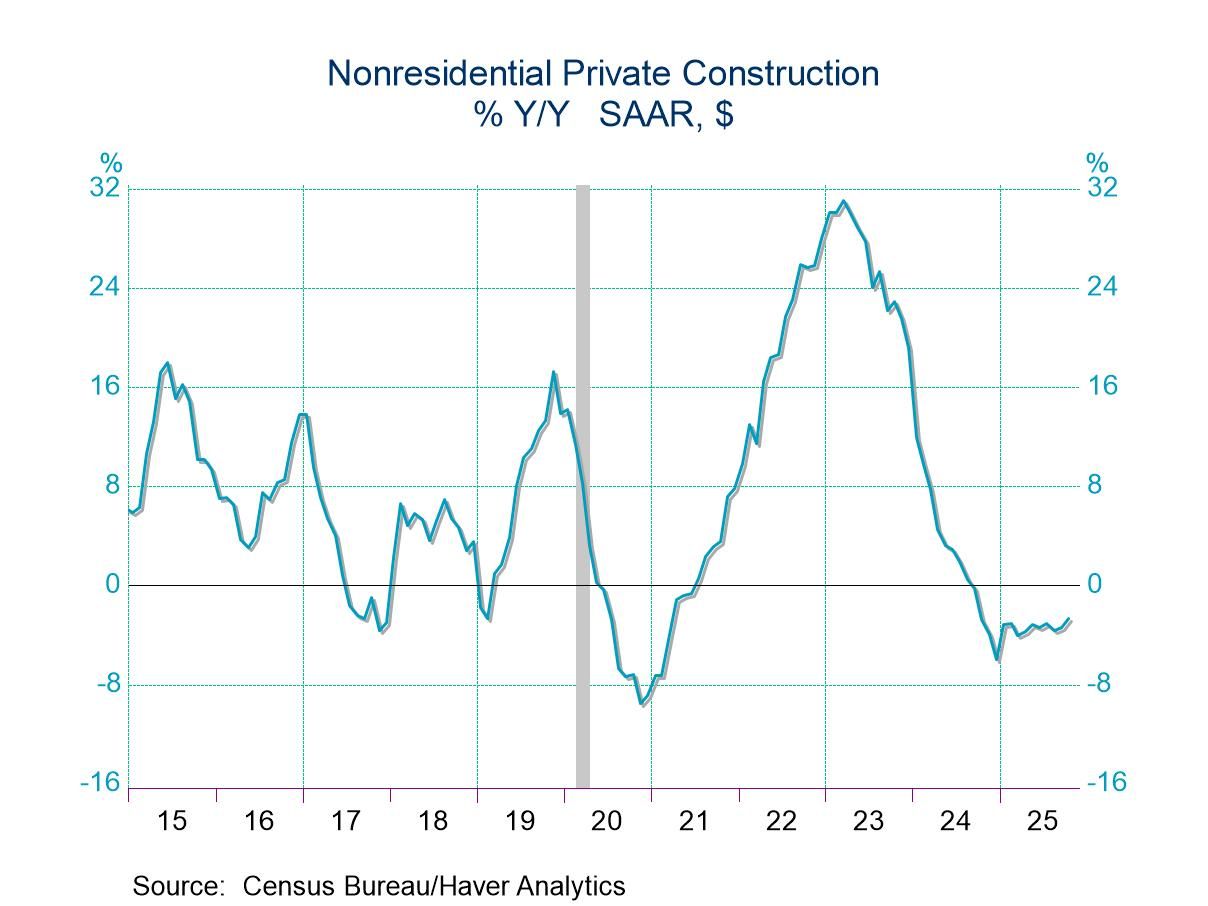
Spending on private construction was at a seasonally adjusted annual rate of $1,651.3 billion in October, 0.6% above the September estimate of $1,640.8 billion (-3.0% y/y), which fell 0.9% m/m from August. Private residential construction was at a seasonally adjusted annual rate of $913.9 billion in October, up 1.3% m/m from September, which declined 1.4% from August. Private nonresidential construction was at a seasonally adjusted annual rate of $737.4 billion in October, down 0.2% m/m from September, which also had declined 0.2% in September from August.
The October increase in private residential investment was due entirely to a 4.5% m/m increase in spending on improvements, its largest monthly gain since April 2024, following a 2.2% monthly decline in September. Single family construction fell 1.3% m/m in October, its eight consecutive monthly decline, while multi-family construction slipped 0.2% m/m, its first monthly decline in five months. The decline in private nonresidential construction was more than accounted for by a 0.9% m/m drop in manufacturing construction, its ninth consecutive monthly decline.
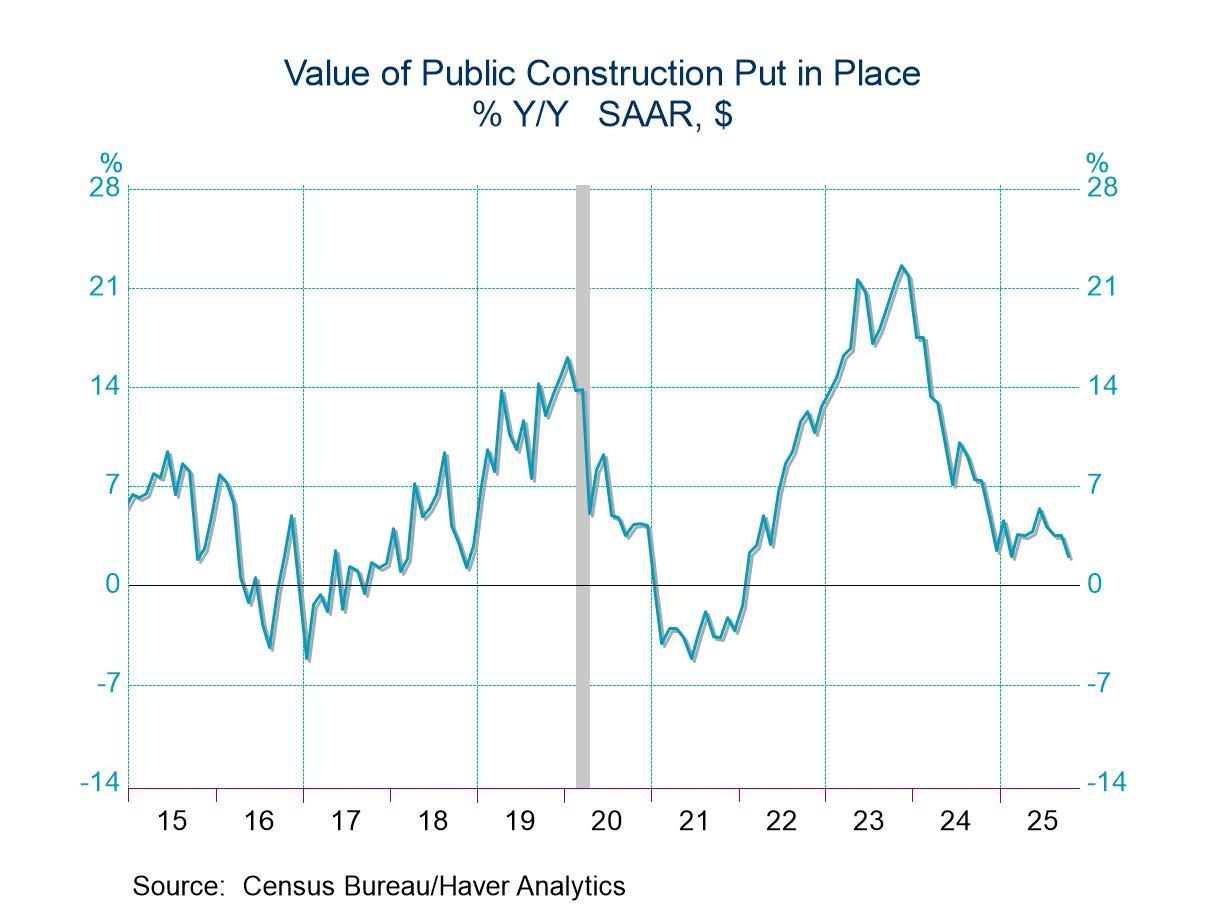
The value of public construction spending edged up 0.1% m/m in October to $524.0 billion after having risen 0.4% m/m in September. Of particular importance, educational construction was at a seasonally adjusted annual rate of $114.8 billion, up 0.7% m/m in October on top of a 1.1% m/m increase in September. Highway construction was at a seasonally adjusted annual rate of $141.6 billion, 0.1% m/m above the September estimate after a 0.4% monthly decline in September from August. Spending on highways and educational facilities are by far the two largest components of public construction spending. Spending on water supply construction at $35.2 billion was also important in October, up 1.2% m/m on top of a 1.5% monthly gain in September.
The construction figures can be found in Haver’s USECON database. The expectations figure is from the Action Economics Forecast Survey in AS1REPNA.

Sandy Batten
AuthorMore in Author Profile »Sandy Batten has more than 30 years of experience analyzing industrial economies and financial markets and a wide range of experience across the financial services sector, government, and academia. Before joining Haver Analytics, Sandy was a Vice President and Senior Economist at Citibank; Senior Credit Market Analyst at CDC Investment Management, Managing Director at Bear Stearns, and Executive Director at JPMorgan. In 2008, Sandy was named the most accurate US forecaster by the National Association for Business Economics. He is a member of the New York Forecasters Club, NABE, and the American Economic Association. Prior to his time in the financial services sector, Sandy was a Research Officer at the Federal Reserve Bank of St. Louis, Senior Staff Economist on the President’s Council of Economic Advisors, Deputy Assistant Secretary for Economic Policy at the US Treasury, and Economist at the International Monetary Fund. Sandy has taught economics at St. Louis University, Denison University, and Muskingun College. He has published numerous peer-reviewed articles in a wide range of academic publications. He has a B.A. in economics from the University of Richmond and a M.A. and Ph.D. in economics from The Ohio State University.
More Economy in Brief
 Global